
Understand how Kafka integrates with Apache Iceberg and experiment locally with Docker and Spark The streaming data landscape is evolving rapidly, and one of the most exciting developments is the integration between Apache Kafka and Apache Iceberg. While Kafka excels at real-time data streaming, organizations often struggle with the complexity of moving streaming data into analytical systems.
Here at Canonical we are excited to announce that we have shipped the first release of our solution for enterprise-ready data lakehouses, built on the combination of Apache Spark and Apache Kyuubi. Using our Charmed Apache Kyuubi in integration with Spark, you can deliver a robust, production-level, and open source data lakehouse. Our Apache Kyuubi charm integrates tightly as part of the Charmed Apache Spark bundle, providing a single and simpler-to-use SQL interface to big data analytics enthusiasts.
InfluxDB 3 Enterprise builds on Core with powerful features for production workloads, such as high availability, long-range query support, and advanced security. The good news? Upgrading is seamless, thanks to InfluxDB 3’s modern architecture and easy installation.
Machine learning is radically transforming how supply chains operate, pushing them towards unprecedented efficiency and responsiveness. This technology, powered by vast streams of data and sophisticated algorithms, is enabling businesses to anticipate needs, optimize operations, and adapt more swiftly to market changes. These advancements allow consumer packaged goods companies to enhance accuracy and efficiency, drive significant cost reductions, and better align themselves with consumer expectations.
Set aside the data masking features of PostgreSQL Anonymizer. This plugin can save the day during development by simplifying your workflow and generating schema-accurate, privacy-compliant test data. In a previous post, we discussed using static and dynamic masking to anonymize data. I spent the last two weeks trying to write followups for the anonymization posts. It's time to confess... I'm an over-engineerer.
In operations, we talk a lot about metrics. Teams rely on dashboards, charts, and alerts to spot issues before they spiral. But the truth is, many Ops dashboards are overloaded with noise and lack the clarity that decision-makers need. Business leaders in other domains, like enterprise resource planning (ERP), often take a more disciplined approach. Their dashboards are built to show exactly what matters for day-to-day and long-term performance.
Comma-separated value (CSV) files are one of the simplest formats for structured data and remain widely used across industries. From machine exports to business reports, CSVs are easy to create, edit, and share. They serve as a backbone for data management, ensuring teams can exchange information quickly and consistently. However, CSVs alone are static. When ingested into a time series database, they shift from flat files to part of a living data pipeline.
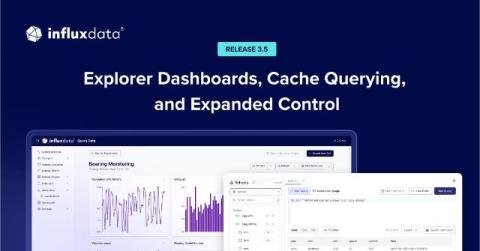
Today, we’re releasing InfluxDB 3.4 for Core and Enterprise, as well as our 1.2 update for the Explorer UI. This release focuses on developer efficiency, operational automation, and targeted security enhancements, giving teams faster setup, smoother workflows, and stronger guardrails for production use. InfluxDB 3 Core is free and open source, optimized for recent data, and licensed under MIT and Apache 2.