
Best Manufacturing Email List Providers in 2026

Image Source: depositphotos.com
The short answer: the right manufacturing list depends less on record count than on what you sell. A CNC machine supplier needs plant managers and operations directors. A staffing agency needs HR at facilities with hiring pressure. Same industry, different lists, and a provider who cannot filter to that level is selling you the same file either way.
Manufacturing looks like one market until you try to sell into it.
The sector runs to roughly $7.61 trillion in annualised shipments, and the buying committee changes entirely depending on what is being bought. A generic "manufacturing contacts" file underperforms because the provider question is really a segmentation question.
Key takeaways
- Your product determines your list. Equipment, software, staffing and materials each reach different roles.
- Company size distribution is extreme. 59% of US manufacturers have fewer than 10 employees, while firms over 500 employ 59% of the workforce.
- Timing is structural. Section 179 pulls equipment buying into December. July shutdowns suppress materials orders.
- Built-on-request beats instant download where plant leadership turns over and facilities close.
- Ask what the verification date is, not what the accuracy percentage claims.
- State concentration matters. Employment clusters heavily, and national lists dilute regional campaigns.
Why "manufacturing" is not a segment
Start here, because it decides everything downstream.
A CNC machine supplier needs plant managers and procurement leads at facilities running production lines.
An ERP or MES vendor needs IT directors and operations leadership at companies large enough to have both. Selling MES data analytics into a plant means reaching people who own production visibility, a committee that looks nothing like the one for shop-floor equipment.
A staffing agency needs HR contacts at facilities hiring machinists, welders and quality inspectors.
A raw materials supplier needs purchasing managers on recurring procurement cycles.
A consulting or engineering firm needs plant leadership with authority over process change.
A logistics provider needs supply chain and distribution managers.
Six products, six different contact profiles, one industry label. Six products, one industry label. A provider without segment-level filtering cannot distinguish between them.
1. Emarketnow
Best for: buyers who know which manufacturing segment they need and want the list built around it.
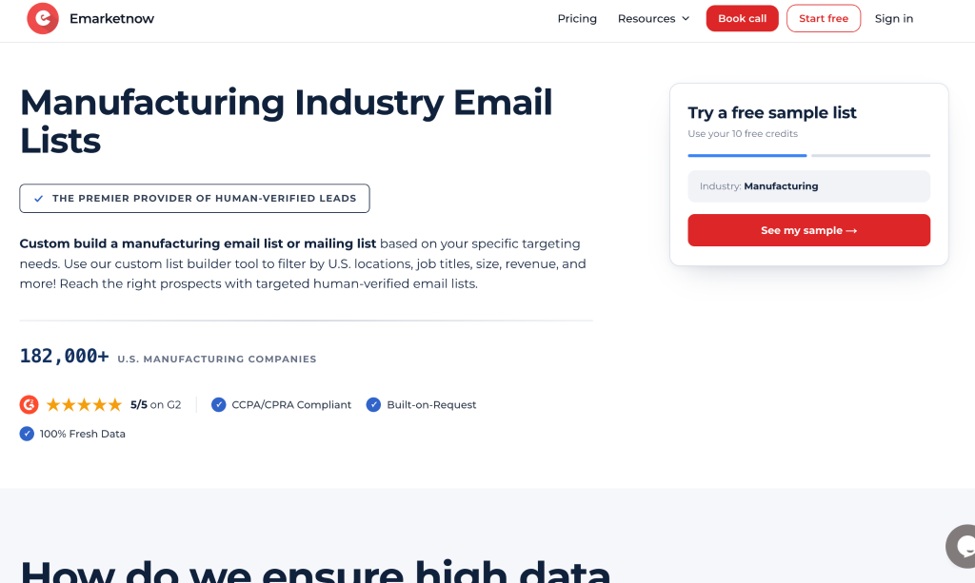
eMarketNow manufacturing email list page showing segment filtering options.
eMarketNow builds its manufacturing email list on request against your filters rather than pulling from a pre-existing file. That matters more in manufacturing than most verticals, because plant leadership turns over and facilities close.
Segment-specific targeting. Their page maps six buyer types: industrial equipment suppliers, manufacturing software companies, staffing agencies, raw material suppliers, consulting and engineering firms, and logistics providers. Each needs a different contact profile.
Role and niche filtering. Target plant managers, VPs of Operations or quality managers, and narrow by niche including machinery manufacturers, semiconductor and electronics, or metal and steel fabricators.
Those roles are not interchangeable. The person responsible for production operations evaluates equipment differently from the one responsible for quality, and a list that treats them as one audience reaches neither properly.
Human verification, not automated scoring. Records are checked by a person using multiple sources immediately before delivery, rather than scored against a stale file.
Data points on request include work email, mobile, office phone and LinkedIn, delivered as CSV or Excel that imports into any CRM or email platform, with Salesforce, HubSpot and Pipedrive named as examples.
Delivery. Paid orders arrive in three to five business days, with a 100% money-back guarantee on every plan.
Published pricing. Starting at $99 per month for 200 contacts, Pro at $299 for 1,000 with unlimited CRM export, and an Enterprise plan adding account-based marketing. No minimum commitment on any plan, and annual billing includes two months free.
Compliance: CCPA and CPRA.
Consider: US coverage only, and built-on-request means a delivery window rather than instant access.
2. ZoomInfo
Best for: enterprise teams wanting intent data alongside contacts.
ZoomInfo homepage showing B2B intelligence platform
Broad coverage with buying-signal layers, integrated into most major CRMs.
Verification: automated, with machine-learning validation and community contribution rather than manual review.
Pricing: annual platform subscription, quoted per seat and per credit allowance. Not published.
Consider: priced for enterprise with annual commitments. Manufacturing depth varies by segment, and job-shop coverage is thinner than the platform's overall scale suggests.
3. Data Axle USA
Best for: buyers who want SIC and NAICS filtering with long-established data.
Deep industry classification and long history in compiled business data, suiting manufacturing's reliance on standardised codes.
Verification: periodic refresh of a compiled database rather than validation at point of order.
Pricing: per-record or subscription depending on volume, quoted rather than published.
Consider: compiled rather than built on request, so recency depends on their refresh cycle.
4. UpLead
Best for: self-serve buyers wanting to build and verify lists themselves.
Real-time verification at export, transparent per-credit pricing, a usable interface.
Verification: real-time email validation performed at the moment you export, so you only spend credits on records that pass.
Pricing: monthly plans with a credit allowance, published on their site. Credits are consumed per record revealed.
Consider: manufacturing filtering is generic rather than segment-aware, and you build the list yourself.
5. Thomas (Thomasnet)
Best for: industrial sourcing rather than outbound prospecting.
Purpose-built for manufacturing and industrial, with supplier data no general provider matches.
Verification: supplier-maintained profiles, so accuracy depends on the supplier keeping their own listing current.
Pricing: free platform access for buyers. Supplier-side advertising and marketing services are quoted separately.
Consider: the model is buyer-side sourcing rather than seller-side prospecting, so fit depends which direction you are selling.
Comparison at a glance
|
Provider |
Model |
Manufacturing segmentation |
Verification |
Sample before purchase |
|
eMarketNow |
free tier plus paid plans from $99/mo |
Six buyer segments, role and niche filters |
Human, multi-source |
10 free contacts |
|
ZoomInfo |
Platform subscription |
General plus intent |
Automated |
Demo |
|
Data Axle USA |
Compiled database |
SIC and NAICS codes |
Periodic refresh |
Varies |
|
UpLead |
Self-serve credits |
General filters |
Real-time at export |
Free credits |
|
Thomas |
Sourcing network |
Industrial-native |
Supplier-verified |
Free access |
Details other than eMarketNow reflect published positioning as of September 2026. Confirm before purchase.
The company size problem
This is the structural fact behind a lot of underperforming manufacturing campaigns, and it is rarely planned around.
Census SUSB data shows 59% of US manufacturing firms have fewer than 10 employees. At the other end, firms with more than 500 employees account for 59% of manufacturing employment.
What that means for your list. A file weighted toward company count is dominated by small job shops. One weighted toward employee count reaches a handful of large operations. Different campaigns, and worth knowing which you are buying.
Decide before you buy. If your product needs a $200,000 budget, filtering by employee count is not optional.
The same logic governs manufacturing software selection. Category-level information is useless without knowing which segment applies to you, and contact data behaves identically.
Timing is more predictable than you think
Manufacturing buying cycles have structural rhythms that most outbound programmes ignore.
Section 179 pulls equipment purchases into December, as buyers accelerate capital spending to capture the deduction within the tax year. Equipment outreach landing in November is timed against a decision already forming.
July shutdowns suppress materials ordering, with many plants closing for maintenance and retooling. Materials campaigns in that window reach people who are not buying.
Neither is a guess. Both are calendar-driven and repeat annually, which makes them straightforward to plan around.
Geography is not evenly distributed
BLS data shows manufacturing employment concentrating heavily in specific states rather than spreading nationally.
A national list dilutes a regional campaign. If your team covers three states, national coverage means paying for records you will never call and diluting your metrics with contacts outside your service area.
Ask for state-level filtering and check it is applied before delivery.
What to ask any provider
Can you filter by my buyer segment? Not "manufacturing," but plant managers at facilities of a given size in a given region.
When was each record verified, and how? A date beats a percentage.
Can I see a sample before paying? A provider confident in their data will show you some.
What is the bounce replacement policy? Get the threshold in writing.
Is this built for me or pulled from a file? Both work. Knowing which determines what to expect on recency.
Before you buy
Define the segment before you shop. Buying for "manufacturing" when the requirement was operations directors at metal fabricators over 100 employees in three states is where most disappointment starts.
Providers can filter to that level. The specification is the part that gets skipped.