
The Hidden Operations Layer: Why SaaS Sprawl Is Becoming an Operations Problem

Modern operations teams have become exceptionally good at managing complexity. They monitor infrastructure, automate repetitive processes, maintain service reliability, document workflows, manage incidents, analyse performance and build systems that allow organisations to grow without adding an equivalent amount of operational overhead. Yet there is another layer of complexity developing quietly beneath many of these carefully managed environments: the software itself.
A typical organisation may now rely on applications for communication, project management, customer relationship management, accounting, HR, marketing, analytics, security, development, collaboration, document management, recruitment and customer support. Most of these applications are individually useful, and many have become essential to the way people work. The difficulty is not necessarily that organisations have too much software - it is that relatively few have a complete operational view of the software that they actually depend upon.
An application might be purchased by one department, paid for by another, accessed by dozens of employees, connected to several other systems and renewed automatically, without any single team having complete visibility of the relationship. It can become an important part of a business process while remaining almost invisible from an operational perspective.
As SaaS becomes increasingly embedded in everyday business activity, that blind spot is becoming harder to ignore.
SaaS Sprawl Isn't Just an IT Problem
SaaS sprawl is often treated as an IT issue, and there is an obvious reason for that. IT teams are generally responsible for security, integrations, access management and technology standards, so it is natural to assume they should also be responsible for controlling the organisation's software estate. Modern SaaS adoption, however, doesn't always work that way.
Employees can discover and adopt new applications without waiting for a traditional IT deployment. A marketing team may purchase a specialist campaign platform, a sales team may introduce a prospecting tool, HR may adopt recruitment or employee engagement software, Finance may subscribe to a reporting service, and an Operations team may introduce a workflow automation platform. None of these decisions necessarily originate with IT.
The technology is no longer necessarily deployed by IT. It is adopted by the business.
That changes the question organisations need to ask. Rather than asking, "What software does IT manage?", it becomes more useful to ask, "What software does the organisation depend on?" The second question is considerably broader because it includes applications that may have been adopted independently by departments but have subsequently become important to the way the organisation functions.
This is where SaaS management begins to overlap with operations. The objective isn't necessarily to prevent departments from adopting useful tools, nor is it to force every software decision through a central IT approval process. It is to create enough visibility that the organisation understands what is being used, why it is being used, who is responsible for it and what dependencies it creates.
This broader responsibility is also changing the role of operations teams, particularly as SaaS becomes embedded in more everyday business processes. For organisations looking to explore this relationship in more detail, the guide to SaaS management for operations teams looks at how operational teams can approach software visibility, ownership, costs and ongoing management as part of their wider responsibilities.
The Operational Cost of Invisible Software
The most obvious consequence of SaaS sprawl is financial. If an organisation has hundreds of applications and even a relatively small proportion are underused, duplicated or no longer required, the resulting subscription waste can become significant over time.
The financial cost, however, is only one part of the equation.
Every additional application creates some degree of operational dependency. There are users who need access, licences that need to be managed, contracts that need to be renewed, data that needs to be protected, integrations that may need maintaining and employees who may need training or support. There may also be processes that depend on the application and data that needs to be considered if the service is eventually retired.
Depending on the application and how deeply it is embedded in the business, those dependencies can include:
- User access and licence management
- Contract and renewal management
- Data protection and security requirements
- Integrations with other business systems
- Employee training and support
- Internal processes that rely on the application
- Vendor relationships and accountability
An inexpensive application can therefore create a surprisingly large operational footprint.
Consider a marketing team that adopts a new automation platform because it solves a particular problem. The platform connects to the CRM, email system, analytics tools and lead database, and over time it becomes part of the team's normal workflow. Six months later, the employee who originally introduced it leaves the organisation. The subscription continues, the integrations continue running and the data continues flowing, but nobody is entirely sure who owns the vendor relationship or whether the application is still required.
Nothing has necessarily broken. There may not even be an obvious security incident or operational failure. Yet the organisation has accumulated a business dependency without establishing clear ownership around it.
That is a very different kind of operational problem from a server going offline, but it can be just as important to understand.
The Difference Between Technical Visibility and Business Visibility
Operations teams have spent years developing sophisticated ways to understand technical environments. Infrastructure can be monitored, applications can be observed, networks can be mapped and incidents can be tracked. These capabilities provide enormous value because they allow teams to understand what is happening inside increasingly complex technical environments.
Business software requires a slightly different perspective.
Knowing that an application is available does not necessarily tell an organisation whether it should still have the application. Technical monitoring might establish that a service is running normally, while operational management needs to answer questions about who owns the service, who relies upon it, what it costs and whether it continues to support a genuine business requirement.
The distinction is important because SaaS applications increasingly sit directly inside business processes. A CRM isn't simply another piece of software. It may contain the organisation's customer information and underpin the sales process. A payroll system isn't simply a subscription. It may be essential to paying employees. A project management platform may contain the workflows and information required to deliver customer work.
The more deeply an application becomes embedded in a process, the more important it becomes to understand its operational context.
This is where the concept of business observability becomes interesting. Traditional observability tends to ask whether systems are healthy and where problems are occurring. A broader operational view also needs to understand what systems the business depends upon, who is responsible for them, what they cost and what would happen if they were no longer available.
Every Application Has a Lifecycle
One useful way to think about SaaS is to stop treating applications as static assets. Every application has a lifecycle, beginning with a business need and continuing through evaluation, purchase, adoption, usage, renewal and eventually retirement.
Someone identifies a problem, a solution is found, a subscription is purchased and employees begin using it. Over time, the organisation changes. People join and leave, departments grow or shrink, requirements evolve and alternative applications appear. Eventually the subscription reaches its renewal date and the organisation has to decide whether it still makes sense to continue.
Without visibility throughout that lifecycle, the easiest option is often to do nothing. But guess what happens then? …doing nothing frequently means renewals for unused SaaS come through frequently.
This is one reason SaaS costs can increase gradually without anyone making a conscious decision to expand the software budget. The organisation may not be purchasing large quantities of new software every month. Instead, it is simply failing to remove applications that are no longer necessary.
That is why a renewal should not be viewed as an isolated financial event. It is a checkpoint in the lifecycle of an application and an opportunity to ask whether the software still serves the organisation in the way it originally did.
The Employee Lifecycle Creates Another Layer of Complexity
The relationship between employees and SaaS is particularly important because access to software changes as people move through an organisation.
When someone joins a business, they may require access to ten, twenty or more applications depending on their role. When they move to another department, their requirements can change considerably. When they leave, the organisation needs to review their access and determine what should happen to the accounts and licences associated with them.
This creates an important connection between HR, IT and SaaS management.
An employee leaving the organisation is not simply an HR event. It can also be an opportunity to recover licences, remove unnecessary access and reassess whether the associated subscription is still required. Likewise, a new employee can represent additional software costs that need to be understood as part of the wider onboarding process.
This is one reason SaaS management is increasingly relevant to teams outside IT. HR may know that an employee has left, while IT may have the technical information about their accounts, and Finance may ultimately be paying for the subscription. Without some way of connecting those pieces of information, a relatively simple employee lifecycle event can create unnecessary work across several departments.
The same principle applies to internal moves. An employee changing roles may no longer require access to applications associated with their previous position, while their new role may require entirely different tools. Regularly reviewing access alongside changes in the workforce can therefore help organisations maintain both appropriate access and better licence utilisation.
The Same Problem Exists in Finance
Finance teams encounter SaaS from a different direction. They see recurring payments, annual contracts and renewal invoices, but an invoice rarely provides enough context to determine whether a subscription remains worthwhile.
A £5,000 annual subscription may look entirely reasonable as an isolated expense. What the invoice does not necessarily reveal is whether fifty people actively depend on the application, whether only five people use it, whether another department already pays for a similar tool, whether the original application owner has left or whether the contract is about to renew automatically.
Financial visibility becomes considerably more useful when it is connected to operational information.
This is why SaaS management should not simply be framed as a cost-cutting exercise. The objective is to connect cost with usage, ownership and business need, allowing Finance and other stakeholders to understand not just what the organisation is paying for, but why.
That distinction can change the nature of a renewal conversation. Instead of Finance simply approving an invoice, the organisation can ask whether the number of licences still reflects actual requirements, whether the software remains strategically important and whether there is an opportunity to negotiate different terms.
Shadow IT Is an Operations Problem Too
The phrase Shadow IT can sometimes suggest that employees are deliberately bypassing organisational policies. In reality, much of it is considerably less dramatic.
An employee needs to solve a problem, discovers a tool that appears to do exactly what they need and signs up for it. The tool works, colleagues begin using it and eventually it becomes part of a normal business process. There may have been no intention to circumvent IT or create risk.
The difficulty is that the organisation has acquired a new dependency without necessarily establishing the normal processes around it.
That can create questions about security, compliance, cost, data ownership, continuity and accountability. The answer, however, isn't necessarily to prevent employees from finding useful tools. Excessive bureaucracy can simply encourage people to find ways around the process.
A better approach is to make the approved path straightforward while maintaining visibility over what is actually being adopted.
For operations teams, this distinction matters. Innovation and control do not have to be opposing forces. An organisation can allow employees to experiment with technology while still developing mechanisms for identifying new applications, understanding their purpose and deciding whether they should become part of the managed software environment.
The objective is not to eliminate experimentation. It is to make experimentation visible.
From Monitoring Infrastructure to Understanding Business Systems
This shift represents a broader change in the role of operations.
As organisations have moved towards cloud infrastructure, distributed systems and automated workflows, operations teams have developed increasingly sophisticated methods for understanding technical dependencies. Yet the business application layer can remain fragmented between departments, budgets and individual employees.
A business might therefore have excellent infrastructure observability while still having poor visibility into its SaaS estate. There is no contradiction in that. They simply represent different layers of the organisation.
As more business processes move into SaaS applications, understanding those dependencies becomes part of operational resilience. If an application is essential to a process, the organisation should know that. If nobody uses it anymore, the organisation should know that too. If its contract renews in three weeks, someone should know that before the renewal happens.
Good SaaS operations bring these questions into the same conversation.
What Good SaaS Operations Looks Like
A mature SaaS environment does not necessarily mean having fewer applications. It means having a clear understanding of why those applications exist and how they contribute to the business.
For each significant application, an organisation should be able to establish its purpose, owner, users, cost, renewal position and level of utilisation. It should also understand whether the application overlaps with other tools and what operational consequences might arise if it were removed.
None of these questions are particularly complicated individually. The challenge is that the answers often exist in different places.
Application information might sit with IT, invoices with Finance, employee information with HR and operational requirements with individual department managers. Bringing those perspectives together is therefore less about collecting more data and more about making existing information useful.
This is also why ownership matters so much. An application without a clear owner can easily become an application that nobody feels responsible for reviewing. Assigning accountability creates a natural point at which questions about usage, cost, access and renewal can be considered.
The Importance of a Single Source of Truth
Many organisations initially attempt to manage their SaaS environment through spreadsheets, and spreadsheets can be perfectly adequate when a business has a relatively small number of applications. As the software estate grows, however, maintaining accurate information across multiple documents becomes increasingly difficult.
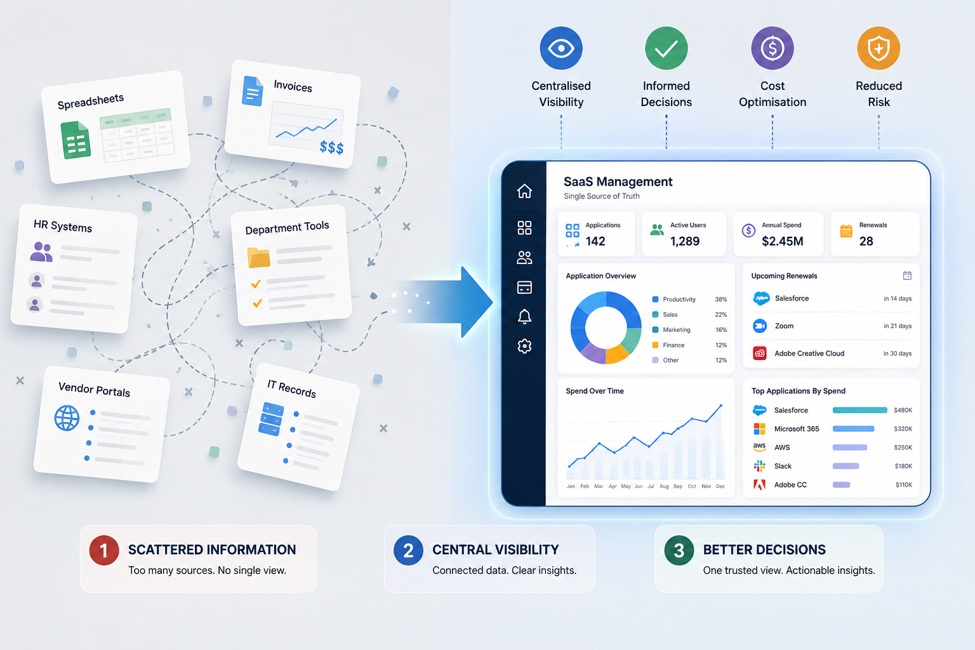
This infographic shows how moving from scattered SaaS information to a centralised view can improve visibility, support better decisions, optimise costs, and reduce operational risk.
One spreadsheet might contain renewal dates, another might contain software costs and IT might maintain a separate application inventory. HR may have employee information while Finance has the invoices, and individual departments may maintain their own records of the tools they use.
The issue isn't necessarily that any one source contains incorrect information. It is that somebody has to reconcile them.
That reconciliation becomes another operational process, and like any manual process, it can become outdated.
A single source of truth does not necessarily mean that every piece of information must originate in the same system. It means there needs to be a reliable place from which the organisation can understand the overall software environment and connect the different pieces of information that influence a decision.
For operations teams, that can be particularly valuable because it turns isolated data points into something that can support an actual process.
Automation Helps, But Visibility Comes First
Automation is understandably attractive to operations teams. Whenever a process happens repeatedly, there is usually an opportunity to remove some manual effort.
However, automation without visibility can simply make an inefficient process happen faster.
For SaaS management, the first step is understanding the environment. Once an organisation knows what applications exist, who uses them, how they are connected and when they require attention, automation becomes considerably more useful.
Employee information can be synchronised automatically, renewal reminders can be generated in advance, inactive accounts can be flagged and regular reports can be produced without someone manually assembling the information each month.
The principle is straightforward: understand the system first, then automate it.
This is a familiar idea in operations. Automation works best when the underlying process is understood well enough to determine what should happen, when it should happen and who needs to be involved.
Where SaaS Management Platforms Fit
The growing complexity of SaaS environments has created a need for tools specifically designed to provide visibility across the software estate.
Platforms such as SaaSi Hub: a SaaS management platform approach this problem by bringing information about applications, employees, licences, departments, owners, costs and renewals into a central operational view. The significance of this type of platform is less about any individual feature and more about the shift in thinking behind it.
SaaS is no longer simply a collection of subscriptions appearing on a company's credit card. It has become part of the operational infrastructure of the organisation.
Managing that infrastructure effectively requires many of the same principles that operations teams already apply elsewhere: visibility, ownership, measurement, automation and continuous improvement.
That makes SaaS management less about policing software purchases and more about understanding how technology supports the organisation.
The Future of Operations Is Cross-Functional
The traditional boundaries between departments are becoming increasingly difficult to maintain when it comes to SaaS.
IT may own infrastructure and security, Finance may own budgets and payments, HR may manage employee records, Operations may oversee processes and Procurement may manage vendor relationships. Yet a single SaaS application can touch every one of those areas simultaneously.
A CRM can be an IT dependency, a Finance expense, a sales workflow, a security consideration and a procurement relationship at the same time. Trying to assign the entire responsibility to one department therefore creates unnecessary friction.
The same application can therefore create different responsibilities across the organisation:
- IT may be responsible for access, integrations and security
- Finance may oversee the cost, budget and payment relationship
- HR may need to consider employee access throughout the workforce lifecycle
- Operations may depend on the application as part of a wider business process
- Procurement may manage the vendor relationship and contractual terms
- Department leaders may be responsible for determining whether the application continues to meet their team's needs
Trying to assign the entire responsibility to one department therefore creates unnecessary friction.
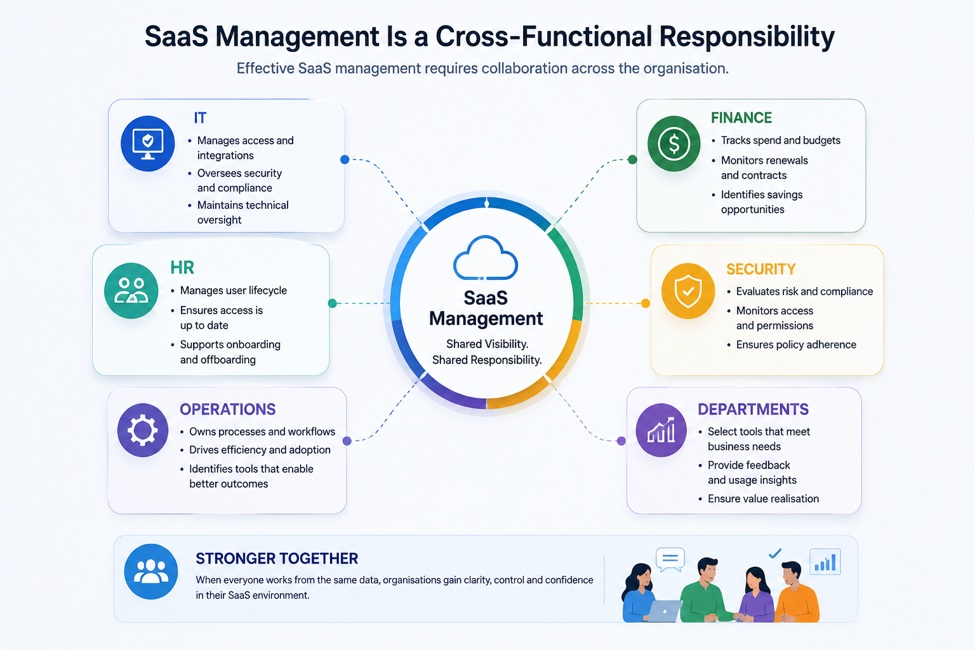
This infographic shows how IT, HR, Finance, Operations, Security, and individual departments each contribute to effective SaaS management through shared visibility, clear ownership, and collaboration.
IT does not need to approve every software decision. Finance does not need to understand every technical dependency. HR does not need to manage every licence, and Operations does not need to chase every invoice. Instead, each team needs access to the information relevant to its role while contributing to a shared understanding of the technology environment.
This is perhaps the most important reason SaaS management is becoming an operations concern. Software has stopped being something that exists purely within the technology department. It now forms part of almost every business process.
The Real Goal Isn't Fewer Tools
There is a natural temptation to approach SaaS sprawl with a simple objective: reduce the number of applications. But that isn't necessarily the right goal.
An organisation with one hundred well-managed applications may operate far more efficiently than an organisation with fifty poorly managed ones. The objective should not be to minimise the software estate at any cost, but to maximise the value that the software estate provides.
Sometimes that means cancelling an application. Sometimes it means buying more licences because demand has increased. Sometimes it means consolidating several tools, while in other cases the right decision may be to leave an application exactly as it is.
The important difference is that the decision should be intentional. An organisation should understand why an application exists, what value it provides, who depends upon it and what would happen if it were removed. Once those questions can be answered, the size of the software estate becomes considerably less important than its quality and relevance.
That is the difference between software accumulation and software management.
Turning SaaS From a Blind Spot Into an Operational Asset
SaaS has transformed the way organisations work. Teams can adopt sophisticated capabilities within minutes, employees can collaborate across locations, small companies can access technology that was once available only to large enterprises, and new services can be tested without significant infrastructure investment.
Those advantages are unlikely to disappear. If anything, the number of applications available to businesses will continue to increase.
The challenge for operations teams is therefore not to resist that growth, but to make it visible.
Once an organisation understands its software environment, it can begin asking better questions about which applications are essential, which overlap, which licences are unused, who owns each application, what is renewing next and where spending is increasing. It can also begin identifying software that has been adopted outside established processes and understanding whether those applications represent useful innovation, unnecessary duplication or an operational risk.
Those questions turn SaaS from an invisible collection of subscriptions into something that can actually be managed.
Perhaps that is the next stage of operational maturity: not simply monitoring whether the technology is running, but understanding why the organisation has it, who depends upon it, what it costs and whether it is still delivering value.
A More Complete View of Operational Resilience
Operational resilience is often discussed in terms of infrastructure, cybersecurity, disaster recovery and business continuity. Those areas remain fundamental, but the growing dependence on SaaS means organisations may need to consider another question: how resilient are the business processes that depend on third-party applications?
If a critical application becomes unavailable, changes its pricing model, loses an integration or is acquired by another company, the consequences can extend well beyond IT.
The organisation may suddenly find that a sales process cannot operate normally, employees cannot access important information, customers cannot be supported or a financial process has been interrupted.
This doesn't mean organisations should attempt to eliminate every dependency. That would be unrealistic. It means they should understand the dependencies they have created.
Knowing which applications support which processes, who owns those relationships and how important each service is provides a much stronger starting point for contingency planning.
SaaS visibility can therefore contribute to operational resilience in a way that is easy to overlook. It gives organisations another layer of understanding about how the business actually functions.
Final Thoughts
Operations has always been about bringing order to complexity. As organisations have moved from physical infrastructure towards cloud platforms, distributed systems and automated workflows, the nature of that complexity has changed. One of the least visible layers may now be the software employees use every day.
SaaS sprawl isn't inherently a bad thing. In many cases, it is evidence that teams are finding new ways to work, experimenting with technology and solving problems quickly. The challenge arises when adoption moves faster than visibility.
Organisations that can clearly see their software environment are better positioned to manage cost, access, renewals, risk and operational dependencies. They can support innovation without allowing every new application to become another unmanaged piece of infrastructure.
The future of SaaS operations is therefore unlikely to be about simply having fewer tools. It will be about knowing what the organisation has, understanding why those applications exist, and making deliberate decisions about what happens next.
That is ultimately what operational control looks like in a SaaS-first business: not controlling every decision, but having enough visibility to make the important ones with confidence.