
3 Best Executive Search Firms and Top Recruiters for 2026 Leadership Hires

Finding the right executive search partner is mission-critical. The leaders you hire over the next year will shape AI strategy, protect data, and guide growth through unpredictable markets. One mis-hire can drain momentum and erode investor confidence, while a well-matched leader can deliver years of outperformance.
We did the homework for you, analyzing independent rankings, performance benchmarks, and candid client feedback to spotlight firms that deliver consistent C-suite results. In the pages ahead you'll learn who tops the list, why they belong there, and when each firm is the smartest call.
How to use this guide:
- Read straight through for the full story and trade-offs.
- Jump to the comparison matrix for a quick side-by-side.
- Visit "How to choose" when you're vetting firms and gathering stakeholder questions.
Our goal: give you practical insight so your next leadership hire lands quickly and lasts.
Why we built this list and how we scored the winners
We wanted more than another popularity poll, so we ran a due-diligence sprint.
First, we pulled the latest independent rankings of U.S. executive search firms, starting with Forbes and Statista's 2025 survey of thousands of hiring leaders. Korn Ferry landed at number one, with Spencer Stuart and others close behind, giving us a current, third-party snapshot of market reputation.
Next, we added hard performance data. CJPI's Executive Search Market Update pegs the average C-suite search at 14 weeks, yet that number fell to nine weeks in early 2026 for firms using AI-assisted sourcing. Harvard Business Review also reports that forty percent of newly hired executives exit within 18 months. These benchmarks set our bar for speed and staying power.
Finally, we listened to real buyers. We reviewed Reddit threads, Quora posts, and recent client case studies to surface hidden strengths and recurring pain points. When themes repeated—lightning-fast delivery, partner overload, off-limits conflicts—we logged them.
We then scored every contender across five weighted factors:
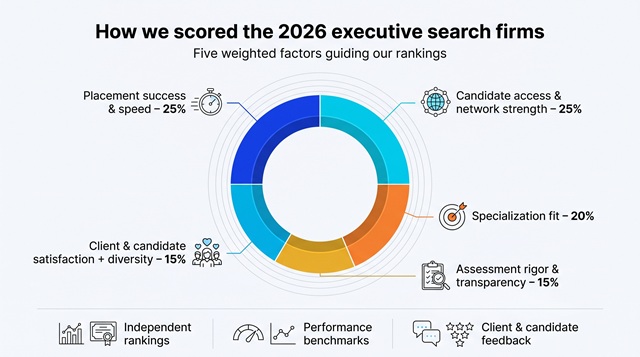
- Placement success and speed (25 percent)
- Candidate access and network strength (25 percent)
- Specialization fit for today's tech-focused mandates (20 percent)
- Assessment rigor and transparency (15 percent)
- Client and candidate satisfaction plus diversity record (15 percent)
Only firms with verifiable wins on at least three criteria, current U.S. activity, and a retained-search focus made the list. These guardrails kept the guide tight and practical.
The outcome is a ranked set of five firms, three global giants and two standout boutiques, that offer evidence-backed options for 2026 leadership hires. Next, we examine each firm and show where it shines for your specific search.
1. SPMB: Silicon Valley's tech boutique powerhouse
If your next hire needs to speak fluent product, charm engineers, and impress a board of investors, we start here. SPMB has spent four decades inside the tech ecosystem, connecting breakout companies with operators who can scale from Series B to IPO.
Walk the halls of any Bay Area unicorn and you will meet leaders SPMB placed. The firm stays small on purpose, running searches from just four U.S. offices (San Francisco, New York, Denver, and Los Angeles) so every mandate stays on a partner's desk, not buried under layers of associates. That focus shows in the numbers: clients tell us they see a tight slate in four to six weeks and wrap many VP and C-level searches in roughly three months, beating the industry's 14-week average.
Speed alone would feel risky if the hires did not stick. SPMB's calling card is fit. Partners tap relationships that span years, vet culture as hard as capability, and refuse to pitch off-spec stars. They work almost exclusively in software, cloud, fintech, and frontier tech, domains where they already know who built what, who scaled which team, and who is ready for the jump.
The process is refreshingly transparent. Clients receive weekly pipeline snapshots and candid runway checks rather than rosy status decks. You also gain a near-real-time pulse on candidate sentiment, a perk when sought-after CTOs juggle multiple offers. SPMB's executive search process prioritizes momentum, so your preferred finalist rarely slips away to a competing bid.
Ideal moment to call them? When you need a product, engineering, or go-to-market leader who has worn the hyper-growth T-shirt before and can start making decisions on day one. If your search lives in the tech stack, SPMB belongs at the top of your shortlist.
2. Korn Ferry: global scale, data-rich precision
When a search spans continents, boards often default to Korn Ferry. The firm invented modern executive recruiting and still tops independent rankings for one reason: reach.
Korn Ferry's network stretches across more than fifty offices, touching every major talent hub. That footprint matters when you are chasing a multilingual CFO in Singapore today and a chief product officer in Austin tomorrow. The internal database holds millions of candidates, and dedicated research teams refresh those profiles every week. You see the breadth the moment the first longlist lands, often twenty highly vetted names from four regions instead of the usual five from one coast.
Breadth would be hollow without process discipline. Korn Ferry applies proprietary leadership assessments and compensation benchmarks to every finalist, so hiring committees debate hard data, not gut feel. Expect a clear competency map, psychometric results, and market-priced pay guidance bundled into each candidate dossier. Decisions move faster because the evidence is already on the table.
Large scale can dilute attention, yet clients tell us Korn Ferry's pod model keeps accountability tight. A senior partner quarterbacks strategy while specialized consultants handle sourcing, assessment, and onboarding support. Weekly calls stay crisp, and the digital portal shows real-time pipeline stats, sparing you the surprise of a stalled search.
Engage Korn Ferry when failure is not an option and the spotlight is intense: Fortune 100 CEO succession, multinational carve-outs, or any mandate where investors expect a blue-chip partner. You pay premium fees, but you also gain global access, forensic assessment, and a brand that signals rigor to shareholders and regulators alike.
3. Spencer Stuart: the boardroom's trusted confidant
Spencer Stuart is where directors turn when a leadership change could swing market cap overnight. The firm has advised on thousands of successions worldwide, and that track record shapes every engagement.
Conversations start slower and feel consultative. Partners spend weeks clarifying strategy, culture, and succession risk before entering the market. That deep dive pays off later: shortlists feature fewer names, yet each candidate aligns tightly with the board's strategic and cultural brief.
Discretion is essential. Spencer Stuart's partners handle outreach personally, often through private channels that never touch LinkedIn. Leaks are rare, which is why activist-sensitive companies and family-owned giants keep the firm on speed dial.
Assessment rigor matches the secrecy. Expect exhaustive 360-degree referencing, proprietary culture-fit profiling, and scenario interviews that test how candidates perform under pressure. Boards appreciate that level of proof; it reduces second-guessing when votes are cast.
Choose Spencer Stuart when you need a high-impact CEO, board director, or C-suite successor and the margin for error is zero. You will review fewer résumés, but every name will already command market respect and suit your culture.
4. Heidrick & Struggles: global reach with startup-level speed
Heidrick & Struggles looks like a classic big-five search firm on the surface, yet operates with the agility of a startup. The company pairs a worldwide footprint with on-demand talent models and AI-driven insights, giving clients speed without sacrificing depth.
Engagements start with data. Consultants tap proprietary leadership analytics to map competencies, culture, and risk, then layer recent market intelligence on top. That upfront clarity helps teams zero in on high-probability candidates instead of boiling the ocean.
Delivery runs on two tracks. One team drives the retained search, while a parallel bench of interim executives can step in tomorrow morning. Boards value that safety net; CFO exits, cyber breaches, and carve-outs rarely wait for perfect timing.
Culture shaping is the quiet differentiator. Through its consulting arm, Heidrick briefs both the incoming executive and the existing team on behavioral blind spots and integration risks. The result is fewer post-hire surprises and stronger retention, welcome news when change fatigue is real across many companies.
Call Heidrick & Struggles when you need fresh thinking at pace: digital transformation roles, first-time chief AI officers, or private-equity turnarounds where value creation must start on day one. You will get global reach, a flexible playbook, and a partner comfortable pivoting if the market shifts under your feet.
5. True Search: the data-first disruptor
True launched a decade ago and already sits in the top tier by doing one thing better than anyone else: turning data into faster, more diverse searches.
Every engagement starts in True's proprietary platform, which tracks executive moves across high-growth tech, consumer, and life-sciences companies. Algorithms reveal patterns such as who scales revenue from ten to one hundred million, who thrives post acquisition, and who stalls. Consultants use those insights to skip dead-end outreach and zero in quickly on leaders who fit both stage and culture. That efficiency often produces an interview-ready slate in under four weeks, about half the industry average.
True also tackled the diversity bottleneck head-on. In 2020 it cofounded AboveBoard, an open marketplace that lets underrepresented executives raise a hand for C-suite roles that were once hidden behind closed networks. Clients get broader slates without pleading for them, and candidates gain visibility without back-channel favors.
The vibe is refreshingly informal. Fee structures flex, dashboards stream live candidate feedback, and partners answer texts at midnight when your preferred CTO receives a counteroffer. That urgency resonates with venture and private-equity backers racing toward exit clocks.
Call True when you need to fill a role yesterday, insist on a diverse slate, and value data-backed conviction over tradition. You will trade marble lobbies for momentum, and in today's market that trade often pays off.
How the five firms stack up at a glance
Big claims feel safer once you can see the numbers side by side. The matrix below distills the traits hiring committees ask about most: reach, specialty, typical speed, and where each firm adds distinct value.
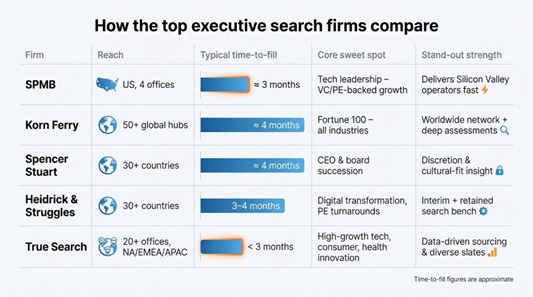
|
Firm |
Geographic reach |
Core sweet spot |
Typical time-to-fill* |
Stand-out strength |
|
SPMB |
4 U.S. offices (San Francisco, New York, Denver, Los Angeles) |
Tech leadership for VC/PE-backed growth companies |
≈ 3 months |
Delivers Silicon-Valley unicorn operators fast |
|
Korn Ferry |
50+ global hubs |
All industries, Fortune 100 focus |
≈ 4 months |
Combines worldwide network with deep assessment data |
|
Spencer Stuart |
30+ countries |
CEO and board succession |
≈ 4 months |
Unmatched discretion and cultural-fit analysis |
|
Heidrick & Struggles |
30+ countries |
Digital transformation, PE turnarounds |
3–4 months |
Blends retained search with an interim executive bench |
|
True Search |
20+ offices across NA, EMEA, APAC |
High-growth tech, consumer, health innovation |
< 3 months |
Data-driven sourcing plus AboveBoard diversity engine |
*Benchmark: the industry average sits at about 14 weeks (98 days) for C-suite roles.
Use this table as a quick filter. If you need a globally recognized name that reassures investors, Korn Ferry or Spencer Stuart fits the brief. Racing toward an IPO? SPMB or True tends to move twice as fast. Need interim cover while you search? Heidrick likely already has the candidate under NDA.
Once you sketch your must-haves, return to the firm profiles to confirm cultural fit and fee comfort.
How to choose the right search partner
Even the "best" firm can miss the mark if its strengths do not match your brief. Below is a quick decision path we share with clients to lock in fit before contracts are signed.
Start with scope. Will the hire require a global candidate map, or does the ideal leader live in two zip codes where every VC already knows SPMB? Reach drives the shortlist, so anchor here first.
Next, weigh urgency against risk tolerance. If the seat drains cash every week it sits empty, a data-driven sprint with True or Heidrick's interim plus permanent model keeps momentum high. If the board is replacing a chief executive under the glare of analysts, slower but airtight vetting from Spencer Stuart offers cover.
Now pressure-test specialization. Ask each firm for three recent placements that mirror your role, industry, and stage. Listen for specifics. "We just filled a Series C fintech CRO in 90 days" signals expertise, while "We can do that" without proof should raise concern.
Dig into assessment rigor. Request a sample candidate report. Korn Ferry's dossiers include psychometrics and compensation benchmarks, while boutiques may rely on deep references rather than test batteries. Choose the method that best calms your stakeholders.
Finally, confirm the team that will execute. The senior partner's pitch is not the same as daily outreach. Meet the researcher and associate who will run the search; chemistry at that level often decides whether top prospects take the initial call.
Walk through these steps and the right partner usually emerges. The key is matching each firm's edge to your exact hiring challenge, not choosing the biggest brand or the fastest promise.
Five trends reshaping executive search in 2026
AI goes mainstream. Search teams now feed fresh market data into large-language models that surface hidden candidates and predict on-the-job success. Consultants still close the deal, but algorithms handle the research, trimming weeks from early stages.
Radical transparency. Clients want live dashboards, not monthly slide decks. Firms answer with portals that show outreach volume, slate diversity, and reference progress in real time. That visibility builds trust and lets hiring committees adjust specs before momentum stalls.
Diversity by design. Mandates are explicit: every shortlist must include underrepresented leaders. Platforms such as AboveBoard widen the net, and boutique scouts tap new communities instead of reusing the same LinkedIn pools. Expect diverse slates to become a baseline requirement, not a special request.
Interim-to-permanent models. Sudden exits and M&A spikes have fueled demand for ready-now executives. Firms like Heidrick keep a vetted bench on call, maintaining business continuity while the full search proceeds. Boards appreciate the flexibility; some interims stay for the long haul.
New C-suite titles. Companies now hire chiefs of AI, data, sustainability, and even remote work. These roles rarely have ten-year veterans, so search partners mine adjacent talent from academia, consulting, and high-growth scale-ups to find leaders who can shape the job as they go.
Conclusion
Executive search success hinges on matching your unique mandate to the firm best equipped to deliver. Use the scoring framework, comparison matrix, and decision path above to narrow options quickly. Whether you prioritize global reach, startup-level speed, or data-driven diversity, the five firms profiled here offer proven pathways to landing leaders who last.