
8 Best App Development Companies for Startups in 2026

Launching a startup in 2026 is like sprinting a marathon: funding windows close fast, users expect AI polish on day one, and security audits can land before your first sale. Choosing the right development partner often decides whether you scale—or join the sixty-three percent of tech ventures that fold within five years.
We wrote this guide to tilt the odds your way. Using a transparent rubric—startup exits, speed to MVP, technical depth, client praise, and flexible pricing—we surfaced eight agencies that consistently turn ideas into investor-ready products.
First on the roster is Monstarlab Americas, our client and a global heavyweight with a startup-first mindset. Seven more specialists follow, each brilliant for a specific stage or scenario. Compare their strengths, pick your match, and move fast without breaking budgets—or user trust.
How we picked the eight winners
You deserve more than a random list, so we built a scoring rubric that treats app agencies the way startups triage feature requests: each criterion earns or loses points only when it truly affects early-stage success.
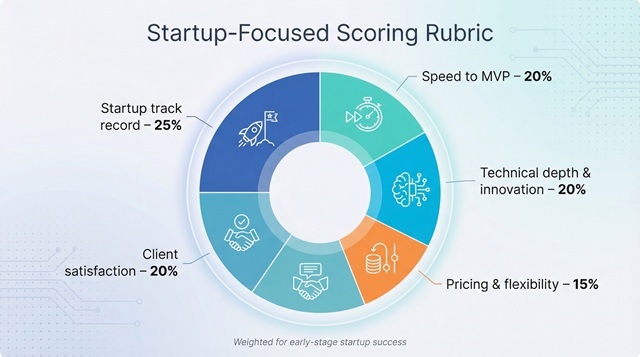
Startup track record carried the most weight at 25 percent. An agency that turns prototypes into funded companies matters more than one that impresses Fortune 500 brands.
Speed to MVP followed at 20 percent. In 2026, months feel like years; we rewarded firms that ship usable products in weeks, not quarters.
Technical depth and innovation earned another 20 percent. We looked for modern stacks, built-in AI options, and DevOps habits that keep releases humming after launch day.
Client satisfaction accounted for 20 percent as well. Public reviews had to praise communication, reliability, and that crucial “partner” vibe.
The final 15 percent measured pricing and flexibility. We favored studios willing to sync payment schedules with a startup’s cash flow, whether that means phased budgets, global delivery centers, or creative equity models.
We tallied the numbers, checked them against fresh 2024–2026 milestones, and surfaced the eight companies you’ll meet next. The result is simple, transparent, repeatable and ruthlessly relevant.
Top startup app developers at a glance
Before we dive into individual stories, review the field on one screen. Scan the table, spot the row that mirrors your situation, then keep reading for the deeper take.
|
Company |
Founded / HQ |
Team size (2026) |
Stand-out startup work |
Core strength |
Clutch rating |
Best for |
|
Monstarlab Americas |
2006 • Tokyo / NYC |
≈ 1,200 |
NYTimes Crossword, wellness wearable |
Enterprise-grade builds with startup coaching |
4.8 |
Series A+ scale-ups |
|
Appinventiv |
2015 • Noida |
≈ 1,600 |
JobGet, Domino’s India |
High-capacity dev at sharp rates |
4.7 |
Cost-sensitive hyper-growth |
|
Thoughtbot |
2003 • Boston |
≈ 100 |
Kickstarter, Houseparty |
Lean MVP plus UX mentorship |
4.9 |
Pre-seed to Seed |
|
Fueled |
2007 • New York |
≈ 150 |
Warby Parker, Afterlight |
Design-first, viral-ready apps |
4.8 |
Design-driven B2C |
|
Yalantis |
2008 • Cyprus |
500+ |
JLL, Orbis |
Scalable cloud architecture |
4.8 |
Post-MVP re-platforming |
|
Hedgehog Lab |
2007 • UK |
≈ 200 |
AJ Bell, Aviva |
Award-winning fintech UX |
4.9 |
Fintech or compliance-heavy |
|
ChopDawg |
2009 • USA |
≈ 50 |
Six Flags, 500+ MVPs |
Transparent, founder-friendly |
4.8 |
Bootstrapped launches |
|
SEM Nexus |
2017 • NYC |
≈ 15 |
Noomii, indie hits |
Build plus growth marketing |
5.0 |
Consumer apps needing traction |
One row rarely tells the whole story, yet patterns emerge quickly: Monstarlab offers global scale, Thoughtbot provides hands-on mentorship, and SEM Nexus combines code with user acquisition. Keep these headlines in mind as we explore each contender next.
Monstarlab Americas: global muscle, startup heart
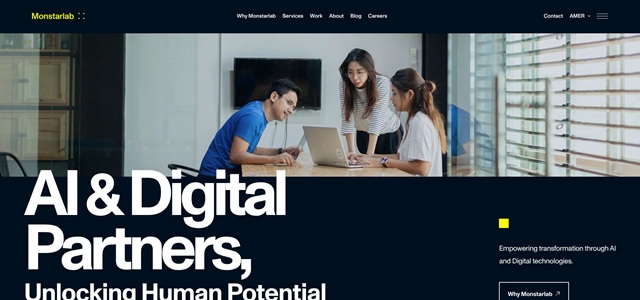
Monstarlab Americas website screenshot demonstrating global digital product development services
Monstarlab began in Tokyo, acquired New York studio Fuzz, and now fields more than 1,000 engineers across four continents. The global reach gives you time-zone coverage and specialist depth that few pure-startup shops can match. Founders still praise the personal touch: project leads jump into Slack, share Loom demos, and feel like part of the crew.
Technical strength shows up fast because its digital product development services carry founders from the first spark through launch and scale. Teams add AI modules, ship cloud-native pipelines, and deliver dashboards your own developers can extend without diving into tangled code. One health-tech client grew from pilot to one million users without rewriting a single microservice.
Quality sits in the premium band, but the payoff is speed without rework plus a 4.8/5 average on Clutch. Reviewers repeat a single theme: “They acted like true product partners, not vendors.”
If you have seed or Series A funding and want enterprise-grade foundations from day one, Monstarlab is the steady choice that still feels agile.
Appinventiv: 1,600 engineers, startup-friendly pricing
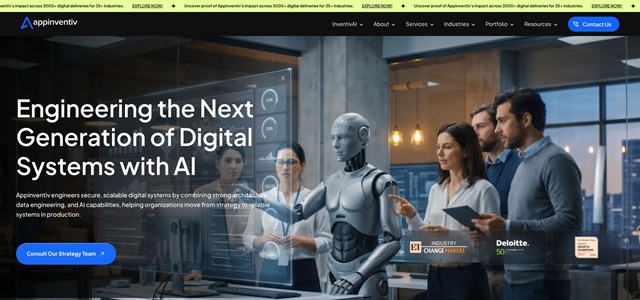
Appinventiv homepage screenshot showing large-scale startup app development team
Appinventiv shows that large and affordable can live in the same sentence. The Noida-based team grew to 1,600 specialists in 10 years yet still quotes a $50,000 project minimum, a bargain for that headcount.
Scale appears in the work. The crew built JobGet’s job-search app, which later raised $52 million, and keeps Domino’s India running during midday traffic. Behind the scenes, parallel squads cover AI, blockchain, and DevOps, so you never wait for specialists.
Founders like the value equation. Reviews label pricing “competitive,” delivery “enterprise quality,” and communication strong. Time-zone gaps exist, but Appinventiv balances them with Western project managers and a 24-hour sprint cycle that advances stories while you sleep.
Pick Appinventiv when you want big-league engineering depth on a Series A budget and are ready to run several tracks at once.
Thoughtbot: lean MVP mentorship
Thoughtbot product studio website screenshot for lean MVP mentorship
Thoughtbot works more like a product studio than a typical agency. Bring a sketch of an idea; leave a few weeks later with a clickable MVP, user-tested flows, and a clear sense of what not to build.
Small senior squads, usually one designer and two developers, pair-program in the open. You join stand-ups, watch code ship in real time, and leave with practices your team can reuse.
An open-source pedigree fuels their speed. Reusable Rails gems trim boilerplate, and the Liftoff generator produces a scaffold with authentication, CI, and analytics on day one. Success stories include Kickstarter’s early platform and Houseparty’s pivot that drew millions of users.
Rates match top U.S. talent, but scope stays tight by design. Pick Thoughtbot when you need a precise MVP that nails product-market fit, not a twenty-person dev army.
Fueled: design that sparks downloads
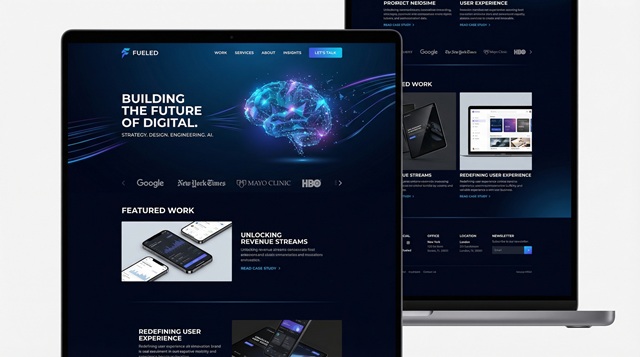
Fueled agency website screenshot highlighting design-first mobile app experiences
Some apps win because they solve a problem; Fueled’s apps win because users fall in love at first tap. The New York studio treats interface design like brand storytelling, refining color, motion, and microcopy until the product feels App Store ready.
That focus pays off. Warby Parker’s mobile shop doubled conversion after launch, and Afterlight’s photo editor topped 20 million downloads without paid ads. Performance keeps pace with polish, as engineers build for scale on the same sprint cadence as designers, so beauty never delays release.
Innovation Lab sessions take concepts from sketch to tested prototype in two weeks, whether that means an AR try-on or a crypto wallet module. A 2025 Webby for best mobile fintech UX is the latest proof point.
Budgets start near $100,000, but if your growth plan relies on viral buzz and top-tier reviews, few partners rival Fueled’s blend of creativity and technical discipline.
Yalantis: engineering for both sprint and marathon
Many startups patch an MVP, then watch the codebase buckle under user growth. Yalantis steps in before that snap. Founded in Ukraine, now headquartered in Cyprus with hubs across Eastern Europe, the firm focuses on scalable architecture from day one.
Teams map your business goals to cloud diagrams, split monoliths into microservices, and wire DevOps at launch. When real-estate giant JLL needed a platform to handle millions of property records without lag, Yalantis rebuilt core services and future-proofed the stack.
The studio is engineering-first. Design polish is secondary; bulletproof backends are the draw. Pricing sits above offshore quick fixes but below Madison Avenue rates, reflecting that focus.
Pick Yalantis if your prototype already proves demand and you need an infrastructure partner who will keep the wheels on while you double, triple, then 10× user counts.
Hedgehog Lab: fintech focus, research-grade UX
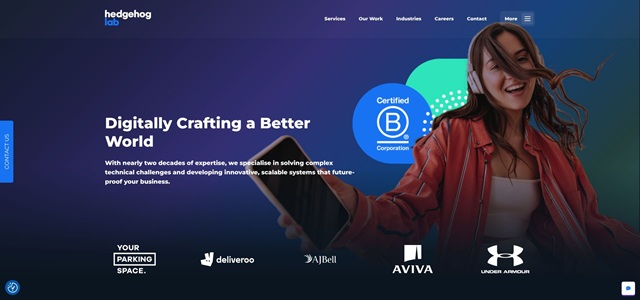
Hedgehog Lab website screenshot showcasing fintech UX and research-driven design
Hedgehog Lab treats app design like a science experiment. Researchers interview users, sketch hypotheses, and run usability tests before a single line of code lands in Git. The result is an interface that feels trustworthy, essential when people move money or share health data.
The trophy case proves the approach: a UX Design Award for AJ Bell’s investing app, Webby honors for accessibility, and a Microsoft Mixed Reality partnership that keeps the team exploring new tech.
Founders in regulated sectors breathe easier here. Hedgehog Lab builds GDPR and PSD2 controls plus bank-grade encryption into every project, so compliance never stalls the roadmap. Pricing lands below New York design boutiques but above bare-bones dev shops, a fair trade for meticulous research without Manhattan rent baked in.
If your product depends on user trust and you need screens that turn skeptics into advocates, Hedgehog Lab fits the brief.
ChopDawg: friendly guide to first launch
ChopDawg feels less like an agency and more like a skilled teammate who walks you through every step. Founded by a teenage entrepreneur in 2009, the crew has shipped more than 500 startup apps, clear proof that its “explain-as-we-build” process resonates with new founders.
Engagements start with a scoping workshop that trims your idea to a lean feature set and clear cost. Transparency drives every project: milestone pricing, no surprise invoices, and candid advice when no-code tools can save you cash. Reviews praise their willingness to “act like a CTO, not a vendor.”
Speed counts too. Small, distributed teams prototype in weeks, then iterate on real user feedback. When Six Flags needed an event companion app, ChopDawg delivered a polished build on a timeline larger firms called impossible.
If your budget is thin but your ambition is big, and you want a partner who translates jargon into plain English, ChopDawg is the launchpad you need.
Conclusion
Choosing the right development partner can define your startup’s trajectory. Use this guide’s transparent rubric and detailed profiles to match your needs with the strengths of these eight standout agencies, then move quickly toward launch.