
Responsible AI Writing: How Teams Use AI Tools Without Losing Authenticity

Image Source: depositphotos.com
AI writing tools have made content creation significantly faster. Drafts that once required hours can now be produced in minutes, helping teams scale documentation, communication, and content production.
However, speed alone does not guarantee quality. As AI-generated content becomes more common, many teams are finding that raw output often lacks clarity, consistency, or the tone required for professional use.
This shift has made one thing clear: responsible AI writing is less about choosing a single tool and more about using the right combination of tools effectively.
What Responsible AI Writing Looks Like in Practice
Responsible AI writing is not about avoiding AI—it’s about how it is used within a workflow.
In most cases, teams treat AI as a starting point. Drafts are generated quickly, but they are not used as-is. Instead, they are refined, adjusted, and validated before being shared.
This approach ensures that content is not only efficient to produce but also clear, readable, and aligned with its intended purpose.
The Trade-Off Between Speed and Authenticity
AI tools are highly effective at generating structured content. They can organize ideas, summarize information, and produce coherent drafts at scale.
At the same time, AI-generated text often lacks variation in tone, contextual nuance, and natural phrasing. This can result in content that feels repetitive or slightly mechanical.
Balancing speed with authenticity requires deliberate refinement—something that cannot be achieved through generation alone.
A Practical Workflow for Responsible AI Writing
In real-world scenarios, teams follow a multi-step workflow to ensure AI-generated content meets quality expectations.
1. Restructuring and improving clarity
The first step is to refine how the content is structured. Initial drafts are often reworked using tools like a paraphraser to improve flow, remove repetition, and make the text easier to follow without changing its meaning.
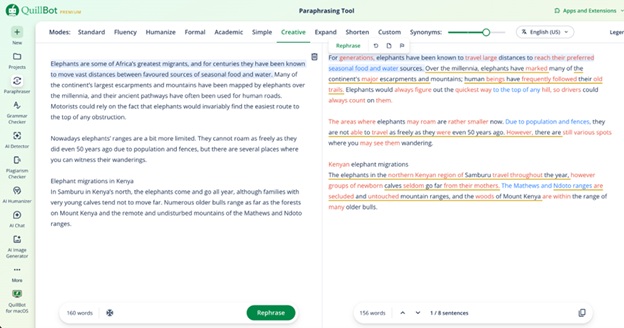
Example: Improving sentence clarity and structure using a paraphrasing tool
2. Refining tone and readability
Once the structure is clear, attention shifts to how the content reads. Even well-organized AI text can feel uniform or overly rigid.
At this stage, teams often humanize AI content to improve readability, smooth transitions, and align the tone with real-world communication standards.
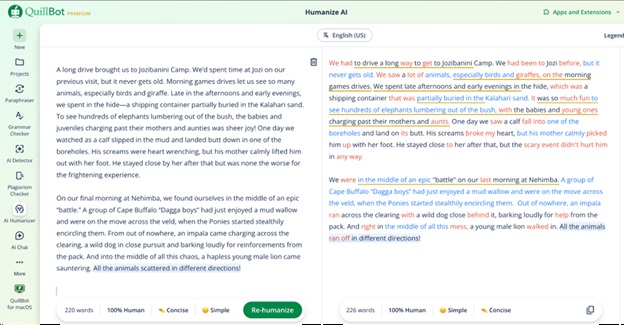
Example: Refining AI-generated text to improve tone and readability
3. Validating content before use
Before finalizing, content is reviewed to understand how it may be interpreted. This is particularly important in academic, professional, or compliance-driven environments.
Using an AI detector helps identify patterns that may require further refinement and provides an additional layer of validation. For AI-generated images and other media, teams can also use a remove AI label tool to manage supported AI metadata or Content Credentials before publishing.
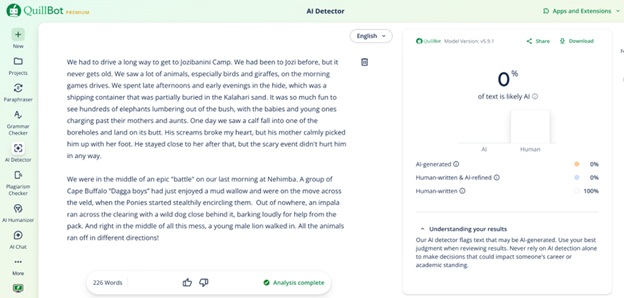
Example: Reviewing content for AI-generated patterns before final use
4. Adding human context
AI can structure content effectively, but it cannot fully replace context or perspective. Adding examples, clarifications, or adjustments ensures the content reflects intent and audience expectations.
5. Final review and alignment
The final step is a comprehensive review for clarity, tone, and consistency before publishing.
Where Tools Fit Into This Workflow
Each stage of this workflow is supported by different types of tools—from rewriting and humanization to validation. The goal is not to rely on a single solution, but to combine tools in a way that improves both speed and quality.
This shift reflects how teams are moving from isolated tool usage to more integrated writing workflows.
Common Challenges in AI-Assisted Writing
Even with structured workflows, teams often encounter recurring issues:
- Publishing content without sufficient refinement
- Over-reliance on uniform AI-generated phrasing
- Lack of alignment with audience expectations
- Prioritizing speed over clarity
These challenges highlight the importance of treating AI as part of a process rather than a standalone solution.
Best Practices for Teams
To maintain quality while using AI tools, teams are increasingly adopting the following practices:
- Treat AI-generated text as a starting point
- Prioritize readability and clarity during editing
- Use rewriting and validation consistently
- Align content with audience and context
- Incorporate human input before publishing
Why This Approach Matters
Responsible AI writing is not just about improving individual outputs—it is about maintaining consistency, trust, and usability across all content.
As AI becomes more embedded in daily workflows, the ability to refine and validate content becomes a key differentiator between average and high-quality output.
Conclusion
AI writing tools have made content creation faster and more accessible. But without refinement, speed can lead to inconsistent or unclear results.
By combining rewriting, humanizing, and validation into a structured workflow, teams can ensure that AI-assisted content remains clear, credible, and fit for purpose.
Responsible AI writing is not about limiting AI—it is about using it effectively to produce better outcomes.