
Stop Fighting Your Mouse: How I Traded "Drafting Slavery" for Real Restaurant Design

I’ve spent the better part of twelve years in the hospitality design trenches. If there’s one truth I’ve brought back from the front lines, it’s this: the soul of a restaurant is decided long before the chef ever steps into the kitchen. It’s won or lost in your Restaurant Floor Plan.
For the longest time, I was a "manual drafting" purist. I had this misguided notion that if I didn't spend forty hours meticulously snapping lines, calculating egress paths, and fighting with layer properties, I wasn't "really" designing. But a few years ago, I hit a breaking point. I realized I wasn't an architect anymore; I was a high-priced data-entry clerk. I was wasting my best creative energy on the most mindless parts of the job.
That’s when I moved my workflow to AIAI.com. It wasn't about being lazy—it was about reclaiming the "Why" behind my work.
The Invisible Cost of "Manual Labor" Drafting
In the traditional design world, the first step is often the most draining. You start with a site survey—usually a cramped, irregularly shaped shell of a building with columns in all the wrong places. You then have to translate those messy real-world measurements into clean, CAD-ready vectors.
I remember a project for a bistro in a converted 1940s warehouse. I spent an entire week just trying to get the new wall lines to align with the existing structural quirks. By the time I actually sat down to think about the guest experience, I was already burnt out. This is the hidden trap of traditional drafting: Creative Fatigue.
When I first opened the dashboard at AIAI.com, the relief was instant. Look at the "Zoning" logic in the platform above. Traditional CAD treats every wall the same—whether it’s a partition for a walk-in freezer or a decorative screen.
But this system understands context. When I’m working in a "Commercial/Flex Zone," the AI already knows the baseline requirements for movement and clearance. It handles the "Auto-Generation" of the structural skeleton, allowing me to skip the four days of mindless line-snapping and move straight to the refined 2D and 3D exports. I stopped being a slave to the cursor and started being a consultant again.
The Kitchen "Hot Line": Where Layouts Go to Die
If you want to know if a designer actually understands the restaurant business, look at their kitchen. The "Back of House" is a high-speed factory. If the distance between the prep station and the pass-through is three feet too long, you’ve just added ten minutes of wasted labor to every hour of service. Over a year, that’s thousands of dollars in lost efficiency.
Traditionally, testing these "server paths" was a guessing game. I’d have to manually draw colored lines to see where the bottlenecks would happen. It was tedious and, frankly, primitive.
Now, look at how I set up a project on AIAI.com. I’m no longer just "drawing a kitchen." I’m defining the Service Model.
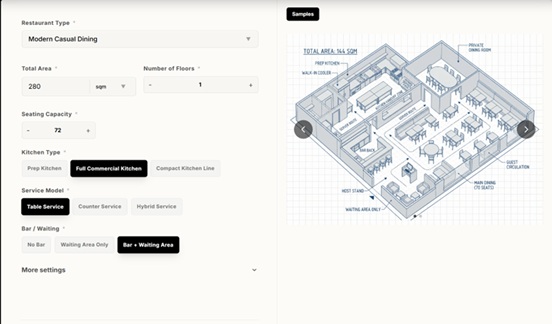
In this interface, I can select "Modern Casual Dining," set the seating capacity to 72, and tell the AI I need a "Full Commercial Kitchen" with "Table Service." The AI then generates a sample that actually functions for the business. Look at the grid on the right—it maps out the "Kitchen Handoff Zone" and "Server Routes" automatically. It flags circulation issues before I’ve even picked out a floor tile. I’m using a tool that understands the math of the "Rush."
Turning "Napkin Dreams" into Reality
We’ve all had that client. They sit down, pull out a cocktail napkin with a few shaky lines, and say, "This is the vision." Turning that "chicken scratch" into a professional Restaurant Floor Plan used to be a three-day ordeal of scanning, tracing, and re-drawing.
This is my current "Cyborg" workflow. I take a raw, conceptual sketch from a site walkthrough and let the Smart Wall Detection do the heavy lifting. It identifies the boundaries, scales the entire room based on a single measurement, and populates the 2D layout.
But the real closer is the Instant 3D Sync. I’ve sat in meetings where a chef told me the prep area looked too tight. In the past, I’d have to say, "Let me go back to the office and re-model that." Now? I drag the wall in the 2D view on AIAI.com, and they see the 3D space expand in real-time. It turns a "meeting" into a "collaboration."
Precision in the Age of "Good Enough"
There’s a dangerous trend in some AI tools toward "hallucination"—where the AI makes up dimensions that look nice but don't work. In our world, that’s a lawsuit waiting to happen.
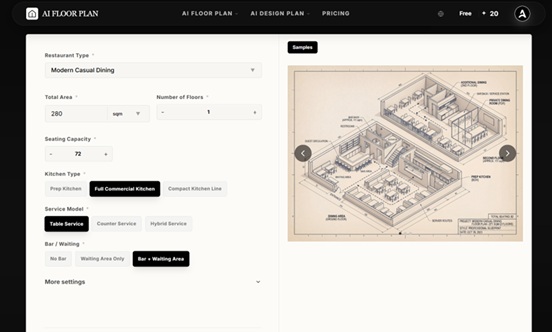
Look at this mechanical rod analysis. In that world, a 0.1mm error is a disaster. In restaurant design, our tolerances are slightly larger, but the principle is the same. If my "Pass-Through" window is six inches too high, my servers get back pain. If my bar height is 105cm instead of 107cm, the stools won't fit.
The engine on AIAI.com captures the intent of the dimensions. When I label a constraint, the system builds geometry around that rule. It isn't "painting" a picture; it’s building a mathematical model of a physical space.
Final Thoughts: Reclaiming the Weekend
I didn't get into this business because I loved the sound of a mechanical keyboard clicking until 3:00 AM. I got into it because I loved the feeling of walking into a finished space and seeing people enjoy a meal in a room that works.
By offloading the grunt work to AIAI.com, I’ve reclaimed about fifteen hours of my week. That’s fifteen hours I can spend on the things that actually define a restaurant:
The Lighting Design: Which creates the "vibe" that keeps people coming back.
Material Selection: Ensuring the space can survive 500 covers a night.
Acoustic Engineering: So guests can actually hear each other over the kitchen noise.
If you’re still starting every project by staring at a blank screen and manually drawing every wall for four hours, you aren't being "thorough." You’re just being inefficient.
The future of the Restaurant Floor Plan isn't about how many lines you can draw; it’s about how many problems you can solve before the first brick is laid. It’s time to stop drafting and start designing.