Operations | Monitoring | ITSM | DevOps | Cloud

How are data centers changing their practices to become more sustainable? #datacenter #dcim

It all begins with recognizing the interconnected relationship between financial performance, social equity, and environmental impact. Hyperview CEO, Jad Jebara talks about the data center movement towards a greener future.

Hyperview Joins Forces With Novem Digital to Transform Property Risk Management and Asset Sustainability

Vancouver, British Columbia, August 27, 2024 – Hyperview, the leading cloud-based data center infrastructure management (DCIM) platform, is pleased to announce a strategic partnership with Novem Digital, an innovative digital risk management and IoT company.

What is the impact of AI on data centers? #AI #datacenter #datacentersolutions

AI is the buzzword of the year for good reason—it's transforming industries, including data centers. Hyperview CEO, Jad Jebara explains how AI is tripling data center capacity, solving industry challenges, and why this is just the beginning.

What is DCIM software? #datacenters #datacentersolutions #datacenter

@hyperviewhq CEO Jad Jebara: "If you're someone in the industry or who has experienced DCIM software in the past, you would know that it can be a PAIN. But for those who are unfamiliar, let's break it down and discuss how a modern DCIM solution can transform your operations.".

Hyperview DCIM 4.5 Software Release: Carbon Footprint Reporting

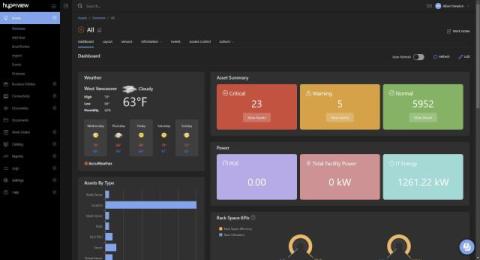
Version 4.5 introduces a new add-on feature, Carbon Footprint Reporting that lets you keep an eye on the carbon footprint of any location with ease. Dive into the details of rack workloads, assess how your average offset percentages are shaping up, and get specific insights for each location. Plus, we've added a sleek dark mode option for Hyperview, introduced two fresh dashboard widgets, and rolled out a bunch of improvements to enhance your experience.

Carbon Footprint Reporting

We’re excited to share some big updates and enhancements that underscore our dedication to innovation and efficiency. Check out our new Carbon Footprint Reporting add-on feature, a sleek dark mode GUI theme, and major improvements to Business Entity tracking and Dashboard Widgets. Plus, we’ve added new custom components for better peripheral logging and expanded firmware update support for Panduit Gen6 rack PDU products.

Is it possible for data centers to be eco-friendly? #datacenter #datacenters #datacentersolutions

Data centers are major energy consumers, emitting CO2 equivalent to 13 million cars in North America alone. Emissions arise from primary operations and auxiliary systems like cooling and backup generators. Inefficiencies in IT equipment management and a lack of detailed emissions analysis hinder targeted reduction strategies. So, is it possible to make them more sustainable? The short answer is, yes.

DCIM tools are expensive. How is @hyperviewhq making it more accessible to everyone? #datacenter

@hyperviewhq CEO explains why customers refer to Hyperview as the '@tesla of the DCIM software. It's sold direct to customers, pricing is fully transparent, and artificial intelligence is built into the foundation of the platform.

Patch or Perish: Secure Your Data Center with Firmware Management

Firmware is the permanent software programmed into a device’s read-only memory. It provides the low-level control for the device’s specific hardware. In a data center, firmware is embedded in various components such as servers, storage devices, and networking equipment. Firmware management involves the processes and tools necessary to update, maintain, and monitor these firmware systems.

Vendor-Neutral Asset Auto-Discovery: The Cornerstone of DCIM Software

Data centers today are dynamic ecosystems with heterogeneous infrastructures. They encompass a wide array of equipment including servers, storage systems, networking devices, power distribution units, and environmental controls. These assets often originate from multiple vendors and support various communication protocols. Traditional manual asset management methods are ill-equipped to handle this complexity, leading to inefficiencies, inaccuracies, and increased operational costs.