Operations | Monitoring | ITSM | DevOps | Cloud

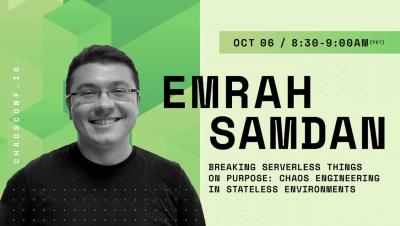
Breaking Serverless Things on Purpose: Chaos Engineering in Stateless Environments - Emrah Samdan

Serverless enabled us to build highly distributed applications that led to more granular functions and ultimate scalability. However, it also brought the risk of failure from a single microservice to many serverless functions and resources. You might be able to predict and design for certain troublesome issues but there are many, many more that you probably will not be able to easily plan for. How do you build a resilient system under these highly distributed circumstances? The answer is Chaos Engineering: Breaking things on purpose just to experience how the whole system will react.
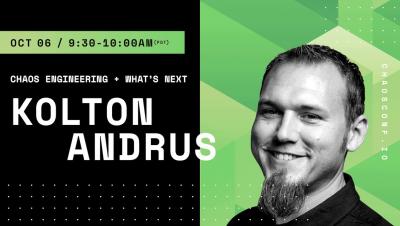

Chaos Engineering: The Path to Reliability - Kolton Andrus

We’re all here for the same purpose: to ensure the systems we build operate reliably. This is a difficult task, one that must balance people, process and technology during difficult conditions. We operate with incomplete information, assessing risks and dealing with emerging issues. We’ve found Chaos Engineering to be a valuable tool in addressing these concerns. Learn from real world examples what works, what doesn’t, and what the future holds.

Identifying Hidden Dependencies - Liz Fong Jones

You don't need to write automation or deploy on Kubernetes to gain benefits from resilience engineering! Learn how Honeycomb improved the reliability of our Zookeeper, Kafka, and stateful storage systems through terminating nodes on purpose. We'll discuss the initial manual experiments we ran, the bugs in our automatic replacement tools we uncovered, and what steps we needed to progress towards continuously running the experiments. Today, no node at Honeycomb lives longer than 12 months, and we automatically recycle nodes every week.

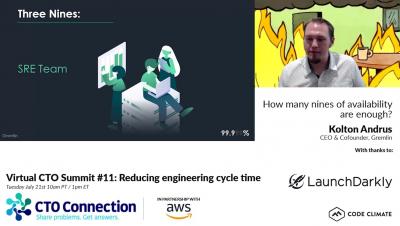
How many 9's are enough? Kolton Andrus  CTO Connection: Reducing engineering cycle time

How many nines of availability are enough? In this talk, Gremlin CEO Kolton Andrus shares insights from years at Amazon, Netflix, and now working with a wide array of customers across various disciplines and industries. He’ll describe what each level of availability looks like, the challenges faced at each stage, and the trade-offs required to achieve the next nine of uptime.

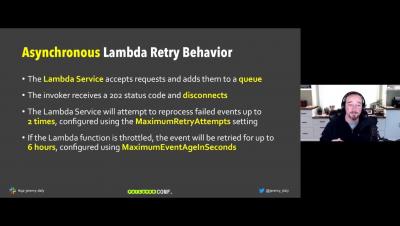
How to fail with Serverless  Jeremy Daly Failover Conf 2020

Everything fails all the time. Knowing how to deal with these failures in serverless applications becomes essential to building resilient, highly-available systems. In traditional monolithic applications, catching errors and handling retries is relatively straightforward. But as our systems become more distributed, we now have multiple (often asynchronous) components processing events from several sources, all with vastly different retry behaviors and failure mechanisms. Utilizing old patterns can cause errors to get swallowed, creating brittle, unreliable systems that are difficult to debug and hard to maintain.

Slowdown is the New Outage  Marco Coulter  Failover Conf 2020

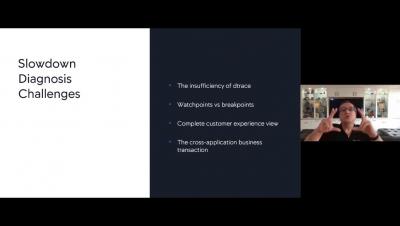
While outage-driven news headlines can cause stock prices to plummet short term, the performance-driven reputation loss is a slow burn for longer-term customer loss. This session compares slowdowns vs outages and the resulting need for insight more than observability. By understanding these difference, you'll be ready to drive agile applications, gain funding for lowering technical debt, and focus on customer retention.

The Halo of Resilience Engineering  J. Paul Reed  Failover Conf 2020

Recent world-impacting events have caused us all to have to rethink the way we go about our daily work; in this talk, we'll look at how some of the pillars of Resilience Engineering might help you and your team deal with the changes we're all being forced to confront.