
9 Best HR Management Software for Enterprises in 2026 - Top Platforms Ranked

Image Source: depositphotos.com
I have lost count of how many HR software platforms I’ve used over the years. At this point, I can squint my eyes and point out an HRMS issue from a mile away. Enterprise HR software doesn’t have a reputation of being fun, but the reality is that HR software is mission critical to large organizations and choosing the right one is make or break.
Good HR software at the enterprise level is not simple. You’re dealing with global teams, compliance headaches, shifting org structures, and leadership that wants clean data on demand. When your systems are not up to the task, things start slipping through the cracks. Payroll errors creep in, onboarding slows down, and suddenly HR feels like it is playing catch up instead of leading from the front.
These issues are avoidable with the right software. Processes click into place, reporting starts to make sense, and teams spend less time chasing admin tasks and more time focusing on people. That kind of shift is not subtle. You feel it almost immediately.
So I put this list together with one goal in mind. I wanted to cut through the noise and highlight the platforms that actually hold up in real enterprise environments. Some are well-known names. Others might surprise you. All of them have their place, though only a few truly stand out when you look at how they perform day to day.
What is enterprise HR management software in a nutshell?
Enterprise HR management software is the system that keeps your entire workforce from descending into organized chaos. It is where employee data lives, where payroll gets processed, where performance is tracked, and where hiring pipelines are managed without ten different spreadsheets fighting for attention.
Once you hit a certain size, you simply cannot run HR on emails and shared drives anymore. Something has to hold it all together, and that something is your HR management software.
How to choose the best HR management software for enterprises
When I evaluate enterprise HR platforms, I focus on how they perform under pressure. It is one thing to manage 50 employees. It is another to handle global payroll, compliance, and reporting across multiple regions without breaking workflows.
Here is what I typically look for:
- Global capability, including multi-country payroll and compliance support
- Scalability that holds up as teams expand and structures become more complex
- Reporting and analytics that leadership can actually use
- Integration flexibility across HR, finance, and IT systems
- A user experience that employees will not avoid
I also pay close attention to implementation timelines and support. Enterprise systems can take months to roll out, and poor onboarding can create long-term problems that are hard to fix later.
How I ranked these platforms
To keep things consistent, I evaluated each platform across a few core areas:
- Core HR functionality and workforce management
- Depth of analytics and reporting
- Automation across the employee lifecycle
- Global support and compliance features
- Ease of use for both admins and employees
- Real user feedback trends from platforms like G2
My top choice for 2026 is HiBob. While HiBob is generally considered the market leader in mid-market, it scales to enterprises seamlessly. After toiling through systems that were either suited to one or the other (or none), HiBob’s flexibility stood out by a long way, but that doesn’t mean the others are all bad. Here’s how each platform measured up on direct comparison:
Quick comparison of the top enterprise HR platforms
|
Platform |
Best For |
Key Strength |
Main Limitation |
|
HiBob |
Modern enterprises |
Balance of usability and global scale |
Requires consultation for custom pricing |
|
Rippling |
Automation-heavy teams |
Unified data + automation |
HR can feel secondary |
|
Deel |
Global hiring |
Compliance and contractor management |
Expensive at scale |
|
Workday |
Large enterprises |
Deep enterprise functionality |
Complex and costly |
|
UKG |
Workforce-heavy orgs |
Scheduling and compliance |
Outdated UX |
|
Personio |
European enterprises |
Regional compliance |
Limited global reach |
|
ADP Workforce Now |
Payroll-heavy orgs |
Reliable payroll |
Interface and flexibility |
|
BambooHR |
Simpler operations |
Ease of use |
Limited scalability |
|
Sage HR |
Budget-conscious teams |
Low cost |
Limited depth |
1. HiBob
Best for: Modern enterprises that want flexibility without complexity
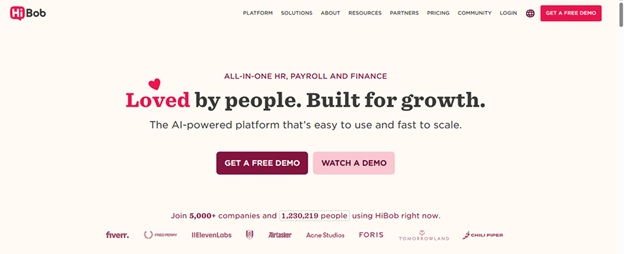
HiBob is the platform I consistently see performing well across both mid-sized and enterprise environments. It brings together core HR, payroll integrations, performance management, and workforce planning into a system that actually feels usable on a daily basis.
What I like most is how it handles scale without becoming overwhelming. You can manage global teams, automate onboarding, and track performance without needing a dedicated technical team to keep everything running. That balance is rare, especially at the enterprise level.
HR management software that actually cares about culture
HR management software that actually cares about a unified company culture is rare, though that is exactly where HiBob stands out. From what I have seen, most platforms treat culture like an add-on, something you measure once a quarter and forget about. HiBob builds it directly into how the system works. It connects employees through features like recognition, surveys, and shared updates. This helps teams feel part of something bigger even when they are spread across different locations.
The company has been sweeping international awards and consistently receiving solid ratings for years now and is rapidly building its global recognition as a result. As a proper disruptor of note, it manages to outdo legacy systems that feature far above its pricing structures.
What makes it work is that it is not just surface-level engagement. The platform gives HR teams real visibility into how people feel, using tools like surveys and sentiment tracking, then actually helps them act on that feedback. It creates a central place where communication, feedback, and day-to-day interactions happen naturally, which strengthens connection across the company.
When that kind of structure is in place, culture stops being a vague idea and starts becoming something you can see and actively improve. With a 4.5 rating on G2, it’s a standout solution in both enterprise and mid-market segments.
Another strong point is employee experience. The platform is designed in a way that people actually engage with, which improves adoption and keeps data accurate. When teams use the system consistently, reporting becomes far more reliable.
HiBob at a Glance:
A well-rounded platform that supports growth without adding unnecessary complexity.
Pros:
- Strong global capabilities
- Clean and intuitive interface
- Solid automation across workflows
Cons:
- Custom pricing requires consultation
2. Rippling
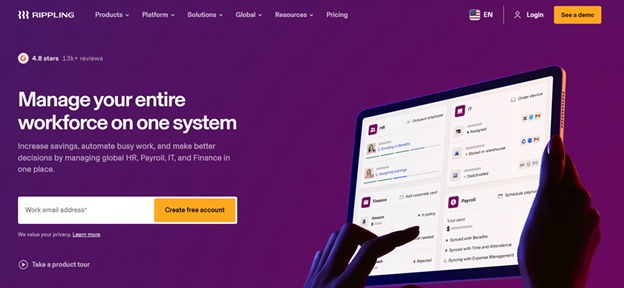
Rippling is one of those platforms that feels like it started with a simple idea and then kept expanding until it covered almost everything. At its core, it runs on a single source of employee data, which then powers HR, payroll, IT, and even finance tools. That foundation makes a real difference if your company requires unified strategies to deal with major organizational changes across teams and regions.
An HR management solution that favors speed and automation
What I find interesting about Rippling is how aggressively it leans into automation. You can trigger workflows based on almost anything, role changes, salary updates, compliance requirements, and have those changes ripple (excuse the pun) across the entire system instantly.
There is also a strong emphasis on speed. Payroll can be processed quickly, onboarding can happen in minutes, and approvals can move without endless back-and-forth emails. For companies that value efficiency above all else, that can be a huge advantage.
That said, I have noticed a trade-off. Rippling sometimes feels more like an operations engine than a people-first HR platform. It excels at managing systems, data, and workflows, though the employee experience side can feel less front-and-center compared to something like HiBob.
Despite this, it currently holds an impressive 4.8 rating on G2, driven by its loyal customer base.
Rippling At Glance:
A powerful, automation-heavy platform that connects everything, though it leans more toward operations than culture.
Pros:
- Single source of truth across HR, IT, and finance
- Extremely strong automation and workflow control
- 600+ integrations for building a connected tech stack
Cons:
- Can feel overwhelming for non-technical teams
- Less focus on employee engagement and culture
3. Deel
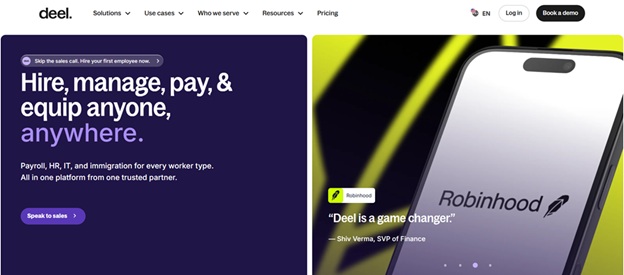
Deel has built its reputation around one thing, making global hiring less painful. If you are dealing with contractors or full-time employees across multiple countries, it handles the legal and payment side in a way that removes a lot of friction.
Enterprise HR management software for compliance at scale
What stands out to me is how much Deel focuses on compliance infrastructure. It operates through local entities in many countries, which allows companies to hire internationally without setting up their own legal presence. That alone can save months of effort and a fair amount of stress.
The reporting tools are also worth mentioning. You can track workforce data across countries, contract types, and payment structures, all in one place. That kind of visibility becomes more important as your workforce spreads across regions.
The limitation is that Deel is not trying to be a full HR platform in the same way as others on this list. Also boasting a 4.8 G2 rating, it does global hiring extremely well, though it does not offer the same depth in areas like employee engagement or internal culture.
Deel at a Glance:
A strong global hiring platform that solves compliance challenges, though it is not a complete HR system.
Pros:
- Excellent for international hiring and compliance
- Strong reporting across global teams
- Simplifies contractor and EOR management
Cons:
- Expensive for large teams
- Limited depth outside global hiring
4. Workday
Workday is one of those HR management software platforms that almost everyone in enterprise HR has heard of, and for good reason. It offers a deep, all-in-one system that covers HR, finance, and analytics at a scale that few competitors can match.
HR management software that is detailed but can be complex
From what I have seen, Workday shines when companies need highly detailed reporting and strict governance across departments. With a solid 4.2 rating on G2, Workday connects workforce data with financial data, which gives leadership a broader view of how the organization is performing.
The challenge is that it often feels like a system built for a different era. Implementation takes time, customization can get complicated, and the learning curve is real. Teams usually need dedicated resources just to manage it properly.
For some enterprises, that trade-off is worth it. For others, especially those moving quickly, it can feel like too much weight for everyday operations.
Workday at a Glance:
A powerful enterprise platform with deep functionality, though it comes with complexity and slower adoption.
Pros:
- Strong analytics and reporting
- Deep enterprise functionality
- Trusted by large organizations
Cons:
- Long implementation timelines
- Requires dedicated internal support
- Less intuitive than newer platforms
5. UKG
UKG has carved out a strong position in industries where workforce management is front and center. Think retail, healthcare, and manufacturing, where scheduling, time tracking, and compliance are daily priorities, not occasional tasks. I have seen teams rely on it to keep large, shift-based operations running without things falling apart. When you are dealing with hundreds or even thousands of employees clocking in and out, that kind of consistency matters more than anything.
HR management software at scale
The platform is built to handle complexity at scale, and it does not try to hide that. You can set detailed scheduling rules, manage overtime, track labor costs, and stay aligned with compliance requirements across different regions. With a strong 4.2 rating on G2, it’s ideally suited to companies with large, hourly workforces, and brings a level of control that can be a game changer.
I have also noticed that UKG leans heavily into data. The reporting tools are detailed, and you can pull insights around labor trends, attendance, and workforce performance. That is useful for leadership teams that want to understand what is happening across different departments without relying on guesswork.
At the same time, the experience can feel a bit behind the curve compared to newer platforms. The interface is not the most intuitive, and it can take time for teams to get comfortable with it. Setup is rarely quick, and ongoing management often requires someone who knows the system well. For lean teams, that can become a challenge over time.
UKG at a Glance:
A strong workforce management tool, though it feels heavier and less modern than newer platforms.
Pros:
- Excellent for scheduling and compliance
- Handles large workforces well
- Strong reporting for labor data
Cons:
- Interface feels outdated
- Requires more effort to manage
- Not as flexible for modern teams
6. Personio
Personio has built a strong presence in Europe, and it shows in how the platform is structured. I have seen it work particularly well for companies that want clear processes, strong compliance support, and a centralized way to manage their workforce. It feels organized and predictable, which is exactly what many HR teams need when dealing with regional regulations.
Personio as an Enterprise HR System for European Companies
The platform covers core HR functions like employee records, time tracking, recruiting, and performance management in one place. For teams operating within Europe where regulations and culture can be vastly different from US working experiences, this makes day-to-day work much easier. You are not constantly worrying about whether you are meeting local requirements because a lot of that is already built into the system.
Where it starts to feel limited is when companies expand beyond its core markets. Global capabilities are not as strong, and some features lack flexibility when dealing with more complex, multi-region setups. I have also noticed that advanced workforce planning tools are not as developed as they are in more modern platforms.
Personio holds a 4.4 rating on G2, which reflects solid user satisfaction overall. Most users highlight ease of use and structure, while some point out limitations when scaling internationally.
Personio at a glance: A structured HR system built for European compliance, though it struggles to support global scale.
Pros:
- Strong compliance support across Europe
- Clean and organized interface
- Solid core HR and recruiting tools
Cons:
- Limited global capabilities
- Less flexibility for complex organizations
- Basic workforce planning features
7. ADP Workforce
ADP Workforce Now is one of the most established platforms in the HR space, and it has built its reputation on reliability. I have seen it used by large organizations that need payroll to run smoothly every single time without fail. That consistency is where it really shines.
ADP Workforce Now provides enterprise payroll and HR management software
The platform offers a wide range of features, including payroll, benefits administration, workforce management, and analytics. It can integrate easily with other tools and this is particularly useful for tech-savvy employees who can really get the best out of the system. This also helps it fit into existing enterprise environments without too much disruption.
At the same time, it can feel a bit rigid. The interface is not the most modern, and customization options are not as flexible as some newer platforms. It does the job well, though it may not feel as intuitive or adaptable as teams would like.
ADP Workforce Now holds around a 4.1 rating on G2, with users consistently praising its payroll reliability. Reviews often mention usability and navigation as areas that could be improved.
ADP Workforce at a glance: A dependable payroll-focused system with broad features, though it lacks flexibility and modern usability.
Pros:
- Highly reliable payroll processing
- Wide range of HR features
- Strong brand reputation
Cons:
- Interface feels outdated
- Limited customization
- Can be harder to navigate
8. BambooHR
BambooHR is one of those platforms that almost anyone can pick up quickly. I have seen teams get comfortable with it in a matter of days, which is not something you can say about most enterprise systems. It keeps things simple, and that simplicity is a big part of its appeal.
BambooHR as an Enterprise HR management platform for simpler operations
The platform handles essential HR tasks like onboarding, employee records, and the problem of performance tracking without adding unnecessary complexity. It works well for companies that want a clean system that people will actually use, rather than one packed with features that sit untouched.
The trade-off becomes clear as companies grow. BambooHR does not always keep up with the needs of larger or more complex organizations and tends to stay within its lane in that regard. Reporting can feel limited, and global functionality is not as strong as what you get with more advanced platforms.
BambooHR has a 4.4 rating on G2, with users frequently praising its ease of use and quick implementation. Reviews often mention that growing companies eventually outgrow its capabilities.
BambooHR At a glance: An easy-to-use HR platform that works well early on, though it can struggle as complexity increases.
Pros:
- Very user-friendly interface
- Quick setup and onboarding
- Strong adoption across teams
Cons:
- Limited scalability
- Basic reporting tools
- Weak global support
9. Sage HR
Sage HR takes a more minimal approach, focusing on core HR features without trying to cover every possible use case. I have seen it used by smaller teams within larger organizations that just need something simple and reliable to manage day-to-day tasks.
A lightweight HR management software option for smaller teams
The platform handles essentials like leave management, employee data, and basic reporting. It is easy to get started, and most teams can use it without much training. That makes it appealing for companies that want to avoid long implementation cycles.
The downside is that it does not offer much beyond the basics. Reporting is fairly limited, integrations are not as extensive, and global capabilities are not strong enough for larger workforces. The pain of effectively managing distributed teams will likely only be amplified if a lighter system is tried. For these reasons, Sage HR systems work best in environments where complexity is low.
Unfortunately, at the enterprise level, that usually means Sage HR usually isn’t at the table. Despite this, for what it does best, Sage HR holds a 4.4 rating on G2, with users appreciating its simplicity and affordability. Feedback often points to limited functionality as the main drawback for larger organizations.
Sage HR at a glance: A simple and affordable HR tool that covers the basics but lacks depth for enterprise use.
Pros:
- Easy to set up and use
- Affordable pricing
- Good for small teams or simple needs
Cons:
- Limited reporting and analytics
- Weak integration ecosystem
- Not suitable for complex or global operations
10. ThriveSparrow
ThriveSparrow is an AI-powered HR platform that helps businesses improve employee engagement, performance, and employee development. It brings together engagement surveys, continuous feedback, one-on-one meetings, recognition, and OKR tracking in a single platform. For organizations looking to create a more connected workplace while simplifying HR processes, ThriveSparrow offers an intuitive and scalable solution.
HR management software that helps businesses grow
What I like about ThriveSparrow is how it combines employee engagement with performance management instead of treating them as separate functions. HR teams can use AI-powered pulse surveys, eNPS, sentiment analysis, and continuous feedback to gain actionable insights that improve employee satisfaction and retention.
The platform also simplifies goal tracking, performance reviews, and employee recognition, helping managers build high-performing teams through ongoing development rather than annual evaluations. With a 4.7 rating on G2, ThriveSparrow is a strong choice for organizations looking to modernize their HR processes. Businesses comparing the best HR software for small businesses can also explore ThriveSparrow's in-depth guide to evaluate leading HR solutions and choose the right platform for their needs.
ThriveSparrow at a Glance: A modern HR management platform that combines employee engagement, performance management, and AI-powered insights to help businesses build stronger, more productive teams.
Pros:
- AI-powered employee engagement surveys and sentiment analysis
- Continuous performance management with OKR tracking
- Built-in employee recognition and feedback tools
- Integrates with leading HR and workplace applications
Cons:
- Payroll functionality relies on third-party integrations
- Less focused on workforce scheduling than enterprise workforce management platforms
My Final notes on choosing the best HR management software for enterprises in 2026
After reviewing these platforms, the pattern is clear. Enterprise HR software is no longer just about functionality. In 2026,that functionality needs to fit into everyday workflows.
My vote for the best HR management software for enterprises goes to HiBob. The system manages to balance power and usability in a way that most platforms struggle to achieve. It supports global teams, automates key processes, and keeps the experience simple enough that employees actually use it.
Other tools on this list have strengths in specific areas. Some excel in automation. Others handle global hiring well. Most offer depth for large organizations, while others should likely be avoided at enterprise level. The right choice depends on your priorities and how complex your operations are.
FAQs about best HR management software for enterprises
What is the best HR management software for enterprises?
From what I have seen, HiBob is one of the strongest options for enterprises that want flexibility, strong automation, and high user adoption without unnecessary complexity. Even if you’re a mid-market company looking to scale, it’s the ideal option.
Can enterprise HR software support global teams?
Yes, though some platforms handle this better than others. HiBob is designed to support multi-country teams and compliance requirements. It also helps centralize employee data across regions, which makes managing distributed teams far more efficient. That kind of visibility becomes essential as companies expand into new markets.
Is HR management software difficult to implement at the enterprise level?
It depends on the platform. Systems like Workday can take months, while tools like HiBob are generally faster to roll out. A smoother implementation often means less disruption for employees and quicker time to value. That can make a big difference for teams that cannot afford long transition periods.
What features should enterprises prioritize?
Global payroll, analytics, automation, and user experience should all be high on the list. It also helps when those features are easy to access and actually used by teams, not buried under layers of complexity. Practical usability often matters just as much as feature depth.
Do all HR platforms include payroll?
Not all of them. Many integrate with payroll systems. HiBob offers payroll integrations that keep everything connected. This allows companies to manage payroll alongside HR processes without switching between tools. It also reduces the risk of errors that can happen when systems are disconnected.
How important is user experience in HR software?
It is critical. If employees do not use the system, the data becomes unreliable. The best HR management software platforms place a strong emphasis on usability, which improves adoption. When teams engage with the platform regularly, reporting becomes more accurate and decisions become easier to make.