
Your Compliance Export Needs a CI Pipeline: Lessons From an 830-Page Signed PDF Leak
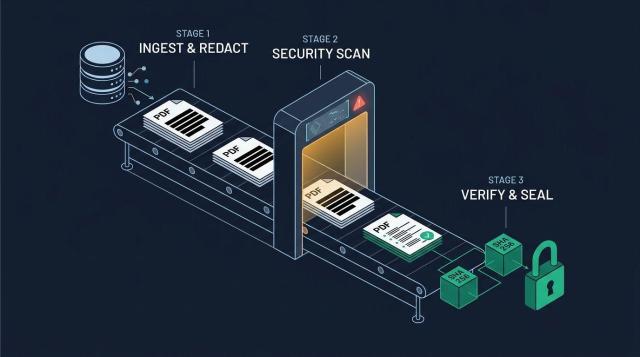
Most engineering teams will not merge a one-line change without SAST, secret scanning, and a green regression suite. Yet the same organizations routinely generate legally binding, digitally signed PDF exports straight from production databases with no automated gate between the render step and the signature.
What Broke in an 830-Page Production Export
Answering a data access request under GDPR Article 15, a major digital platform shipped "Anlage 1": an 830-page PDF generated with Aspose.PDF for .NET 20.8 and signed with a Qualified Electronic Signature (QES). PhishDestroy's open-source TgWitness forensic study published a publicly reproducible analysis of the artifact, and it reads like a textbook post-mortem.
Redaction was implemented as 1,044 solid black vector rectangles drawn over an intact text layer. Nothing underneath was removed. Running pdftotext (or pressing Ctrl+A in any viewer) recovers 905,672 plaintext characters, including usernames and complaint texts belonging to more than 1,800 unrelated third parties.
The build window is equally telling. Correspondence referenced a month of manual sanitization, but the PDF's creation and modification timestamps span 36 seconds, from 19:58:05 to 19:58:41. Timestamps do not capture upstream preparation in other systems, so they cannot disprove earlier review work. They do show that the final 830-page artifact was emitted in a single run, and the surviving text layer shows that run passed through no automated text-layer verification gate.
The leaked layer also exposed data quality problems. A complaint table of 1,995 rows had 50 visible rows, 1,944 covered, and 1 blank. Across all rows, a broad profile-related category accounts for 1,148 (57.5%) and a security/account-hijacking category for 312 (15.6%). Of the 50 visible rows, 43 (86%) come from the security category and zero from the majority category. The hypergeometric probability of a random 50-row sample containing 43 or more security rows is roughly 6.2 × 10⁻²⁹. That establishes non-random selection. It does not establish motive: a filter predicate, a category-scoped query, or a manual choice could each produce it.
There is also a timeline mismatch. Visible August 2025 entries mention suspicious account activity or password changes, while the Login History in the same PDF stops in May 2025 and the Security History on page 830 records the last password change in July 2024. Page 830 is itself covered by a black rectangle. The file alone cannot determine whether the logs were truncated or the reports were inaccurate.
QES catches none of this. A qualified signature attests to two properties: the identity of the signer and the integrity of the bytes after signing. It says nothing about whether the content is complete, consistent, representative, or actually redacted. Whether the leak engages security-of-processing duties under Article 32 or notification duties under Article 33 is an open legal question for regulators and courts. The engineering question is simpler: why did nothing in the pipeline fail?
Four Automated Pipeline Gates Before Any Export Gets Signed
Treat every regulated export as a release artifact. Signing is the deploy step, not the test step.
- Run a text-layer leak gate. Extract the candidate artifact with
pdftotext -layout export.pdf -and match the output against two lists: every token the redaction step claims to have removed, and third-party patterns such as foreign user IDs, email addresses, handles, and complaint text keyed to other subjects. Any hit fails the build. This check costs seconds of CI time and would have stopped all 905,672 characters from shipping. - Enforce a structure and revision gate. Redaction belongs in the data layer, before rendering, so the renderer never receives a third-party value at all. On the output side, reject overlay-only redactions by flagging filled rectangles that intersect extractable text runs. Inspect
pdfinfooutput and the cross-reference tables (qpdf --show-xrefhelps) to confirm the unsigned candidate is a single full rewrite, not an incremental update that appends new objects while keeping the originals in earlier revisions. Run this before signing, since the signature itself is normally appended as an incremental update. - Add a cross-section consistency gate. Parse the rendered sections back into structured data and compare date ranges across login logs, security events, and complaint tables. A complaint alleging a password change in August 2025 against a security log whose last password change is July 2024 is a failing assertion, not a footnote. Then run a distribution sanity check: compare per-category counts in the visible output against the source query and fail if the divergence is statistically implausible (a hypergeometric or chi-square test with a strict threshold) unless the manifest declares a filter that explains it. Truncated logs and skewed selections become build failures instead of discoveries made by the recipient.
- Finish with a cryptographic verifiability gate. Physically delete third-party bytes and replace each removed field with a salted commitment
c = SHA-256(salt || value), using a fresh 16-byte random salt per field so short values like usernames cannot be brute-forced from the hash. Generate a manifest listing the SHA-256 hash of every output file, the filter predicates applied, and per-category row counts before and after filtering, then sign it. Seal the original values and their salts in an escrow envelope (OpenPGP, or RSA-OAEP-256 wrapping an AES-256-GCM key) encrypted to the public key of the supervisory authority or court, decryptable only with their private key. The data subject gets verifiable commitments, the regulator can check any commitment on demand, and the data controller cannot silently alter what was withheld.
Why This Is Ready to Deploy Today
None of these gates requires new tooling. pdftotext and pdfinfo ship with Poppler and run in any CI container. SHA-256, AES-256-GCM, and RSA-OAEP are available in every major cryptographic library.
The escrow side already exists as well. In Germany, the Federal Commissioner for Data Protection and Freedom of Information (BfDI) and state data protection authorities publish OpenPGP keys, and courts operate end-to-end encrypted EGVP over the OSCI protocol. Encrypting an escrow envelope to a regulator's published key is a pipeline step, not a research project.
A QES proves who shipped the artifact and that nobody touched it afterward; it does not prove the artifact was fit to ship. If a pull request cannot merge without passing its checks, a legally binding export should not get a signature without passing its own.