Operations | Monitoring | ITSM | DevOps | Cloud

The Hidden Tax of Complexity: Why Modern Environments Cost More Than Leaders Realize

Enterprises rarely notice the moment complexity begins to reshape their environment. Growth initiatives move forward. New cloud services are adopted. Modernization programs introduce new architectures. Business units implement tools that solve immediate problems. Acquisitions add their own ecosystems. Each change is logical in isolation. The cumulative effect becomes something else entirely.

The Cognitive Ceiling: Why Modern Environments Outgrew Human Interpretation

For more than a decade, organizations invested in tools and telemetry with the belief that more visibility would create more control. Monitoring expanded across cloud, application, network, and infrastructure layers. Observability platforms entered the mainstream. Automation tools promised faster detection and improved coordination. Yet despite these advancements, incidents are not easier to understand. War rooms still fill with conflicting interpretations. Signals generate more questions than answers.

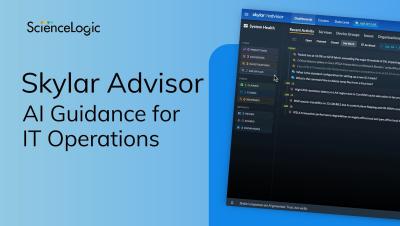
How Does Skylar Advisor Cut Alert Noise?

What if you could start your day without hundreds of alerts? Skylar Advisor transforms noisy event streams into a short list of prioritized advisories by grouping related alerts and signals together. It shows what is happening in your environment, explains why it matters, and provides clear next steps so instead of chasing alerts, IT teams get guidance focused on real operational impact.

How GDIT Automated Early Response to Preserve Critical Event Context

In this video, Jason Boig, Solutions Engineer at GDIT, shares how his team uses ScienceLogic to streamline network infrastructure monitoring and improve response times. Instead of relying on manual processes after an alert is triggered, ScienceLogic helps automate the initial response and capture critical data the moment an event occurs. This ensures nothing is lost as conditions change and gives teams immediate visibility into issues.

The Hidden Crisis in Modern IT: Interpretation Risk

Technology leaders spent the past decade investing heavily in visibility. They expanded monitoring footprints, adopted cloud-native observability tools, integrated analytics dashboards, and layered on automation intended to streamline detection. Every addition promised deeper insight. Every initiative aimed to bring clarity to increasingly complex environments. Yet operations feel more chaotic, not less. Outages move faster. Incidents cross more boundaries. Signals appear without context.

Why Generic AI Fails in Ops: What Trustworthy Actually Requires

Enterprise operations reached a point where complexity outpaced human interpretation and outgrew the capabilities of generic AI. As environments became more distributed and interdependent, every incident, anomaly, and degradation produced ripple effects across systems that require context, lineage, and reasoning. Yet most AI models were not built for this reality. They were trained for general knowledge tasks, not the deeply connected operational truths that define enterprise performance.

Bring Clarity and Confidence Back to Ops: How Trustworthy Guidance Sets a New Standard

For years, enterprises have chased the promise of artificial intelligence as a remedy for growing operational complexity. It seemed logical that if environments were expanding faster than teams could keep up, smarter models could fill the gap. But early deployments of generic AI proved a difficult truth. Intelligence alone does not create operational clarity. It does not guarantee safety.

The Speed of Clarity: How Grounded Context Transforms Triage and Strengthens Operational Decision-Making

Modern operations move at a pace that leaves little room for ambiguity. When an incident emerges, teams must determine what is happening and how best to respond. Yet triage often slows under the weight of fragmented data, noisy alerts, and limited shared understanding across engineering groups. These conditions stretch routine issues into drawn-out investigations and delay action exactly when teams need to move with purpose.

Enabling Proactive ITOps with Skylar Advisor

By continuously connecting signals across your IT environment, Skylar Advisor turns operational complexity into clear, prioritized guidance. It highlights potential impact, explains why it matters, and delivers clear next steps so IT teams can act early and stay ahead of alerts before they turn into issues.

The Accountability Era: Decision Paths That Stand Up to Review

Modern IT environments depend on decisions that can withstand scrutiny. As systems grow more interconnected and outages carry greater cost, organizations must understand not just what actions teams take, but how those actions were formed. Operators need guidance anchored in evidence and aligned with business impact. Operational accountability now extends beyond correctness. Teams must show the information that shaped the decision, the options considered, and the reasoning behind the chosen path.