
Operations | Monitoring | ITSM | DevOps | Cloud

The latest News and Information on APIs, Mobile, AI, Machine Learning, IoT, Open Source and more!

The hard part of AI root cause analysis is no longer the model

Every few weeks someone tells me root cause analysis is a solved problem now: pipe your telemetry into an LLM, let it tell you what broke. I wish it were that easy. After years on this, I think "can AI do RCA?" is the wrong question, because doing RCA with an LLM is really two separate jobs, and the answer is different for each. They break in completely different ways, so it's worth pulling them apart.

From a $28,000 AI Bill to $0.60 Per Ticket

Engineering teams are burning through AI budgets with nothing to show for it — $100M across 10,000 engineers and no cost per run, no cost per outcome, just a number that keeps climbing. When it runs dry, your infrastructure upgrade gets cut. Harness ties every AI token to the outcome it created: cost per run, cost per resolved ticket, and anomaly detection before the invoice hits. One customer went from a $28,000 black box bill to $0.60 per ticket.

The Journey to Achieving Hyperscale Availability with AI-Driven Prediction

At hyperscale, a regional cloud outage is not merely a technical disruption—for Samsung Account, which serves 2.1 billion users across three global regions, it is an immediate global service crisis. Fragmented, region-siloed monitoring creates blind spots that make early detection nearly impossible, leaving SRE teams perpetually reactive rather than predictive. The path to proactive reliability requires both a philosophical shift and a foundational change in how observability data is collected, unified, and reasoned over.

Building an AI Ready Data Backbone: Dima Kan at AICamp 2026

The Aiven Platform is more than a collection of open source services for streaming, storing and analyzing data. The platform ensures that all services run reliably and securely in the clouds of your choice, are observable, and can easily be integrated with each other and with external 3rd party tools.

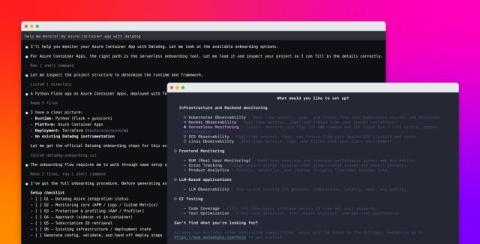
Debug and evaluate your AI app from your coding agent with Datadog Agent Observability

Coding agents like Claude Code, Cursor, and Codex CLI handle the coding parts of building an AI application well. The harder work comes after: understanding why a response went wrong, building eval sets that reflect real production behavior, and keeping up with an application that changes faster than any one-off script can. Teams spend 60–80% of their time on evaluation and error analysis, and much of that work needs to be redone every time the stack shifts.

5 pitfalls to avoid when measuring DevEx in the AI era

Developer experience, commonly known as DevEx, describes how an organization’s systems, workflows, tools, and culture affect developer productivity. A positive DevEx leads to tangible organizational benefits, including faster releases, increased innovation, and reduced technical debt. Measuring DevEx enables engineering management to quantify their team’s impact and understand where to direct improvement efforts.

Datadog acquires Adaptive ML

Off-the-shelf models are easy to deploy, but they are rarely enough to solve complex, domain-specific challenges in production. The key to sustained AI value is not in the models themselves but in the ability to tune, evaluate, and refine those models against your organization’s real-time signals. We are excited to announce that Adaptive ML is joining Datadog to accelerate this vision by combining our deep observability data with their expertise in building specialized, high-performance AI agents.