Operations | Monitoring | ITSM | DevOps | Cloud

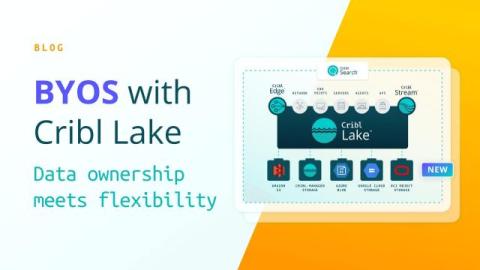
BYOS with Cribl Lake: Data ownership meets flexibility

Today, more than ever, organizations face a difficult balancing act: how to keep sensitive data fully under their control while still making it accessible and usable so teams can unlock the value and insights they need. Industries such as financial services, healthcare, and government agencies often must comply with strict regulations that require data to remain in environments they directly own and manage.

Cribl.Cloud Government Is a New Era of Secure Cloud Telemetry for Federal Agencies

As a Co-founder and CPO at Cribl, I'm genuinely stoked that our new federal suite, Cribl.Cloud Government, has achieved an “In Process” designation under the Federal Risk and Authorization Management Program (FedRAMP). This isn’t any old milestone. We’re bringing all of Cribl’s kickass capabilities to government agencies, even those that require the strictest compliance and security standards. Because, who doesn’t love a good set of rules?

Cribl to the rescue for SIEM migrations

Your security teams face escalating data volumes, vendor changes, and cost pressures when they migrate between SIEM platforms. Cribl simplifies these migrations by giving you flexible data routing, reducing storage costs, and accelerating time-to-value. How? Let’s look at how a global customer used Cribl Stream to migrate CrowdStrike FDR logs from Splunk to Microsoft Sentinel efficiently and cost-effectively.

How to Monitor NVIDIA GPU Metrics with Cribl Edge & Stream (Complete Tutorial)

If you’re running AI, ML, or data-intensive workloads on GPUs, monitoring their performance is critical. Overheating, under-utilization, or memory bottlenecks can cost you thousands in cloud bills and potential downtime. This guide walks you through collecting real-time GPU telemetry using nvidia-smi, sending it to Cribl Edge, routing it through Cribl Stream, and using Cribl Search to analyze the data—step by step.

Introducing Cribl Guard

Does sensitive data flowing through your network feel like a ticking time bomb? Well, it just might be. Legal mandates, security frameworks, and customer expectations have made the stakes higher than ever. One leaked spreadsheet of personally identifiable information (PII) can wipe out years of customer trust, rack up regulatory fines, and invite ransomware actors to your doorstep.

Confessions of a CTO: How we Tamed our Cloud Costs

If you’ve ever found yourself staring at a cloud bill that could buy a small island or at least a very nice car, you're not alone. Believe me, at Cribl, we've had our share of those "molotov cocktail" bills that make our CFO, Zach, look like he's about to spontaneously combust. And yeah, a few F-bombs might have dropped from various senior leaders (myself included, I won't lie).

Mastering Global Telemetry: How Cribl Puts You in Control

Let’s face it: managing global data infrastructure isn’t just hard, it’s “I-just-deployed-the-wrong-config-to-prod-again” hard. If you’re a Cribl Admin or Operator working across clouds, continents, and compliance regimes, your to-do list probably reads like a series of increasingly desperate Post-it notes. Sources. Destinations. Pipelines. TLS settings. Proxies. Dev, staging, prod. Repeat. Forever. But what if we told you there’s a better way?

Why Cribl Copilot Editor is Built for the Human, First and Foremost

I’m genuinely excited about what we're rolling out with Copilot Editor, an update to our AI that’s truly packed with new capabilities designed to help you automate pipeline development. You can read about these capabilities here. I wanted to take a moment to share our thinking on a core principle that guides how we build, especially regarding the impactful, and sometimes daunting, world of generative AI.

Map, Transform, Filter: How Copilot Editor Helps Teams (and Their Pipelines) Have It All

Ever spent a week wrangling log pipelines just to get your SIEM to stop screaming about missing fields? Wasted way too much time stripping out noisy events and reformatting data for analytics? You’re not the only one. If you work in Security or ITOps, you know the pain: every new data source means another round of schema headaches, more manual mapping, endless field transformations, and a quick prayer that you didn’t break something critical (or let in a flood of junk events).