Operations | Monitoring | ITSM | DevOps | Cloud

Data Gravity in Cloud Networks: Achieving Escape Velocity

In an ideal world, organizations can establish a single, citadel-like data center that accumulates data and hosts their applications and all associated services, all while enjoying a customer base that is also geographically close. As this data grows in mass and gravity, it’s okay because all the new services, applications, and customers will continue to be just as close to the data. This is the “have your cake and eat it too” scenario for a scaling business’s IT.

Exploring Your Network Data with Kentik

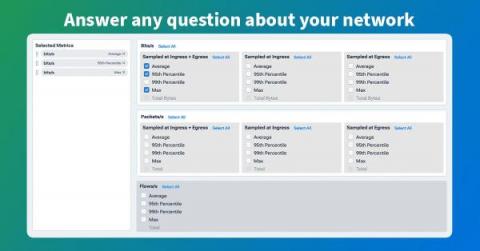
In this short video overview, Kentik’s Phil Gervasi explains how the Kentik Data Explorer lets network engineers (including network systems, cloud security and SREs) ask any question about their networks and explore the tremendous amount and variety of network telemetry being collected. Phil talks about the various types of network telemetry you can explore, the many dimensions of that data that can be filtered and analyzed, and gives a quick tour of the Data Explorer interface.

Digging Into the Recent Azure Outage

In the early hours of Wednesday, January 25, Microsoft’s public cloud suffered a major outage that disrupted their cloud-based services and popular applications such as Sharepoint, Teams, and Office 365. Microsoft has since blamed the outage on a flawed router command which took down a significant portion of the cloud’s connectivity beginning at 07:09 UTC.

Best Practices for Enriching Network Telemetry to Support Network Observability

Network observability is critical. You need the ability to answer any question about your network—across clouds, on-prem, edge locations, and user devices—quickly and easily. But network observability is not always easy. To be successful, you need to collect network telemetry, and that telemetry needs to be extensive and diverse. And once you have that raw telemetry data, you need to interpret it.

Understanding the Advantages of Flow Sampling: Maximizing Efficiency without Breaking the Bank

The whole point of our beloved networks is to deliver applications and services to real people sitting at computers. So, as network engineers, monitoring the performance and efficiency of our networks is a crucial part of our job. Flow data, in particular, is a powerful tool that provides valuable insights into what’s happening in our networks for ongoing monitoring and troubleshooting poor-performing applications.

Cuba and the Geopolitics of Submarine Cables

This week marks a decade since the ALBA-1 submarine cable began carrying traffic between Cuba and the global internet. On 20 January 2013, I published the first evidence of this historic subsea cable activation which enabled Cuba to finally break its dependence on geostationary satellite service for the country’s international connectivity. ALBA-1 was one of my first lessons on how geopolitics can shape the physical internet.

Kubernetes and the Service Mesh Era

Kubernetes is a game-changer for enterprise organizations. Automating deployment, scaling, and management of containerized applications allows organizations to embrace a cloud-native paradigm at scale and more easily employ best practices, such as microservices and DevSecOps. But as with all tech, Kubernetes has its limits. Kelsey Hightower famously tweeted that “Kubernetes is a platform for building platforms. It’s a better place to start; not the endgame.”

The Reality of Machine Learning in Network Observability

For the last few years, the entire networking industry has focused on analytics and mining more and more information out of the network. This makes sense because of all the changes in networking over the last decade. Changes like network overlays, public cloud, applications delivered as a service, and containers mean we need to pay attention to much more diverse information out there.