Operations | Monitoring | ITSM | DevOps | Cloud

Resilience Talks with Somerford: The State of Observability 2024

In 2024, simply having an observability practice is a given. Organisations with leading programs create incredible digital experiences, innovate faster and drive resilience. Our latest research reveals that observability leaders deliver more productivity and value than their peers — achieving a 2.67x annual return on their observability solutions.

Splunk's Path Towards Achieving FedRAMP Moderate Authorization for Splunk Observability

Splunk continues to partner with government agencies on their digital transformation journeys to help deliver their missions and provide faster and more intelligent services. We are committed to the success and support of the security requirements of our public sector customers, and I am thrilled to share the latest strategic investments Splunk is making to expand our FedRAMP program to include Splunk Observability Cloud for government customers.

A Taste of Observability - Embrace the Cloud With OpenTelemetry

Join Splunk Observability expert Kirk O'Quinn and Monster CICD Lead Graham Bucknell for a conversation on OpenTelemetry (OTel), a powerful open-source project that is transforming how we monitor and trace applications. In this informative session, we will delve into the world of Otel, exploring its history, its roadmap and we will discuss lessons, and success/failures of “Companies” journey to OpenTelemetry.

State of Observability 2024 Reveals How Leaders Outpace Their Peers

In 2024, simply having an observability practice is a given. In this era of observability, a high-functioning team will set leaders apart from their peers. Leading observability practitioners don’t fix issues by putting hundreds of people into a virtual room, or frantically messaging in a temporary Slack channel to find root causes. Because leaders embed observability into their development practices early, a feature launch is a quiet non-event.

What is Data Center Colocation (Colo)?

As IT costs continue to balloon, many organizations are caught between the desire to scale and the pressure to cut costs. It’s an incredibly delicate balancing act leaders struggle to maintain: while 66% of companies in one study said they plan to increase their IT budgets, 84% were worried about a recession, while 63% struggled to secure IT talent. By spending on infrastructure, organizations are forced to spend less on innovation. But what if there is a way to have both?

What is Digital Experience Monitoring?

Digital experience monitoring (DEM) is the evolution of application performance monitoring (APM) and end user experience monitoring (EUEM) into a comprehensive tool that analyzes the efficacy of an enterprise’s applications and services. Essentially, DEM combines these functions and goes beyond both — all to ensure consistency across the customer experience.

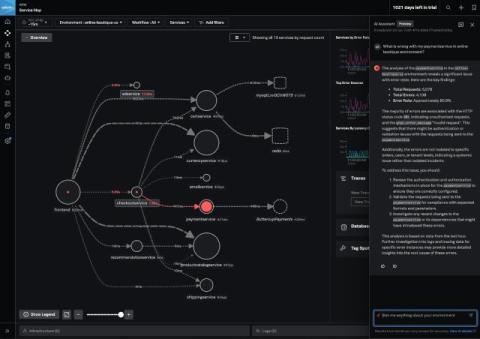
Troubleshooting Microservices with Splunk Observability Cloud and the AI Assistant for Observability

In this video, I’m going show you how to troubleshoot microservices in Splunk Observability Cloud using features like APM’s Service Map and Tag Spotlight to identify what’s causing our microservice to produce high error rates. We’ll then review Related Logs in Log Observer to determine why the error in our service is occurring.

Introducing the Observability Center of Excellence: Taking Your Observability Game to the Next Level

Chasing false alerts — or worse, having your system go down with no alerts or telemetry to give you a heads-up — is the nightmare we all want to avoid. If you’ve experienced this, you’re not alone. Before joining Splunk, I spent 14 years as an observability practitioner and leader for several Fortune 500 companies and in my 2.5 years with Splunk I have had the opportunity to work with customers of all shapes and sizes.