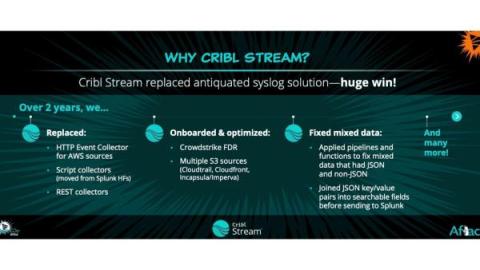
In this livestream, I talked to Ryan Saunders – Manager of Security Operations at SpyCloud, about how he used the Cribl Reference Architecture to build a scalable deployment. He explained how this approach enabled SpyCloud to grow alongside its evolving needs without requiring significant rework. The reference architecture also facilitated a repeatable data-onboarding process, reducing administrative time and allowing the team to focus on critical security and data analysis tasks.
In an era where cybersecurity threats are not just frequent but increasingly sophisticated (and becoming more costly), the need for robust defense mechanisms has never been more critical. Security Information and Event Management (SIEM) emerges as a cornerstone in this complex data environment. It’s not just another tool in your cybersecurity toolkit; it’s a solution designed to elevate your organization’s security posture.
In this Livestream conversation, I spoke with John Alves from CyberOne Security about the struggles teams face in modernizing a SIEM, controlling costs, and extracting optimal value from their systems. We delve into the issues around single system-of-analysis solutions that attempt to solve detection and analytics use cases within the same tool.
In an era where industry standards are as dynamic as the data they govern, Cribl’s core value of putting ‘Customers First, Always’ drives us to stay ahead of the curve. It’s with immense pride and excitement that we announce our strategic partnership with Elastic. This alliance isn’t just a meeting of minds; it’s a bold stride towards a future where flexibility in data management isn’t just a luxury – it’s the standard.
Wow, can you believe it’s been a year since we announced Cribl Search and redefined the search process for observability and security data? Even though the product is just wrapping up its first year, Cribl Search has achieved unrivaled growth in both user adoption and expansion of product capabilities. Why?
Datadog is a monitoring and analytics tool for information technology (IT) and DevOps teams that can be used to determine performance metrics as well as event monitoring for infrastructure and cloud services. The software can monitor services such as servers, databases, tools, and applications. Cribl Stream makes it easy to move data from anywhere, to anywhere. We take the saying to heart, and we also allow you to send our Cribl application metrics anywhere.
This blog demonstrates how to create “inputs” to Cribl Search dashboards. An Input is a control widget that we can add to our Dashboards to control how they execute. They allow the user to supply a range of inputs to customize one or many of the Searches in each of the panels on a given dashboard. Currently, there are four types of inputs: a time picker, a dropdown, a string, and a number. This blog shows how to create all four types of Inputs on a dashboard using built-in sample data.