Operations | Monitoring | ITSM | DevOps | Cloud

Scaling faster and predictable cloud bills with Civo's FlexCore

How does Defense.com scale its SaaS security platform while keeping costs predictable? CEO Oliver Pinson-Roxburgh explains why Civo’s FlexCore was the only choice. FlexCore is engineered to deliver massive scalability and high performance, as milliseconds matter for real-time threat analysis, while ensuring UK Data Sovereignty and Compliance (ISO 27001). Crucially, FlexCore offers predictable pricing, eliminating the sudden, massive bills of larger providers. FlexCore delivers on-prem performance with public cloud scaling and simplicity.

The cloud the way you want it: Introducing cloud parity

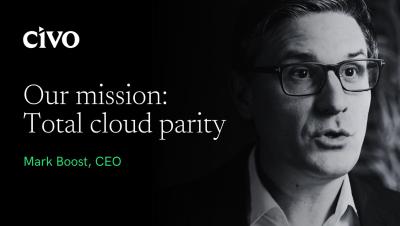
For decades, there have been two incompatible worlds in cloud: Public (AWS, Google, Microsoft) and Private (VMware, Nutanix). Moving between them meant throwing everything away and re-architecting your systems. Civo is rewriting that script. This final thought from the Civo keynote at Civo Navigate London 2025 introduces Cloud Parity: the elimination of the public/private gap. It's just one way of working, with the same product, same API, and same support.

What is cloud parity? The future of flexible and sovereign cloud computing

Back in 2024, I officially put a name to a concept at Civo we had been developing for many years. I called it cloud parity. When Civo was incepted, two completely different worlds existed, the public cloud dominated by Amazon, Microsoft and Google, and the private cloud dominated mainly by VMware.

Cloud cost crisis: 90% of Indian businesses face unexpected bills

Cloud promised simplicity. Instead, Indian businesses are paying for surprises! This video reveals key findings from our Cost of Cloud 2025 research, which exposes a massive cloud cost crisis for Indian organizations: The issue isn't cloud adoption, it's a lack of clarity, predictability, and control. Civo is built for the future: simple, predictable, locally compliant cloud.

Data control with CivoStack Enterprise: Beyond the air-gap debate

When an organization talks about sovereignty it is usually about where its data lives, who can touch it and how it is protected. Adding air‑gap to the discussion often turns the conversation into a binary: either the system is completely cut off from the outside world or it isn’t. In practice the reality sits somewhere in between.

Digital sovereignty: US sanctions and the control of European cloud

"There's a big potential kill switch sitting on his desk." This clip from our Digital Sovereignty Panel exposes a fundamental threat: how US geopolitical interests can compel cloud providers like Microsoft to suspend services, even for international organizations. Panelist Johan David Michels discusses the shocking case of the ICC prosecutor, Karim Khan, whose work email was withdrawn by Microsoft following US sanctions. This illustrates the fundamental lack of digital sovereignty over data hosted by US hyperscalers.

How generative AI solves healthcare's 1% carbon footprint

The healthcare industry accounts for 1% of the global carbon footprint, and a single PET CT scan can generate 60kg of CO₂! Regent Lee, Professor at the University of Oxford and moonshot engineer, reveals how Civo-powered Generative AI is transforming radiology. His team's solution eliminates pharmaceutical contrast injections, digitally displacing the pollution. This technology makes radiology safer, more efficient, and significantly greener for the environment. Sustainability in healthcare is non-negotiable.

Free cloud credits: Why your architecture gets lazy and bloated

This is the uncomfortable truth about cloud credits: Short-term savings mask crippling long-term costs. Taken from our recent webinar, Civo CCO Simon Hansford and Canopy Founder James Marks expose the primary concerns of the credit model. Credits act as a dangerous incentive for architectural laziness. When cost isn't a factor, you stop designing for efficiency, leading to bloated, inefficient infrastructure and the inevitable bill shock.

The AI Workload Punishes Bad Habits

The AI workload presents the ultimate challenge, highlighting the structural limitations of the traditional hyperscaler model. In this segment from a Civo Navigate London 2025 session, Kelsey Hightower explains exactly why AI adoption forces enterprises to confront flawed architecture and rising astronomical costs. When specialized hardware is scarce and rented GPUs sit idle at a premium, it’s clear that traditional cloud providers were not built for this era. Data that didn't move is forcing organizations to move compute back to where it lives.