Operations | Monitoring | ITSM | DevOps | Cloud

Higher Education and the Persnickety Network: How Monitoring Comes to the Rescue

Colleges and universities face immense IT challenges. The end user base is regularly overturning with students coming and going. And residential students are just part of the problem. Increasingly, schools support extensive distance learning, which only gained ground thanks to COVID. Now that remote work and distance learning are the new mandates, there are even more difficult challenges for Higher Education IT to deal with.
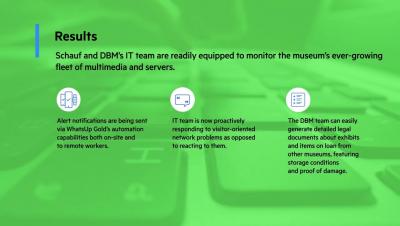
Deutsche Bergbau-Museum Bochum

The Deutsche Bergbau-Museum Bochum (DBM), or the German Mining Museum, is one of the premier locations to show those interested in the history of mining. Over its 100+ years of operation, the DBM has evolved its exhibits to use multimedia players and other digital devices connected to its network. However, the museum’s three-person IT staff faced a series of problems, including a lack of insight into where network outages occurred and no alert notifications. After working alongside P&W Netzwerk, DBM deployed Progress WhatsUp Gold to manage the broad network environment cost-effectively.

Best Practice Series: Securing the Monitoring System

Network security makes the headlines at least once per day – and usually for the wrong reasons. In today's world, ensuring and maintaining a secure deployment is of utmost importance. Did you know that WhatsUp Gold provides several important security features that you can configure and manage to maintain a secure deployment? These features can help you to defend against unauthorized access to the WhatsUp Gold server as well as to devices monitored by WhatsUp Gold.

What is Network Bandwidth? How to Measure and Optimize Bandwidth for Fast, Smooth Traffic Flows

Many think they know what network bandwidth is but conflate performance with capacity. This blog, among other things, will end that confusion. And for true IT experts, we’ll dive deep into the whys and wherefores of network bandwidth monitoring and optimization.

K-12 and Network Monitoring: Solving IT Mysteries, Meeting Challenges

To say that K-12 school systems have challenges is an understatement. COVID forced schools to make a dramatic turn towards remote learning, which meant the network was anything but insular, forcing IT to efficiently support thousands of new remote endpoints. That is on top of other K-12 network challenges. Issue number one: tight budgets. Most school systems are tight for cash, especially after the financial stresses of COVID and all the millions spent on PPE.

Looming 2022 (and Beyond) Network Security Threats

Every year hackers grow in numbers, aggressiveness, organization, and sophistication. And every year there are new attack types and new areas of IT infrastructure that cybercriminals target. 2022 is no different. We are about a third of the way in already and IT pros and security specialists already have their hands full with new attacks and new issues.

Avoid IT's Worst Nightmare by Monitoring Proactively - Not Reactively!

The day-to-day operations of a business rely on having a top-of-the-line network performance. Customers, employees, managers and business partners require fast access to applications, services and data. When bottlenecks or security breaches occur, identifying these threats immediately is an absolute must. Monitoring networks is necessary for IT departments, but doing so effectively is an even more significant challenge.

Network Monitoring Safety Checklist-5 Steps to Take

Network monitoring is a vital part of your security architecture and layered security portfolio. Step one in your network monitoring safety checklist is making sure you have network monitoring in the first place. The rest of our steps assume you have network monitoring and lay out five ways to optimize its value.

How Network Monitoring Defuses Hacker Bombs

You know by now that hackers literally never sleep. Chances are your network has been hit before and absolutely will be hit again. Hackers invent new techniques every day and tweak existing ones, many of which are automated—which is why we can say that hackers literally never sleep. Hackers either attack your network directly or attack your infrastructure through your network. Either way, the network itself is your first line of defense.