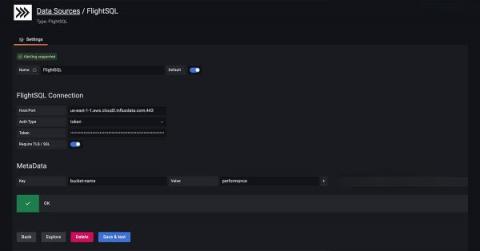
How to Connect Grafana & InfluxDB IOx
This article was originally published on Medium.com and is reposted here with permission from the author. Trying to connect Grafana & InfluxDB IOx? Follow this tutorial to learn how.


This article was originally published on Medium.com and is reposted here with permission from the author. Trying to connect Grafana & InfluxDB IOx? Follow this tutorial to learn how.
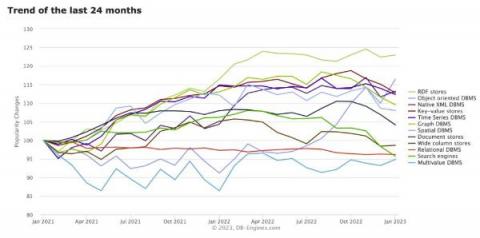
Databases are often the biggest performance bottleneck in an application. They are also hard to migrate from once being used in production, so making the right choice for your application’s database is crucial. A big part of making the right decision is knowing what your options are. The database landscape has been changing rapidly in the past few years, so this article will try to simplify things for you by going over the following topics.
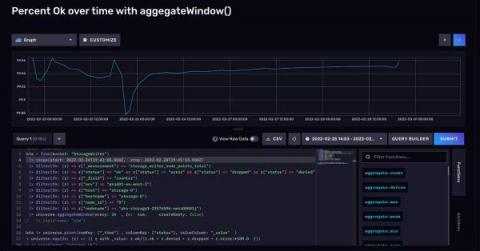
A look at how to use Flux for data cleansing and analytics through the browser and via Visual Studio. Time series data is data you want to analyze and monitor over time. For example, you might want to know the water levels over the course of the day for a plant, or how much sunlight it receives and when. This is a simple but easy-to-understand example. Obviously on a larger scale the stakes can be higher.
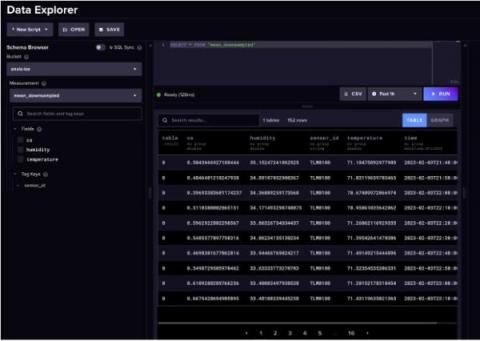
InfluxDB Cloud, powered by IOx, is a versatile time series database built on top of the Apache ecosystem. You can query InfluxDB Cloud with the Apache Arrow Flight SQL interface, which provides SQL support for working with time series data. In this tutorial, we will walk through the process of querying InfluxDB Cloud with Flight SQL, using Pandas and Jupyter Notebooks to explore and analyze the resulting data, and creating interactive plots and visualizations.
Manufacturing and industrial organizations are firmly in the era of Industry 4.0. The third wave of industrial revolution, which saw the introduction of computers, robots, and automation in industrial processes, has given way to instrumentation, and the use of advanced technologies, like machine learning (ML) and artificial intelligence (AI), using both raw and trained data, to enhance industrial processes.
This article was originally published in InfoWorld and is reposted here with permission. The compactor handles critical post-ingestion and pre-query workloads in the background on a separate server, enabling low latency for data ingestion and high performance for queries. The demand for high volumes of data has increased the need for databases that can handle both data ingestion and querying with the lowest possible latency (aka high performance).
In industrial operations, time is money. The more efficient processes and machinery are, the better it is for business. Providing proactive monitoring and maintenance of industrial machines, however, is not an easy task. This is especially true as these machines become increasingly complex and distributed. It’s not possible to have maintenance crews on site for every asset in a distributed system. The edge is where the physical world meets the digital world.
SAN FRANCISCO – March 21, 2023 – InfluxData, creator of the leading time series platform InfluxDB, today announced it has received the ISO/IEC 27001:2013 certification, a globally recognized standard for Information Security Management Systems (ISMS). The certificate scope comprises the ISMS supporting the operations underlying the InfluxDB database cloud and enterprise offerings. It also includes ISO/IEC 27018:2019 compliance for the protection of personally identifiable information.
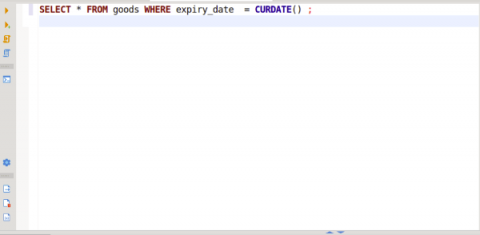
SQL databases have several functions that reduce the complexity of working with date and time. Using these functions and a date and time type column, you can depend on SQL for the logic to write and read data with date and time. In this post, you’ll learn how to use the SQL date and time functions to get the current date and time.