As digital transformation highlights the importance of data protection in India, data sovereignty has become essential for businesses to secure digital assets and meet local regulations. In a world where data security, privacy, and regulatory compliance are top priorities, sovereign cloud solutions have emerged as vital for safeguarding digital operations. Civo is addressing these needs by launching the Civo India Sovereign Cloud.
Managing Kubernetes clusters has always been a significant challenge. AWS’s recent announcement of EKS Auto Mode aims to simplify this by automating key operational tasks like compute scaling, networking, and storage management. While it’s a step forward for reducing complexity, it doesn’t address all the unique needs of growing startups and mid-sized companies.
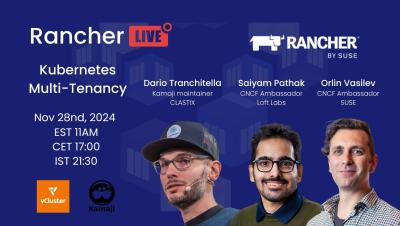
Join us to discover and discuss the challenges with Kubernetes Multi-Tenancy. @Orlin Vasilev will be joined by two esteem Cloud Native contributors - Saiyam Pathak from Loft Labs(vCluster), CNCF Ambassador and Dario Tranchitella from CLASTIX, Kamaji Maintainer.
As Kubernetes continues to dominate the container orchestration space, the need for robust CI/CD tools to streamline deployment workflows is greater than ever. With a plethora of options available, choosing the right CI/CD platform can significantly impact the efficiency and scalability of your DevOps pipeline. In this blog, we’ll explore the top Kubernetes CI/CD tools in 2025 and why RazorOps is a standout choice.
As a DevOps practitioner with over a decades of experience, I have witnessed the evolution of this domain from its nascent stages to becoming a critical aspect of modern software delivery. As we look forward to 2025, the DevOps ecosystem is poised for significant transformation, driven by technological advancements, organizational shifts, and the growing complexity of software systems. Here are the top 50 trends that I believe will shape the future of DevOps in 2025.
Solomon Hykes began his career as a System Administrator at Fairgame in 1999 and later worked as a Junior Software Engineer at the San Diego Supercomputer Center in 2002. In 2003, he became self-employed and worked as a Tech Mentor & Instructor until 2004. Solomon then joined CEIS as a Trusted Infrastructure Engineer from 2004 to 2006. Solomon Hykes then joined SmartJog as a Solutions Engineer from 2006 to 2007.
With India projected to become a US$ 26 trillion GDP economic superpower by 2047, the demand for scalable, secure, and compliant digital infrastructure has never been more urgent. As home to the world’s largest, youngest, and most digitally adept population, India's digital economy is expanding rapidly, driven by a wave of innovation and public cloud adoption.