Operations | Monitoring | ITSM | DevOps | Cloud

The latest News and Information on Containers, Kubernetes, Docker and related technologies.

Creating Memorable Gaming Experiences with Kubernetes

If you’re a gamer, you probably know how immersed you can get in your favorite game. Or if you’re the parent or partner of a gamer, you probably know what it’s like to try to get the attention of someone who is in “gaming mode.” Creating worlds and enriching players’ lives is in Ubisoft’s DNA.

10 Helm Tutorials to Start your Kubernetes Journey

The growth of Kubernetes has been stellar and K8s applications have grown in importance and complexity. Today, even configuring a single application can require creating many interdependent K8s sources that each depend on writing a detailed YAML manifest file. With this in mind, Helm as a package manager for Kubernetes is a major way users can make their K8s configurations reusable.

KMC - How Helm 3 and Helm Charts Create Reproducible Security

Helm 3 is developing a set of best practices that help make Kubernetes applications more secure. As a recent graduate from incubation to full-fledged project of the Cloud Native Computing Foundation, Helm has been developing its own ecosystem and is working towards mature tooling. Join Rancher and JFrog as they provide more details into updates in Helm 3 and how Helm Charts create reproducible security in the Kubernetes ecosystem.

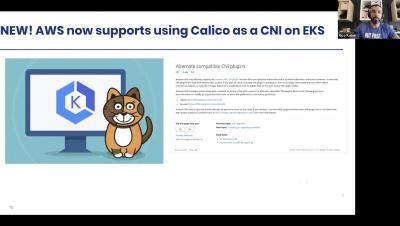
Enforcing Enterprise Security Controls in Kubernetes using Calico Enterprise

Hybrid cloud infrastructures run critical business resources and are subject to some of the strictest network security controls. Irrespective of the industry and resource types, these controls broadly fall into three categories. Workloads (pods) running on Kubernetes are ephemeral in nature, and IP-based controls are no longer effective. The challenge is to enforce the organizational security controls on the workloads and Kubernetes nodes themselves.

My first Kubernetes cluster: Amazon EKS review + tutorial

During my career, I’ve taken part in many on-call rotations and post-mortems. The longest on-call rotation I’ve ever had — no breaks, vacations, or holidays — lasted for a whopping 2.5 years at Lucid Software. I’m jaded. I strongly prefer stability to tinkering with shiny new toys. Very few software engineers start this way, but enough of them make the transition after having been bit enough times by a bad release.

Civo Community Meetup #2: CI/CD focus w/ Sam Weston and Johannes Tegnér

For our second community meetup we focussed on using Civo for CI/CD through GitOps and Github actions for cloud native application development This installment featured talks from our CTO Andy, our Developer Advocate Kai, and guest talks from community members Sam Weston and Johannes Tegnér. The talks touched on a wide variety of topics within CI/CD, from automating builds to monitoring and observability. Here's what was on the agenda...

Automate registry scanning with Harbor & Sysdig

Discover what registry scanning is, how it helps with shifting security left, and how you can implement it using Harbor and Sysdig. Shifting security left is all about moving security to the earliest possible moment in the development process, dramatically improving “time to fix” and security impact. In this article, we’re going to show you how to shift left with Harbor registry and Sysdig Secure.

Calico Enterprise Multi Cluster Management - Federated Identity and Services

Learn how to simplify deployment and ongoing operations for more than one cluster running Calico Enterprise. What is Calico Enterprise Multi-Cluster Management How is Calico Enterprise Multi-Cluster architected How to set up Calico Enterprise Multi-Cluster Management How to enable Federated Endpoint Identity and Services for Multi-Cluster use cases A Calico Enterprise trial is available after this session and you will be able to practice these use cases on your own within a hosted lab.

Disaster Recovery Preparedness for Your Kubernetes Clusters

In the pre-Kubernetes, pre-container world, backup and recovery solutions were generally implemented at the virtual machine (VM) level. That works for traditional applications when an application runs on a single VM. But when applications are containerized and managed with an orchestrator like Kubernetes, this system falls apart. That means effective disaster recovery (DR) plans for Kubernetes must be designed for containerized architectures and natively understand the way Kubernetes functions.

Securely manage credentials while monitoring Kubernetes workloads with autodiscovery

In the world of containers and Kubernetes, observability is crucial. Cluster administrators need visibility into the infrastructure and cluster operators need to know the status of their workloads at any given time. And in both cases, they need observability into moving objects. This is where Metricbeat and its autodiscover feature do the hard part for you.