The latest News and Information on Containers, Kubernetes, Docker and related technologies.
Get to know the differences between cloud-native and cloud-based applications, their benefits, and why a cloud-native tool like Cloudsmith is a game-changer for efficient and secure software artifact management. The term 'cloud' has become a buzzword in the tech industry, often used interchangeably to describe anything from online storage to complex computing services. But what does it really mean? And more importantly, what does it mean for your business?
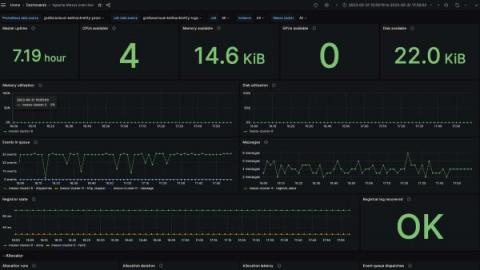
We’re excited to introduce a dedicated Grafana Cloud solution for Apache Mesos, an open-source project for managing clusters in your data center and at cloud scale. Apache Mesos is a distributed systems kernel, running on every machine in a cluster and providing easy orchestration of every resource in the cluster. This allows you to treat compute units, memory, and disk as a single pool of resources.
The Kubernetes & Cloud Native Glossary This post will provide you with an A-Z guide of terms associated with Kubernetes and Cloud Native. Through this, we have compiled a list of over 100 terms with the aim of helping you understand the terminology required to start learning about Kubernetes and Cloud Native. Back to Start.
In Part 1 of this series, you learned the core components of Kubernetes, an open-source container orchestrator for deploying and scaling applications in distributed environments. You also saw how to deploy a simple application to your cluster, then change its replica count to scale it up or down. In this article, you’ll get a deeper look at the networking and monitoring features available with Kubernetes.
In this blog post, we will explore the concept of Kubernetes topology aware routing and how it can enhance network performance for workloads running in Amazon. We will delve into topology aware routing and discuss its benefits in terms of reducing latency and optimizing network traffic flow. In addition, we’ll show you how to minimize the performance impact of overlay networking, using encapsulation only when necessary for communication across availability zones.
This July, the community spirit was profoundly vibrant in the scenic city of Munich, as Kubernetes Community Day (KCD) Munich brought together a meeting of minds and inspired the open-source collaboration we all know and love. The event was a testament to the strength and vitality of the Kubernetes community, which pulsed with an energy of shared intellectual curiosity and passion for all things Kubernetes.