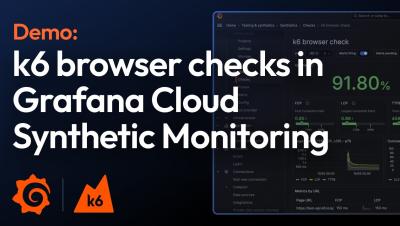
In this demo video, Virginia Cepeda, senior software engineer at Grafana Labs, walks through the k6 browser checks feature in Grafana Cloud Synthetic Monitoring.
With over 426 million active users, comprised of consumers and merchants, Paypal processes approximately 25 billion transactions valued at around $1.53 trillion USD. Paypal is shaping the future of commerce for millions of customers globally, and to do that, they use Datadog to provide timely insights into their entire stack.
In today’s complex IT environments, logs are the unsung heroes of infrastructure management. They hold a wealth of information that can mean the difference between reactive firefighting and proactive performance tuning. Log analysis is a process in modern IT and security environments that involves collecting, processing, and interpreting log information generated by computer systems. These systems include the various applications and devices on a business network.
Engineering teams are always shipping something—new services, resources, models, clusters, etc. You probably have a set of standards you expect developers to abide by when doing that work, like adequate testing, code coverage, resolution of outstanding vulnerabilities, etc. But how are you actually tracking and enforcing those standards? Without an Internal Developer Portal, you might find that to be an incredibly manual effort.
You hear us at Percepio talking about Observability a lot. For customers using our award-winning Tracealyzer tool, this might sound a bit strange – isn’t Tracealyzer about diagnostics, debugging and profiling? Mostly, yes, but let me share why we are putting so much emphasis on our Continuous Observability solutions.
Predictive analytics has become a key goal in observability. If teams can foresee potential system failures, performance bottlenecks, or resource constraints before they happen, they can act preemptively to mitigate issues. AI holds the promise of making this possible. In this post, we explore how AI can push observability toward predictive analytics, the industry’s current hurdles, and practical use cases for leveraging AI today.
Open Shortest Path First (OSPF) is a standard routing protocol that’s been used the world over for many years. Supported by practically every routing vendor, as well as the open source community, OSPF is one of the few protocols in the IT industry you can count on being available just about anywhere you might need it. Enterprise networks that outgrow a single site will often use OSPF to interconnect their campuses and wide area networks (WANs).
In today's fast-paced business environment, the demand for flexible and efficient technology solutions is at an all-time high. Companies are increasingly reliant on data to drive their operations and make informed decisions. As data needs grow, businesses face significant challenges in managing their IT infrastructure. Scalable data center solutions offer a way to adapt to these evolving requirements effectively.