Operations | Monitoring | ITSM | DevOps | Cloud

Monitoring the Impossible - Synthetic Monitoring for 2FA, Virtual Desktops & Windows

In the recent past, it's evident that most people use mobile apps and the web to access various services. Unlike a few decades ago, a simple touch of a button via mobile devices can complete a financial transaction automatically. Consumers need to create accounts using their credentials and passwords then use these details to complete different actions like making account updates and processing transactions.

Creating amazing user experiences in virtual desktop environments with synthetic monitoring

Creating amazing, authentic, and user-driven applications isn't easy. Between the +3 million apps in mobile app stores and the millions of business apps and web experiences nestled in public, hybrid, and private cloud servers, competition is fierce and expectations are sky-high. Your employees expect the same top-tier experiences they get from consumer apps. And failing to deliver those experiences impacts your bottom-line productivity and happiness.

Differences between DevSecOps and DevOps

Many businesses in the current market have integrated both DevOps and agile to stay ahead of the competition. A recent report showed that 97% of companies have now shifted to using agile development methods. By implementing the two concepts, businesses achieve higher customer satisfaction levels and more brand loyalty. One element that makes it possible to achieve these goals is process automation.

The benefits of anyone being able to build synthetic tests

Many businesses in the current market have integrated both DevOps and agile to stay ahead of the competition. A recent report showed that 97% of companies have now shifted to using agile development methods. By implementing the two concepts, businesses achieve higher customer satisfaction levels and more brand loyalty. One element that makes it possible to achieve these goals is process automation.

5 tips for end-user experience monitoring best practise

End-User Experience Monitoring (EUM) is a web performance monitoring option that helps keep track of users' behavior or actions as they interact with an application. A business monitors and uses the findings to analyze data and work on it to create an optimized user experience. The monitoring involves what the user does and how the delivery of the application affects them. The impact of the action is critical to understanding how you can scale up or maintain the performance of your system.

Grafana Cloud updates: revamped Synthetic Monitoring, improvements to Kubernetes Monitoring, and more

We consistently release helpful updates and fun features in Grafana Cloud, our fully managed observability platform powered by the open source Grafana LGTM Stack (Loki for logs, Grafana for visualization, Tempo for traces, and Mimir for metrics). In case you missed it, here’s a roundup of the latest and greatest updates for Grafana Cloud this month. You can also read about all the features we add to Grafana Cloud in our What’s New in Grafana Cloud documentation.

Grafana Cloud Synthetic Monitoring: How to simulate user journeys to ensure the best possible end-user experience

Here at Grafana Labs, we have a long-standing commitment to helping our users understand how their applications and services behave from an external point of view. This critical practice — known as synthetic monitoring — has been a key focus of ours for nearly a decade. Back in 2015, we released worldPing, our first product to help measure the user experience and improve website performance.

Proactively monitor user journeys with Grafana Cloud Synthetic Monitoring

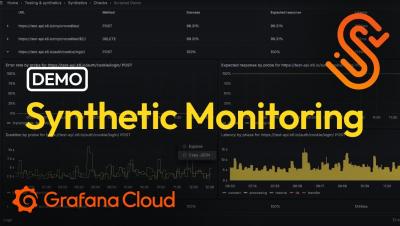
Grafana Cloud Synthetic Monitoring proactively monitors the performance of your APIs and web applications from the user's perspective. Powered by Grafana k6, Synthetic Monitoring combines GUI-based and as-code monitoring to improve efficiency, collaboration, and application reliability. Watch this demo of how to use Synthetic Monitoring in Grafana Cloud.

Checkly adds deep synthetic monitoring to Coralogix with new integration

Starting today, Checkly users can send their traces from synthetics checks to Coralogix to view in-depth synthetic user data along with back-end APM based tracing. This gives SRE’s and Operations engineers a new insight into how the system is responding to automated synthetic tests of your service. For Checkly users, integrating with Coralogix data means it’s easy to correlate end-to-end user experience with backend performance, and track poor performance to its root cause.

The Power of Synthetic Data to Drive Accurate AI and Data Models

We live in a data-rich world - every click, swipe, like, share, and purchase online generates data points companies use to optimize offerings. However, even vast real-world data has limitations in developing robust artificial intelligence (AI) and data models, particularly with regard to AIOps (Artificial Intelligence for IT Operations). Enter synthetic data.