Operations | Monitoring | ITSM | DevOps | Cloud

KubeCon 2025 London: OpenTelemetry Steals the Show and Splunk's Bold Moves

I was lucky enough to attend KubeCon Europe 2025 in London, where the energy around OpenTelemetry (OTel) reached fever pitch. From packed sessions to buzzing hallway conversations, it’s clear: OpenTelemetry isn’t just the future—it’s the present. Here’s what stole the spotlight.

What Is Synthetic Data? A Tech-Savvy Guide to Using Synthetic Data

Synthetic data is gaining attention as artificial intelligence (AI) continues to evolve. But what exactly is it, and why is it so important today? At a high level, synthetic data refers to data that's generated by algorithms or mathematical models. It is not data collected from the real world.

Observability Costs: Tips for More Efficient Data Management

Can you ever get too much data? With modern architectures getting increasingly more complex with hundreds of microservices and containers, data volume grows at an exponential rate, and there’s no pause in sight. In this era of ever-expanding volume of telemetry, it’s nearly impossible to separate valuable data from noise, making things like root cause analysis or alerting needlessly more complicated, while putting pressure on the performance of your stack, your scalability and budget.

Revolutionize Product Development with Feedback-Driven Customer Advisory Boards

In a rapidly evolving business landscape, understanding and responding to customer needs is not just an advantage — it's a necessity. At Splunk, we've taken a bold step by applying a product manager mindset to our Customer Advisory Board (CAB) program, transforming it into a dynamic platform for both customers and our product teams.

Tiered Observability: How To Prioritize and Mature Observability Investments

You may be surprised that delivering observability is a journey and isn’t about observing everything at once — it’s about driving outcomes like proactive detection, faster troubleshooting, and aligning with business priorities. If you’ve followed this series, you’ve already taken steps to.

AI Governance in 2025: A Full Perspective on Governance in Artificial Intelligence

In a world where artificial intelligence (AI) is leaping forward — growing at a CAGR of almost 36% from 2024 to 2030 — questions about governance and ethics with the use of AI are surfacing. As humans continue to develop AI systems, it is crucial to establish proper guidelines to ensure powerful technologies like generative AI and adaptive AI are used in a responsible manner.

Solve Problems Faster with New, Smarter AI and Integrations in Splunk Observability

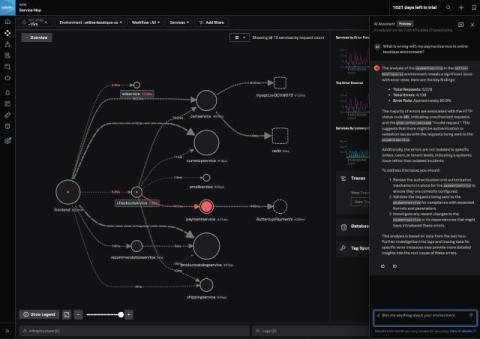
As businesses scale across hybrid and multi-cloud environments and integrate AI-powered technologies, complexity grows — and with it, the risk of performance degradation and cost of downtime. To avoid facing customer-impacting IT issues, organizations need better ways to correlate data across environments, detect anomalies before they escalate, and resolve incidents more efficiently. That’s where Splunk and Cisco come in.

How To Monitor Kubernetes with Splunk Infrastructure Monitoring

Kubernetes is the standard for orchestrating containerized microservices — but it can present some monitoring challenges. Luckily, we’ve already covered why monitoring Kubernetes is a must-do, the basics of how to do it, and the options you have for collecting monitoring data from a K8s environment.