How To Install Graylog On CentOS
Technical Marketing Manager, Ethan Keaton walks you through installing Graylog V5 on CentOS.


Most Linux users will be faced with sudo and su at least once in their lives. Because of their comparable syntax and overlapping functions, it is often complicated for new users to differentiate between them. The commands sudo and su are among the most widespread and effective in Linux. By deterring unpredictable things in your network, you can deter performance and safety issues in your network. The two methods of gaining root privileges are sudo and su.
As we enter the holiday season, online shopping and payment systems are gearing up for higher traffic and workloads. Ensuring that these applications can handle the increased demand without slowing down or crashing is critical for providing a smooth and efficient experience for customers. One way to improve the performance and reliability of these applications is by using chiselled Ubuntu images in your containerised deployment.
If you are looking for a small-scale cloud deployment suitable for the edge, chances are you came across Canonical’s Micro cloud solution. These are small-footprint clusters of compute nodes with distributed storage and secure networking, optimised for repeatable and reliable remote deployments.
Repatriation in cloud computing refers to moving workloads from the public cloud to on-premise infrastructure. Sarah Wang and Martin Casado from Andreessen Horowitz have written one of the most popular articles about repatriation: they explain the motivation with the significant cost savings possible. For software-based businesses, public cloud spend can rise to 50% of the cost of revenue (COR). Reducing these costs has the potential for significant margin increases.
MLOps is the short term for machine learning operations and it represents a set of practices that aim to simplify workflow processes and automate machine learning and deep learning deployments. It accomplishes the deployment and maintenance of models reliably and efficiently for production, at a large scale. MLOps is slowly evolving into an independent approach to the machine learning lifecycle that includes all steps – from data gathering to governance and monitoring.
When you run the uptime command, most of you might be familiar with the three numbers appearing on the top right corner of your Linux screen. But, do you know what those numbers indicate or why there are three such numbers? It is called the load average, a metric that assesses the load on your computer systems. While it can be considered a precise tool for measuring system and resource engagement, it would only be worthwhile if you understand it right.
Financial Institutions (FIs) need to respond with agility and business velocity to keep pace with changing economic conditions. Yet, emerging competition from fintechs and challenger banks and increasing customer expectations is making this task difficult, especially as regulatory and compliance requirements increase. Embracing the next phase of digital transformation is an imperative for financial institutions to sustain and grow in a competitive environment of rising cost pressures.
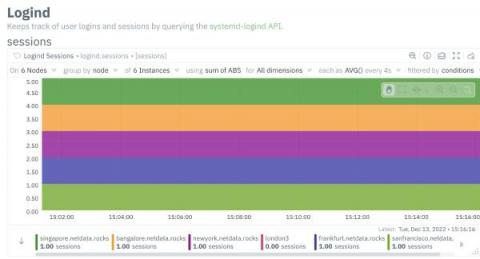
Find out how to effectively and easily monitor and troubleshoot systemd-logind using Netdata.