The latest News and Information on Serverless Monitoring, Management, Development and related cloud technologies.
AWS Lambda is a compute service that enables you to build serverless applications without the need to provision or maintain infrastructure resources (e.g., server capacity, network, security patches). AWS Lambda is event driven, meaning it triggers in response to events from other services, such as API calls from Amazon API Gateway or changes to a DynamoDB table.
In Part 1 of this series, we discussed AWS Lambda functions and some key metrics for monitoring them. In this post, we’ll look at using Amazon’s native tooling to query those metrics. We’ll also show you how to collect logs and traces that provide further visibility into your Lambda functions. Amazon provides built-in monitoring functionality through CloudWatch and X-Ray.
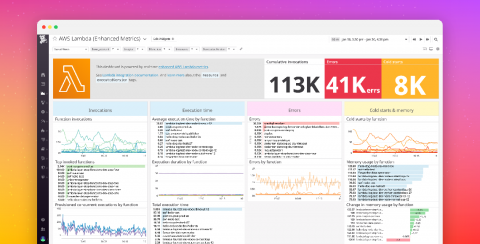
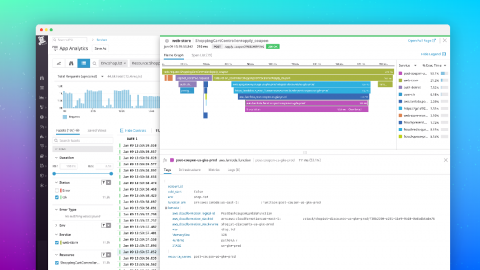
In Part 2 of this series, we looked at how Amazon’s built-in monitoring services can help you get insights into all of your AWS Lambda functions. In this post, we’ll show you how to use Datadog to monitor all of the metrics emitted by Lambda, as well as function logs and performance data, to get a complete picture of your serverless applications. In this post, we will: Datadog integrates with AWS Lambda and other services such as Amazon API Gateway, S3, and DynamoDB.
AWS Lambda decouples the need to provision and maintain a runtime environment from running code, allowing developers to focus on applications rather than infrastructure. But, by abstracting away the underlying infrastructure of an application, serverless architectures introduce new challenges into monitoring and observability.
Since AWS Lambda was launched in 2014, serverless has transformed the way applications are built, deployed, and managed. By abstracting away the underlying infrastructure, developers are able to shift operational responsibilities to the cloud provider and focus on solving customer problems.
The infrastructure that runs your applications can be nearly as complex as the applications it supports. This complexity generally scales with the resilience of the architecture of your application, the scaling needs, and any security concerns. Thus, successful infrastructure for traditional applications often relies on a comprehensive tooling suite that allows the infrastructure engineers to iterate upon and improve your application’s resources.
Orchestrating and composing multiple services in a distributed architecture is not easy. Before we move along with the great solution offered by vending-machines to our distributed architectures, we need to understand what solutions and values we’re looking for. In a serverless environment, there are at least three desired properties of any distributed services implementation.