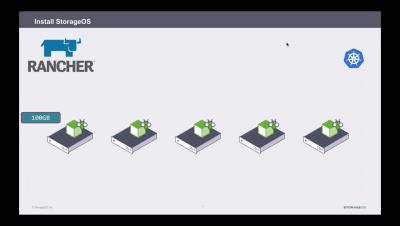
Longhorn is cloud-native distributed block storage for Kubernetes that is easy to deploy and upgrade, 100 percent open source and persistent. Longhorn’s built-in incremental snapshot and backup features keep volume data safe, while its intuitive UI makes scheduling backups of persistent volumes easy to manage. Using Longhorn, you get maximum granularity and control, and can easily create a disaster recovery volume in another Kubernetes cluster and fail over to it in the event of an emergency.
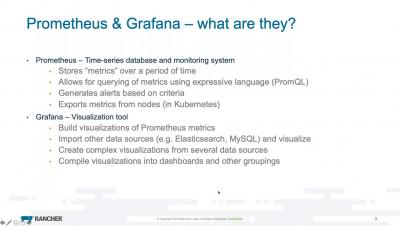
Prometheus is an open-source system for monitoring and alerting originally developed by Soundcloud. It moved to Cloud Native Computing Federation (CNCF) in 2016 and became one of the most popular projects after Kubernetes. It can monitor everything from an entire Linux server to a stand-alone web server, a database service or a single process. In Prometheus terminology, the things it monitors are called Targets. Each unit of a target is called a metric.
In Part 1 of this series, we demonstrated how to enable PSPs in Rancher, using restricted PSP policy as default. We also showed how this prevented a privileged pod from being admitted to the cluster. Enforcement capabilities of a Pod Security Policy We intentionally omitted particular details about role-based access control (RBAC) and how to link pods with specific PSPs. Let’s move on and dig in more on PSPs.
Today, we announced our $40M funding round led by Telstra Ventures. We have been working with Telstra as a customer for many years. When Telstra Ventures, who was familiar with Telstra’s success in using Rancher and Kubernetes, approached us for a potential funding round, it was a no-brainer. A leading telco like Telstra exemplifies Rancher’s vision to Run Kubernetes Everywhere.
AI and Machine Learning are becoming critical differentiators in the technology landscape. By their nature, AI and ML are computation hungry workloads. They require best-in-class distributed computing environments to thrive. AI and ML present a perfect use case for Kubernetes, the distributed computing platform engineered at Google to run their massive workloads.
Norwegian leader in fleet management, equipment and vehicle tracking, ABAX is one of Europe’s fastest-growing technology businesses. The company provides sophisticated fleet tracking, electronic mileage logs and equipment and vehicle control systems to more than 26,500 customers. ABAX manages over 250,000 active subscriptions that connect a variety of vehicles and industrial equipment subscriptions.
This blog will examine how Rancher improves the life of DevOps teams already invested in AWS’s Elastic Kubernetes Service (EKS) but looking to run workloads on-prem, with other cloud providers or, increasingly, at the edge. By reading this blog you will also discover how Rancher helps you escape the undeniable attractions of a vendor monoculture while lowering costs and mitigating risk.