Operations | Monitoring | ITSM | DevOps | Cloud

Ship Reliable AI Faster: How to Operate AI Agents with Control and Confidence

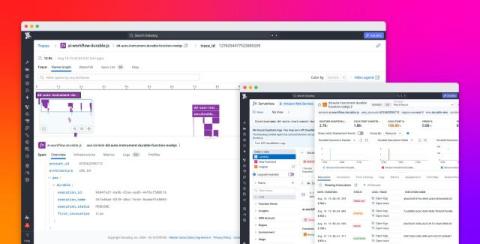
Replace "AI shipped on hope" with an operating model that holds up once real users depend on it. AI quality is multi-dimensional, covering accuracy, tone, safety, and faithfulness to user data, and can't be debugged from outputs alone. Without visibility into what their AI actually did in production, teams miss regressions, reverse-engineer chains by hand, and watch a single bad answer erode trust built over hundreds of right ones.

Reduce CDN log costs with searchable archives

Engineering teams that manage high-volume log sources, such as content delivery network (CDN) edges, streaming platforms, and authentication systems, often have to make a difficult retention tradeoff. Indexing every event keeps logs searchable during investigations, audits, and postmortems, but it can make long-term retention expensive.

The AI Engineering Playbook: How to Evaluate & Iterate at Every Phase of Development

AI coding tools are accelerating development velocity, creating a release challenge most teams aren’t equipped for. Without controlled rollout, higher change velocity makes it harder to know which specific release drove the results you’re seeing in production. And when teams use AI, to build AI – LLM apps and AI agents– complexity multiplies. Traditional observability can’t ensure AI agent quality, performance, and cost-efficiency at production scale.

How we saved over $3 million in idle compute costs with Datadog Kubernetes Autoscaling

At Datadog, our broad Kubernetes footprint amplifies the significance of a familiar autoscaling tradeoff: Overprovisioning wastes cloud spend, while underprovisioning threatens reliability. We built Datadog Kubernetes Autoscaling (DKA) to help teams rightsize their workloads by generating intelligent resource recommendations and automating multidimensional workload scaling. Across Datadog, adopting DKA has eliminated more than $3 million in annualized idle compute costs while reducing reliability risks.

How to migrate feature flags without breaking production

Feature flag migrations have a reputation problem. Ask anybody who’s been through one before and you’ll hear the stories, usually from someone still a little frustrated about a bad cutover, with a postmortem or two to show for it. The reputation is mostly undeserved. While the risks are real, they’re well understood and easily controlled. Getting a migration right doesn’t require a big coordinated effort.

How Coding Agents are Changing the Traditional Software Development Lifecycle

AI coding assistants are rapidly evolving from passive copilots into active, agentic collaborators capable of planning, executing, and iterating on complex software tasks. This shift has huge ramifications onthe software development lifecycle (SDLC), developer productivity, and even the structure of engineering teams.

Fireside Chat with Datadog CPO Yanbing Li and Vercel CPO Tom Occhino

The way we build, ship, and run software is being reshaped by AI. In this fireside chat, Yanbing Li (CPO, Datadog) and Tom Occhino (CPO, Vercel) will discuss their perspectives on the impact AI is having across the industry and what it means for teams navigating this shift today.

Progressing AI Beyond Scaling and Into Deep Reasoning

The breakthroughs in AI today aren’t just coming from bigger datasets and more compute; Reinforcement Learning (RL) has quietly become one of the most powerful forces in modern AI development. RL is teaching models to reason and self-correct, enabling capabilities that make AGI feel less like science fiction and more like an inevitable future.