Operations | Monitoring | ITSM | DevOps | Cloud

RCA Series: Accelerate security investigations w/ machine learning and Elastic (3/4)

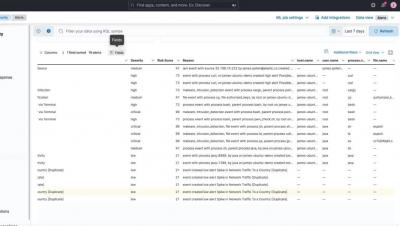
Comprehensive security requires multiple layers of threat protection. Sophisticated threats exploit idiosyncrasies in your environment. Unsupervised machine learning identifies patterns of normal activity from your data, and therefore can catch attacks that standard approaches to threat hunting, such as pre-defined rules, are likely to miss. This video explains how machine learning adds a layer to your threat protection, and how interactive tools offered in the Elastic Security solution accelerate the investigation of security incidents.

RCA Series: Root Cause Analysis in Manufacturing, Electric Grids & Connected Devices (4/4)

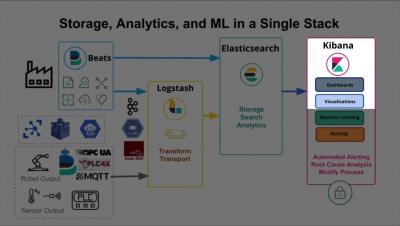
With digitization adopted in many industries, real-time data from manufacturing and operational equipment can be used to monitor and optimize operation - by applying data-driven modeling including machine learning. Learn how you can ingest sensor data from industrial processes and operational equipment into Elastic, build monitoring dashboards and set up automated alerts in Kibana, and apply predictive modeling to optimize your operations (OT).

Logging for public sector: How to make the most of your mission-critical data

With governments doubling down on logging compliance, many public sector organizations have been focusing on optimizing their log management, especially to ensure they retain logs for required periods of time. Logs — though seemingly straightforward — are the backbone of many mission-based use cases and therefore have the potential to accelerate mission success when centrally organized and leveraged strategically. In public sector, logs are instrumental in.

Root cause analysis with logs: Elastic Observability's AIOps Labs

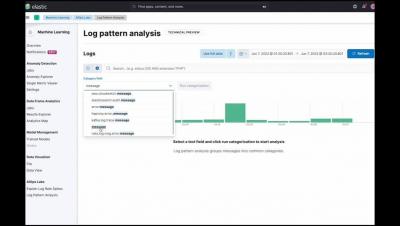
In the previous blog in our root cause analysis with logs series, we explored how to analyze logs in Elastic Observability with Elastic’s anomaly detection and log categorization capabilities. Elastic’s platform enables you to get started on machine learning (ML) quickly. You don’t need to have a data science team or design a system architecture. Additionally, there’s no need to move data to a third-party framework for model training.

Log monitoring and unstructured log data, moving beyond tail -f

Log files and system logs have been a treasure trove of information for administrators and developers for decades. But with more moving parts and ever more options on where to run modern cloud applications, keeping an eye on logs and troubleshooting problems have become increasingly difficult. Watch this video to learn how to go beyond tail -f and process custom and unstructured logs with Elastic.

How to add support for more languages in your Elastic Enterprise Search engines

Engines in Elastic App Search enable you to index documents and provide out-of-the-box, tunable search capabilities. By default, engines support a predefined list of languages. If your language is not on that list, this blog explains how you can add support for additional languages. We’ll do this by creating an App Search engine that has analyzers set up for that language.

Monitoring service performance: An overview of SLA calculation for Elastic Observability

Elastic Stack provides many valuable insights for different users. Developers are interested in low-level metrics and debugging information. SREs are interested in seeing everything at once and identifying where the root cause is. Managers want reports that tell them how good service performance is and if the service level agreement (SLA) is met. In this post, we’ll focus on the service perspective and provide an overview of calculating an SLA.

Elastic Common Schema and OpenTelemetry - A path to better observability and security with no vendor lock-in

At KubeCon Europe, it was announced that Elastic Common Schema (ECS) has been accepted by OpenTelemetry (OTel) as a contribution to the project. The goal is to achieve convergence of ECS and OpenTelemetry’s Semantic Conventions (SemConv) into a single open schema that is maintained by OpenTelemetry. This FAQ details Elastic’s contribution of Elastic Common Schema to OpenTelemetry, how it will help drive the industry to a common schema, and its impact on observability and security.