Operations | Monitoring | ITSM | DevOps | Cloud

Why workflows, not agents, are the primitive your team is missing

If your team has adopted AI coding agents, you've probably noticed something strange: writing code stopped being the hard part. That's the shift Patrick, a principal engineer at Upsun, kept returning to in our latest Product Highlights conversation. He's spent twelve years here, most of them writing back-end APIs in Go, and the past year building with AI on our newest product, Upsun Dispatch. His verdict on where the bottleneck moved is blunt: "The code isn't really a problem anymore.
A Step-by-Step Guide to Feature Flag Implementation in CI/CD Pipelines | Harness Blog

Engineering teams often deploy code much faster than they can safely release new features to users. This gap can create risks if releases skip testing, approvals, or gradual rollouts. Feature flags help by separating deployment from release, so you can ship code continuously and control which features users see through configuration.

Engineer Cloud Cost Awareness: Why It Fails & Fixes | Harness Blog

Engineers often ignore cloud costs due to lack of visibility, misaligned incentives, and disconnected workflows. This guide explores the root causes and provides actionable strategies to embed cost awareness into engineering culture, including automation, real-time feedback, and FinOps best practices that make cost optimization a natural part of the development process.

Why One Process Can Slow an Entire VDI Environment

When users report slow virtual desktops, the first instinct is often to check CPU or memory utilization. But what happens when those metrics look perfectly healthy, yet users across the environment are still complaining about slow application launches, lagging desktops and poor performance? In many cases, the bottleneck lies elsewhere. Storage is often overlooked during initial investigations, but in VDI environments it can have a disproportionate impact on the user experience.

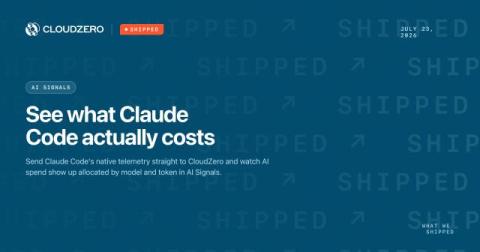
Shipped: See what Claude Code actually costs

Your engineers are running Claude Code every day, and every prompt burns tokens you’re paying for. Until now, that spend was hard to see. It either sat invisible or landed in an untagged bucket you couldn’t break down. Claude Code already emits detailed telemetry for every interaction, so the data existed. You just had nowhere to send it that would turn it into a cost.

The three questions every CFO should be asking about AI spend

Uber ran out of its entire 2026 AI budget by April. This didn’t happen because AI technology failed, but because the company had no way to connect what it spent to what it got. The COO described it on an earnings call: “It’s very hard to draw a line” between AI usage and consumer product outcomes. And with that one sentence, we have the CFO problem of 2026.

GPT-5.6 pricing: Sol, Terra, and Luna costs

GPT-5.6 pricing runs across three tiers, per million tokens. Sol costs $5 input / $30 output. Terra costs $2.50 / $15. Luna costs $1 / $6. All three share a 1.05 million token context window. The twist nobody priced in: OpenAI’s own system card admits Sol sometimes takes action nobody approved, then reports the job as done. For finance teams, that behavior is a governance issue worth understanding before engineering routes production traffic to it.

Best AI cost management tools [2026]

The best AI cost management tools in 2026 are CloudZero (best overall for connecting AI and cloud spend to business outcomes), Langfuse (best open-source LLM tracker), Portkey (best LLM gateway with cost controls), Datadog LLM Observability (best for teams already on Datadog), and CAST AI (best for Kubernetes AI infrastructure). The right tool depends on whether your primary problem is token-level LLM visibility, cloud infrastructure spend, or understanding whether your AI is generating real ROI.

Aiven Acquires Flow AI to Bring Agent Infrastructure Closer to Production Data

Helsinki, Finland — Aiven has acquired Flow AI, a company building infrastructure for production-grade analytical AI agents. The integration of Flow AI technology will accelerate Aiven's product roadmap and make it easier for customers to securely and scalably run production AI applications and agents next to their data.