Operations | Monitoring | ITSM | DevOps | Cloud

Introducing Datadog Real User Monitoring

The performance of your website is a key element in the success of your business—slow page load times and errors can degrade the user experience, leading to customer churn, fewer ad impressions, or abandoned shopping carts. To give you end-to-end visibility into the real-time activity and experience of individual users, we’re excited to add Real User Monitoring (RUM) to Datadog.

Monitor your Arm VMs with Datadog

Acorn RISC Machine (Arm) processors were first released in 1985 to support low-power, low-cost computing. Because of their ability to deliver cost-effective performance, the next big use for Arm-based devices is in the cloud. AWS recently added a range of Arm-based EC2 instance types and is developing additional support (e.g., in Elastic Kubernetes Service). Meanwhile, Arm and Docker are working on tighter integration.

Monitor Amazon EKS on AWS Fargate with Datadog

AWS Fargate has steadily gained traction in Amazon Elastic Container Service (ECS) environments because it allows users to run containerized applications without thinking about their underlying infrastructure. Today, AWS announced that support for Amazon Elastic Kubernetes Service (EKS) on AWS Fargate is now generally available, giving Amazon EKS users the option to seamlessly manage their infrastructure with AWS Fargate instead of manually provisioning EC2 worker nodes.

Monitor AWS Lambda Provisioned Concurrency metrics with Datadog

Serverless computing continues to be a growing trend, with AWS Lambda as a main driver of adoption. Today, AWS released Provisioned Concurrency, a new feature that makes AWS Lambda more resilient to cold starts during bursts of network traffic. If you’re running a consumer-facing application, slow page loads and request timeouts can degrade the user experience and lead to significant revenue loss.

Monitoring AWS Lambda functions with Datadog

The “serverless” movement is taking the industry by storm and now, with Datadog, you can start monitoring your serverless applications and functions on AWS Lambda. As soon as you enable the Lambda integration, you’ll start to see your metrics in an out-of-the-box dashboard like the one above. Monitor and alert on AWS Lambda serverless functions in minutes with Datadog.

Monitor G Suite activity with Datadog

G Suite is a collection of cloud-based productivity and collaboration tools developed by Google. Today, millions of teams use G Suite (e.g., Gmail, Drive, Hangouts) to streamline their workflows. Monitoring G Suite activity is an essential part of security monitoring and audits, especially if these applications have become tightly integrated with your organization’s data.

Announcing Datadog Security Monitoring

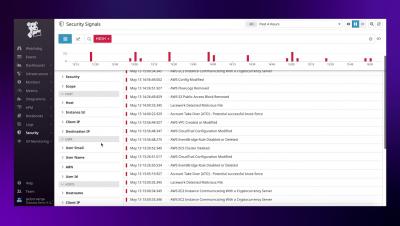
With the growing complexity and velocity of security threats in dynamic, cloud-native environments, it’s more important than ever for security teams to have the same visibility into their infrastructure, network, and applications that developers and operations do. Conversely, as developers and operations become responsible for securing their services, they need their monitoring platform to help surface possible threats.

What's next for monitoring Kubernetes

At Datadog, we rely heavily on Kubernetes, and we’re facing some interesting challenges as we use Kubernetes to scale further and strive for greater efficiency. To address these challenges, we’ve been working on solutions to help us better control how our clusters scale, and to make it easier to deploy and manage the Datadog Agent. Today, we’re open sourcing these solutions to share them with the rest of the Kubernetes community.

Implement monitoring as code with Datadog and CloudFormation Registry

AWS CloudFormation is a service that enables you to build infrastructure as code, similar to Terraform. You can create CloudFormation templates to provision and manage all of the resources for your stacks, such as EC2 instances, load balancers, and security groups. These templates automate the process of building infrastructure, creating repeatable steps that you can easily check into version control. This ensures that your configurations do not drift with each new environment you spin up.