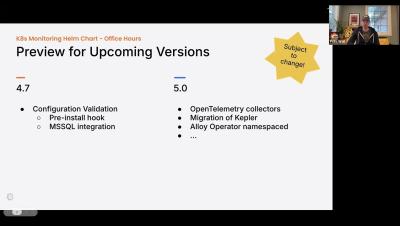
In the October edition of the Kubernetes Monitoring Helm chart office hours, we discuss the version 4.6 release and the upcoming 4.7 feature release, and the next 5.0 major release.
We asked some members of the Grafana AI team what AI tool they use every day, and here are the results. This was taken in June 2026, at the AI offsite in Amsterdam, the Netherlands.
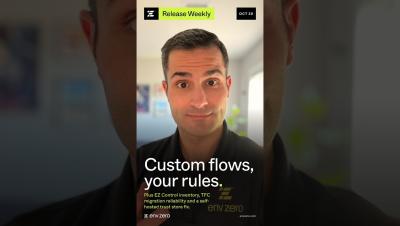
Custom flows can run anything a repo puts in front of them. This week you decide which ones your organization accepts. Everything that shipped in env zero from v4.0.287 to v4.0.298, plus self-hosted agent 5.5.10 and 5.5.11. In this week's release: New EZ Release Weekly every Friday.
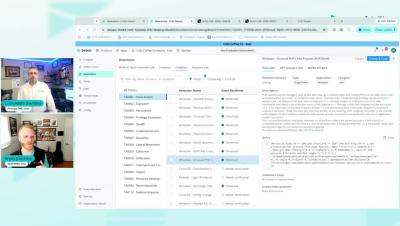
Bryan Peace Leon Adato break down what exactly security-minded IT folks - whether they work in SRE, dev, networking, or more esoteric disciplines - should do when a new, critical, apocalyptic vulnerability is announced. They walk you step by step through research, analysis, and how to protect your company if a patch isn't out yet. Along the way they muse about the nature of the industry, the sudden spike in CVEs, and where to find the best hard cidr to take the edge off.
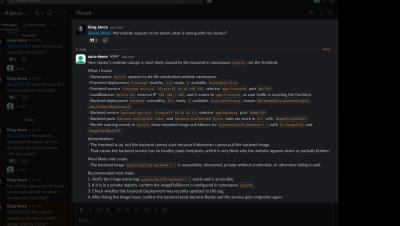
Running an agent in your cluster should not mean opening it to the internet. AURA reaches Slack over an outbound socket, so the cluster stays locked down. Jeff Vogt connects an AURA deployment running in Kubernetes to Slack using AURA's direct Slack integration. The setup is a Slack app with an app token and a bot token, plus a few lines added to the deployment's configuration. The Kubernetes MCP server is already deployed and connected to AURA before the video starts.
One of the most expensive failure modes in AI agents is a silent retry loop. An agent hits a rate limit, blindly retries until it succeeds, the user gets a response, and no ticket ever gets filed. Under the hood, tokens are burning, latency is compounding, and a transient error today becomes a sustained outage tomorrow.
Most teams keep an agent from regressing by hardcoding checks into its logic, an if-statement here, a regex there. Every new rule then becomes a code change, a review, and a deploy, and the person who spots the problem in production is rarely the person who can ship the fix. Agent Control moves those rules out of the code and into one hub. Steer, block, and validate agent behavior in real time, with rules any team member can update without touching the codebase.
Every engineering team has unit tests. They tell you the code still works. They tell you nothing about what the model started saying. This demo wires a single eval gate script into a git pre-push hook, so Splunk Agent Observability scores every agent's output before the push is allowed through. Luna, an on-premise small language model, runs as a synchronous judge against fixed thresholds. Fail one, and the push is blocked.
Your agent breaks in production. You fix it and move on. But the input that actually broke it is gone and two months later the same failure quietly comes back, because there was never anything to test against. That's not a debugging problem. It's a missing dataset. This demo turns low-scoring production traces into a regression suite you can run against every prompt and model change, without writing a single test case by hand.
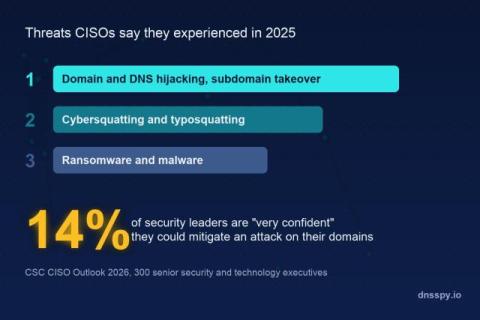
CSC's CISO Outlook 2026 report surveyed 300 senior technology and cybersecurity executives in the first quarter of 2026, split evenly across North America, Europe and the UK, and Asia-Pacific. When asked which cyber threats they had actually experienced in 2025, not which ones worried them but which ones happened, the answer at the top of the list was domain and DNS hijacking, and subdomain takeover. Ahead of ransomware. Ahead of malware.