Operations | Monitoring | ITSM | DevOps | Cloud

The latest News and Information on Cloud monitoring, security and related technologies.

Shipped: Every cost recommendation now comes with the why and the how

A savings number tells you money is on the table, but it doesn’t tell you whether the finding holds up, what it’s based on, or what to do next. In that gap, recommendations pile up unactioned. When you’re staring at thousands of them, a title and a dollar figure isn’t enough to decide which are safe to act on.
AWS Outage Incident Response: What July 24 Taught Us

On the morning of July 24, 2026, a large slice of the internet blinked out at once. An AWS outage centered on the US-West-2 region in Oregon rippled outward and took DoorDash, Reddit, Hulu, Apple Pay, Snapchat, Fortnite, and the PlayStation Network offline for millions of users. If your team runs anything on Amazon Web Services, this is the incident to study, because the hard part was never fixing AWS. The hard part was AWS outage incident response.

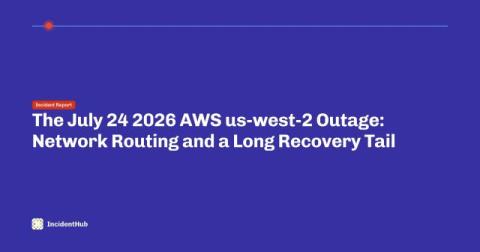
The July 24, 2026 AWS us-west-2 Outage: Network Routing and a Long Recovery Tail

On July 24, 2026, AWS lost connectivity between the us-west-2 (Oregon) region and the Seattle Metro. The initial impact window was 20 minutes for most and 1 hour 17 minutes for a few customers using AWS Direct Connect through EqSe2, Westin Building Exchange, Seattle. Any traffic that both started and ended inside the region kept working, whereas anything crossing the region boundary saw timeouts and errors. This included the AWS Management Console for some customers.

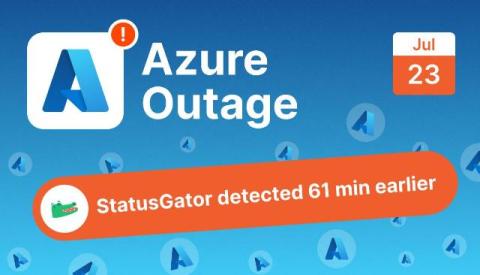
Azure outage on July 23, 2026: StatusGator detected it 1 hour before Microsoft acknowledged it

On July 23, 2026, Azure users around the world began hitting gateway timeouts, DNS failures, and unreachable virtual machines well before Microsoft posted anything on its status page. The first reports reached StatusGator at 15:06 UTC. By 15:28 UTC, StatusGator had sent an Early Warning Signal to subscribers. Microsoft did not acknowledge the incident until 16:29 UTC.

GCP Monitoring: A Complete Guide to Monitoring Google Cloud Applications and Infrastructure

Most production incidents in Google Cloud don't announce themselves as infrastructure problems. A checkout service on GKE starts timing out, a Cloud Function cold-starts under load, a Cloud SQL replica falls behind, and a Pub/Sub subscription quietly backs up until messages start expiring. None of that shows up as a red node in a compute dashboard. It shows up as slow requests, failed webhooks, and a support queue filling up faster than anyone can triage it.

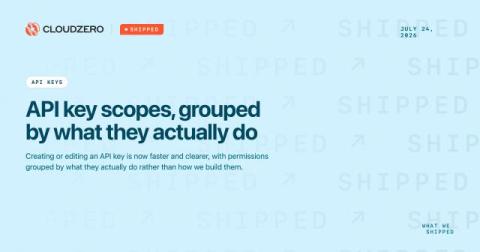
Shipped: API key scopes, grouped by what they actually do

Creating an API key used to mean sorting through categories organized around our internal structure, not how you’d use them, so finding everything you needed for a specific job meant guessing, or having someone on our team walk you through it. Now you can tell what each permission actually does at a glance.

The July 23 2026 Azure West US Outage: IP Route Removal and Downstream Impact

On July 23, 2026, Microsoft Azure experienced a connectivity outage in the West US region that blocked traffic entering or leaving the region for nearly five hours. Workloads that stayed entirely inside West US were not affected. Microsoft's preliminary Post Incident Review (PIR) attributes the failure to a bug in maintenance request conversion software that removed IP routes from more devices than intended during routine device maintenance.

The Failure Mode Your Runbook Probably Does Not Cover

Operations teams rehearse plenty of scenarios. Failed deployments, database corruption, certificate expiry, a region going dark, the on-call engineer who cannot be reached. What gets rehearsed far less often is the building losing power for eleven hours, because that feels like somebody else's problem, filed under facilities alongside the air conditioning and the parking barrier. It stops being somebody else's problem at the moment the UPS batteries drain and everything still running on premises goes down at once.