Operations | Monitoring | ITSM | DevOps | Cloud

The latest News and Information on Cloud monitoring, security and related technologies.

Cloud Outage Response: Lessons From July's Bad Week

In a single week, two of the largest cloud providers on earth failed at almost the same time, and a good chunk of the internet went with them. Effective cloud outage response stopped being a theoretical exercise and became the difference between a calm 30 minutes and a chaotic afternoon for thousands of on-call engineers. On July 23, 2026, a maintenance bug inside Microsoft Azure pulled IP routes off more devices than intended in the West US region, cutting Microsoft 365 access for millions.

How to prove the business value of AI

Proving AI business value means sorting every AI investment into one of four buckets - revenue growth, cost avoidance, productivity gain, or risk reduction - then tracking spend at the unit level (per feature, customer, or team) so each dollar has a traceable return. Most companies measure one bucket well and leave the rest unattributed. That gap is why the same AI deployment can look like a $40M win and a public reversal at the same time.

Business continuity starts with portability

Business continuity planning has a quiet assumption built into most of it: that the infrastructure the plan runs on will cooperate. Backup systems will be accessible. Recovery procedures will work as documented. The provider whose services underpin the critical path will be available, or at least recoverable within the window the plan specifies. That assumption is tested every time a major provider has an outage, a regional failure, or a service disruption that cascades across dependent workloads.

AI fatigue: what happens when product teams can't keep up with their own agents

For the past two years, the conversation around AI in software engineering has focused on one thing: productivity. Engineers are shipping faster, writing more code, and completing work in hours that once took days. Every new model promises another leap forward. What gets far less attention is what all that speed demands from the people using it. Guillaume Moigneu, Field CTO at Upsun, has spent the past year watching engineering teams adapt to AI-assisted development.

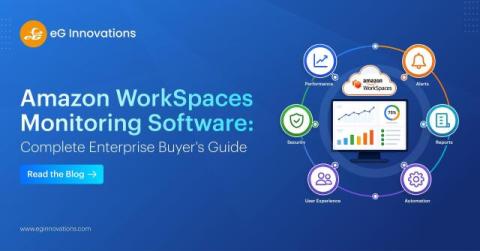
Amazon WorkSpaces Monitoring Software: Complete Enterprise Buyer's Guide

Amazon WorkSpaces is a powerful option for delivering cloud desktops at enterprise scale, but the platform only performs well when it is monitored with the same level of care as any mission-critical application. This guide explains how Amazon WorkSpaces work, why monitoring matters, what to measure, and how to choose the right monitoring software for a modern enterprise environment.

Cloud Outage Response: AWS us-west-2 Lessons

Cloud outage response got another live fire drill on July 24, 2026, when AWS lost network connectivity between its us-west-2 region in Oregon and the Seattle metro. For most customers the pain lasted about 20 minutes, and a small set on AWS Direct Connect saw errors for roughly an hour and seventeen minutes. That is short as major cloud incidents go. What makes it worth your attention is not the duration.

OpenAI Codex pricing in 2026: plans, token costs, and usage limits

Codex pricing runs six tiers, from free to $200 a month, but the sticker price is not your real bill. OpenAI Codex pricing 2026 charges by the token, not the plan, a change that took effect in April. Plus is $20, Pro starts at $100, and everything past that depends on how many files you let the agent read. Most Codex pricing guides hand you a price list and call it done. That is like pricing a taxi ride by the door handle. The meter is what matters, and OpenAI put a real one on Codex this year.

Claude Opus 5 pricing: same sticker, different bill

Claude Opus 5 launched July 24, 2026 at $5 per million input tokens and $25 per million output tokens, identical to Opus 4.8. It delivers near Claude Fable 5 performance at half Fable's price and is now the default model on Claude Max. New effort settings let teams trade capability for token savings, which means two teams on identical pricing can now run up very different bills. Finance teams, that last part is your problem. Anthropic has shipped a model that costs exactly what the old one cost.