Nastel XRay an introduction to predictive analytics, reporting and visualization
Nastel XRay an introduction to predictive analytics, reporting and visualization


The latest News and Information on Monitoring for Websites, Applications, APIs, Infrastructure, and other technologies.
It would not be wrong to say that Observability is the new buzz word for the last couple of years at least and often we find organizations burden themselves with questions like – The answer to these questions lies in understanding the concept of Observability and how it ties in with the digital experience monitoring strategy of your organization and only then can you determine where you stand in terms of Observability.
Observability changes the way you understand and interact with your applications in production. Beyond knowing what’s happening in prod, observability is also a compass that helps you discover what’s happening on the way to production. Pierre Tessier joins us on Raw & Real to talk about how Honeycomb uses observability to improve the systems that support our production applications.
The 2020 State of the Cloud Report finds that 60% of enterprises will increase their cloud infrastructure usage due to Covid-19. Hybrid infrastructure adoption creates new management challenges for IT operations teams which are further exacerbated by shrinking technology budgets and staff skill shortages. Gartner predicts that 40% of IT operations teams will deploy AI-augmented automation by 2023 to keep up with customer expectations and changing business models.
San Jose, CA, July 14, 2020 – Organizations that embrace hybrid cloud migration projects can yield a 145% return on investment within three years, a commissioned study conducted by Forrester Consulting on behalf of Virtana has revealed. The study, which reviewed customer projects completed in the last three years, found that a composite organization achieved benefits of $2 million by adopting planning and optimization platforms, such as as Virtana’s CloudWisdom and VirtualWisdom.
Perhaps one of Nexthink’s most endearing qualities is that it has never been a “drink the kool-aid” type of company. Yes, we are proud to be the leading experience management platform in IT, but that honor is most championed from outside, not within. From its beginnings, Nexthink has been used by enterprise IT to narrow the gap between what employees expect at work and what they receive.
Today, users and customers are driven by response rates to their online requests. It’s no longer good enough to just have a request run to completion, it also has to fit within the perceived limits of “fast enough”. Yet, as we continue to build cloud-native applications with microservice architectures, driven by container orchestration like Kubernetes in public clouds, we need to understand the behavior of our system across all aspects, not just one.
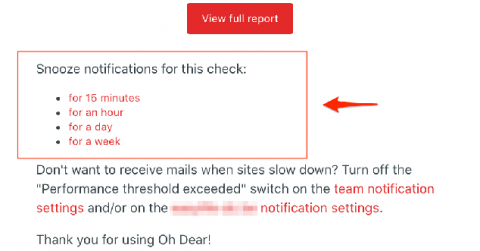
Last week, we improved the email notifications sent by Oh Dear whenever something is down or broken. They now contain links that allow you to snooze further emails, essentially "silencing" the alert for a defined period of time.
Before we get into it, let’s get one thing straight, by SCOMaaS, I am in no way referring to Azure Monitor here. I truly mean that the SCOM Management Groups themselves would be hosted and managed by Microsoft SaaS style! This is the biggest announcement from the SCOM Product Team at SCOMathon 2020, for this single reason – it sets the direction on the future of SCOM as a product and clearly positions it along side Azure Monitor.
There where a raft of announcements at SCOMathon 2020 from Aakash Basavaraj from the SCOM Product Team and one of the most exciting things was a sneak peek at what to expect after SCOM 2019 UR2 is out of the door: PowerBI Dashboards – being developed in partnership with Silect, experts in this area, this will be launched in SCOM 2019 UR2. No info was given on what to expect here, but as Silect’s PowerBI dashboards are already public, we expect this to look similar.