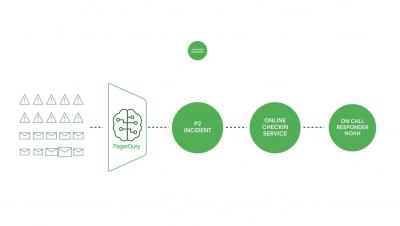
From a single on-call engineer hopping online to resolve a problem, to a massive cross-team effort that brings in even the most senior technical leadership (CTO, CISO, or CIO), incident response teams are lucky when they’re able to resolve issues before a customer is aware. But in the cases where there is customer impact, other stakeholders like sales and customer service need to be informed and updated as well.
We are excited to announce that PagerDuty® Runbook Automation and PagerDuty® Process Automation On Prem are now available on the AWS Marketplace, the leading global cloud provider. With more than 200 different cloud services, AWS makes it simple and attractive to build and grow your cloud-native business and/or migrate your existing infrastructure to the cloud, so you can begin to take advantage of the unlimited scale, agility, and flexibility the cloud offers.
With the rising complexity of our digital ecosystems, incidents are occurring at an unprecedented rate. To combat the additional strain, incident responders are looking to software to help them establish a scalable, repeatable incident response process that reduces toil and noise and gets the right people on the scene at the right time. The best incident response software addresses the entire lifecycle of an incident.
Welcome to our final post in our EI Architecture Series on Intelligent Alert Grouping. I hope you’ve enjoyed this series, and if you’d like to take a look at any of our prior posts, please use the ei-architecture-series tag. Let’s take a moment and recap everything we’ve learned.
The cloud is easy and powerful—until it’s not. Once companies have customers, commitments, and compliance concerns, they often have to create cloud operations teams to manage the cloud on behalf of their fellow employees. Often, organizations that migrate to the cloud find themselves hampered by inefficient cloud operations if they haven’t standardized their IT procedures for operability.