Operations | Monitoring | ITSM | DevOps | Cloud

From Edge to Cloud: How Litmus Edge and InfluxDB Unlock Industrial Intelligence at Hannover Messe

If you’ve spent time in industrial environments, you know the problem isn’t a lack of data. It’s collecting it reliably, contextualizing it, and storing it at scale. Most stacks weren’t built to fight all three battles.

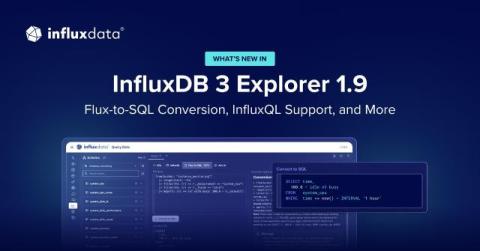
What's New in InfluxDB 3 Explorer 1.7: Table Management, Data Import, Transforms, and More

InfluxDB 3 Explorer 1.7 is a step forward for anyone who wants to manage their time series data without constantly switching between the UI and a terminal. This release adds table-level schema management, the ability to import data from other InfluxDB instances, and a new Transform Data section to reshape your data, all within the Explorer UI.

New Plugins, Faster Writes, and Easier Configuration: What's New with the InfluxDB 3 Processing Engine

The Processing Engine is one of the most powerful features in InfluxDB 3. It lets you run Python code at the database—transforming data on ingest, running scheduled jobs, or serving HTTP requests—without spinning up external services or building middleware. You define the logic, attach it to a trigger, and the database handles the rest. Since launching the Processing Engine, we’ve been building out both the engine itself and the ecosystem of plugins that run on it.

What's New in InfluxDB 3.9: More Operational Control and a New Performance Preview

We’ve spent the last few months listening to how teams are running InfluxDB 3 in the wild. The feedback was clear: as you scale, you need less “guesswork” and more control. Today’s release of InfluxDB 3.9 is our answer to that. As more teams move InfluxDB 3 into production, our focus has shifted toward the operational experience: how you manage the database at scale, how you ensure it remains secure, and how you provide a seamless experience for users.

What is MRO? Maintenance, Repair, and Operations Explained

MRO stands for maintenance, repair, and operations. It refers to the activities, supplies, and services that keep equipment, facilities, and infrastructure running safely and efficiently. Every industry that relies on physical assets depends on MRO, whether that means replacing a worn bearing on a production line, restocking safety gloves in a warehouse, or servicing an HVAC system in a hospital.

Telegraf Enterprise Beta is Now Available: Centralized Control for Telegraf at Scale

Telegraf is incredibly good at what it does: collecting metrics, logs, and events from just about anywhere and sending them wherever you need. But once Telegraf becomes part of your production telemetry pipeline, spread across environments, teams, regions, and edge locations, the hard part isn’t installing agents; it’s operating them. Configs drift. “Temporary” overrides linger. Rolling out changes across hundreds (or thousands) of agents becomes a careful, manual process.

Unifying Telemetry in Battery Energy Storage Systems

Battery energy storage systems (BESS) play a critical role in modern energy infrastructure. Utilities rely on these systems to balance renewable generation, stabilize grid operations, and respond to changing electricity demand. As deployments scale in size and complexity, operators require continuous insight into battery health, system performance, and grid interaction. Operators rely on telemetry generated across several operational platforms.

A New Scale Tier for Time Series on Amazon Timestream for InfluxDB

When we first announced the availability of InfluxDB 3 Core and Enterprise on Amazon Timestream for InfluxDB last year, we set a new standard for managed time series on AWS. We gave developers a simple way to harness high performance at scale while removing the burden of infrastructure management. But as our customers have taught us, “at scale” is a moving target. Across Industrial IoT, physical AI, and real-time observability, data is growing in both volume and resolution.

What is Industry 4.0? Everything You Need to Know in 2026

Industry 4.0 is the term used to describe the fourth industrial revolution, a name given to the integration of physical and digital systems, which includes the internet of things (IoT) and artificial intelligence that are transforming a huge number of industries. At a high level, its goal is to create an efficient, automated process for creating products or services that can be adapted quickly and efficiently to changing customer needs.