
Operations | Monitoring | ITSM | DevOps | Cloud

nginx and PHP Vulnerabilities: How Two Response Headers Told Us Which Customers to Warn

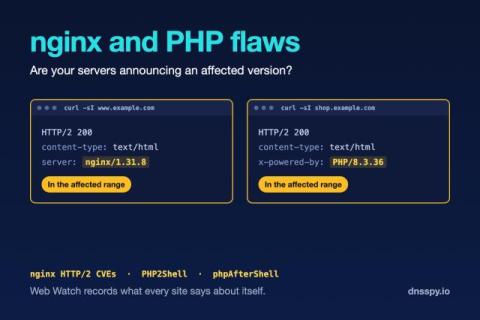
The past five weeks brought two sets of serious vulnerabilities in software that most of the web runs on. PHP fixed a pair of remote code execution bugs known as PHP2Shell on October 21, 2026, and a third issue, phpAfterShell, on November 19. In between, on November 18, nginx fixed two memory corruption bugs in its HTTP/2 code. Each time, teams everywhere had the same question: are any of our servers in the affected range? We asked it on behalf of our customers.
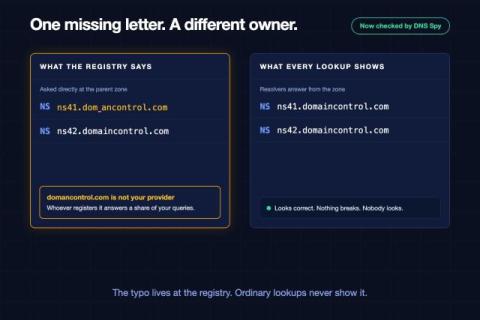
One Missing Letter in a .gov Nameserver, and the Check We Built Because We Would Have Missed It

On November 5, 2026, Alex Shakhov of SH Consulting published research into dangling DNS records on US state and local government domains. The team scanned 25,964 government-related domains and reported 43 that still reference domains outside their control: expired, mistyped or repurposed names sitting in SPF, MX, DMARC and nameserver records. YesWeHack later featured the work in its Bug Bounty Bulletin.

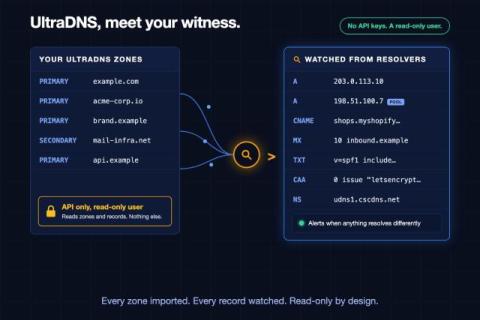
DNS Spy Now Connects to UltraDNS. Every Zone, Every Record, Read-Only.

UltraDNS, now part of DigiCert, runs DNS for some of the largest organisations in the world, and zones at that scale are rarely small. They hold hundreds of records added over years by network teams, security teams, agencies and managed service providers. From the outside, a monitoring service can only find the records it thinks to ask for: the common hostnames, the obvious mail and verification records. The provider knows all of them.

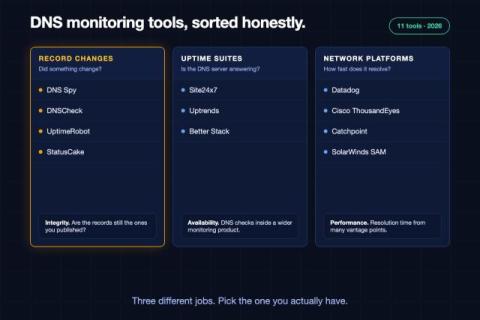
The Best DNS Monitoring Tools in 2026, Sorted by What They Actually Monitor

Search for DNS monitoring tools and you get a dozen lists that rank a network performance platform next to a five-dollar uptime checker as if they did the same job. They do not. This comparison sorts the tools by what they actually monitor, using each vendor's own documentation and pricing pages as they stood in November 2026. A disclosure first: we make DNS Spy, and it is on this list. We have tried to describe every tool, ours included, by what it does and who it suits.

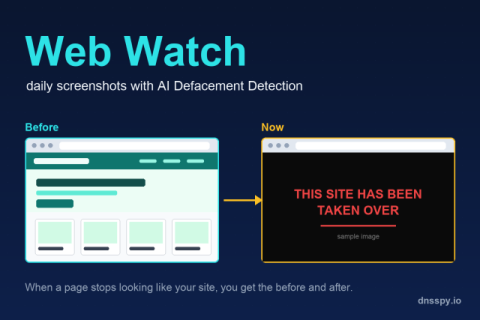
Introducing Web Watch: Daily Screenshots and AI Defacement Detection

A defaced website is a strange kind of outage. The server is up. The page loads quickly. Every uptime check you have is green. And your customers are reading a message someone else wrote. Today we are launching Web Watch, with AI Defacement Detection, for DNS Spy Enterprise. It visits the websites behind your DNS records every day, takes a screenshot, and tells you when a page stops looking like your site. The alert carries the before and after pictures.

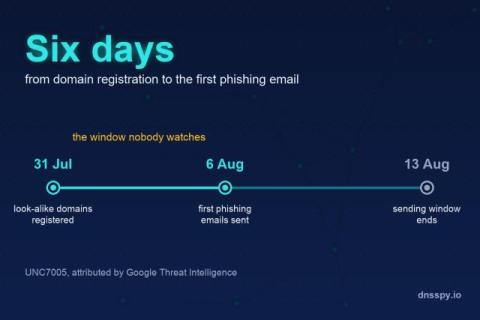
Six Days: What UNC7005 Shows About the Gap Between Domain Registration and Attack

On 20 August, Google Threat Intelligence published an analysis of a phishing cluster it tracks as UNC7005. Google assesses with moderate confidence that the cluster is connected to ICE RELIC, the Russian actor formerly tracked as APT29 and also known as Midnight Blizzard.

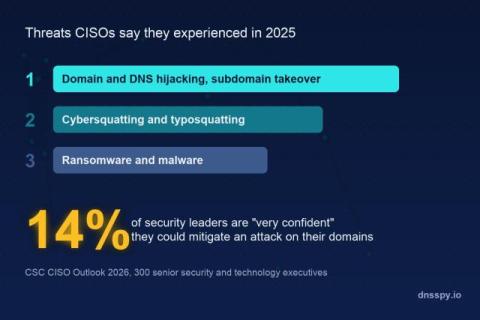
CISOs Now Rank Domain and DNS Hijacking Above Ransomware

CSC's CISO Outlook 2026 report surveyed 300 senior technology and cybersecurity executives in the first quarter of 2026, split evenly across North America, Europe and the UK, and Asia-Pacific. When asked which cyber threats they had actually experienced in 2025, not which ones worried them but which ones happened, the answer at the top of the list was domain and DNS hijacking, and subdomain takeover. Ahead of ransomware. Ahead of malware.

DNS Alerts over Syslog: TLS, CEF, and a Straight Line to Your SIEM

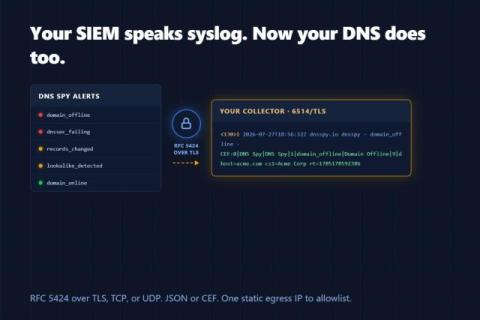
Enterprise teams can now add a Syslog alert channel: every DNS Spy alert delivered as an RFC 5424 message over TLS (or TCP/UDP), formatted as JSON or ArcSight CEF, with syslog priorities mapped from real alert severity. All deliveries originate from one documented static IP, so getting through your collector's firewall is a single allowlist rule.

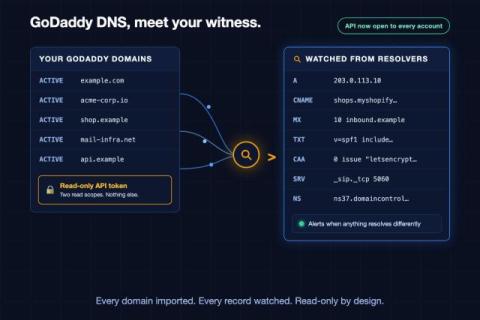
DNS Spy Now Connects to GoDaddy. Every Domain, Every Record, Read-Only.

GoDaddy manages more domains than any registrar on earth, so it has always been near the top of our provider integration list. There was just one problem: in May 2024, GoDaddy restricted its API to accounts holding ten or more domains — fifty for some endpoints. Overnight, certificate renewals broke, dynamic DNS scripts died, and every small business with one or two domains was locked out of automating anything.

Send DNS Spy Alerts to Your SIEM: Introducing Webhook Alerts

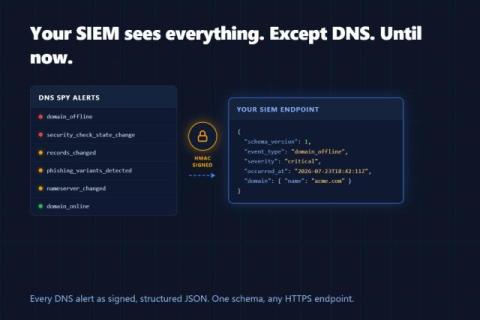
Enterprise teams can now add a Webhook alert channel that POSTs every DNS Spy alert — DNS record changes, domain outages, security check failures, WHOIS updates, phishing look-alike detections — to any HTTPS endpoint as structured JSON. Requests are optionally HMAC-signed, every delivery is logged and retried, and a Send Test button verifies your integration end to end.