Operations | Monitoring | ITSM | DevOps | Cloud

Learn How Slack Helps SREs Stay Ahead of Service Disruptions

Site Reliability Engineers (SREs) are crucial for the smooth delivery of online services. Their job is to ensure that systems are reliable, available, and efficient. But when things go wrong, they’re the ones who jump into action to fix issues as fast as possible. And with modern systems being as complex as they are, managing service disruptions can be quite a challenge. This is where Slack comes in. It’s more than just a chat tool.

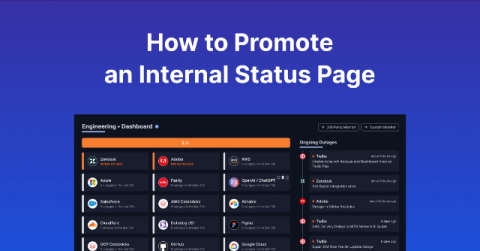
How to promote an internal status page in your company

An internal status page is a centralized platform where a company can display the operational status of its internal systems and external services. It's designed primarily for employees, IT support teams, and relevant stakeholders to stay informed about system performance, outages, maintenance, and other critical updates. First, congratulations on creating an internal status page.
Sponsored Post

Centralizing Vendor Outage Data in Incident Management Platforms

Digital operations are now the backbone of almost every business. The ability to respond to and manage incidents is more critical than ever. Incident management tools like FireHydrant, Opsgenie, SquadCast, and PagerDuty have become essential in helping companies minimize downtime and maintain operational efficiency. However, when vendor outages occur, integrating these incidents seamlessly into your management tools can be a challenge. This is where IsDown steps in.

Start Monitoring Third-Party Outages in Opsgenie

In today's digital world, we rely a lot on third-party services. These services are great because they help us grow, be more flexible, and work more efficiently. However, they also make things more complicated and risky. If a service we depend on stops working, it can cause big problems. To deal with this, we're excited to introduce a new feature that connects Opsgenie with IsDown.
Sponsored Post

Stop using Status Pages RSS Feeds in Slack

Managing RSS feeds in Slack for outage updates is getting harder. Teams rely on them to track the health of their service dependencies. Integrating RSS feeds into Slack channels might seem like a simple way to keep everyone informed. However, this approach has significant drawbacks. It can cause confusion and inefficiency. It doesn't provide clarity and timely updates.

How to set up on-call compensation

Once you set up an on-call team, the next step is to decide their compensation. There might be several questions in your mind right now: "How do we fairly value on-call time?" "Is it a flat rate or hourly?" and a few others. So we are here to help you set up an on-call compensation system because we know compensating people fairly lays the foundation of a healthy business. Are you still stuck on setting up an on-call team? Read this guide first: 7 steps to set up an on-call team.

What is Observability? Monitoring vs Observability

When the process of an application malfunctions, it can have a negative impact on users and the business. Companies need a way to identify and resolve the root cause of problems smartly. This is where monitoring and observability come in. Monitoring and observability are two methods for identifying the underlying cause of problems. Observability in IT is a concept that goes further than simple monitoring.
Sponsored Post

Unlocking Efficiency through Unified Monitoring - Maximizing Status Page Aggregation

Gone are the days of juggling multiple monitoring tools and piecing together fragmented data. The modern IT landscape demands a holistic approach known as unified monitoring when it comes to streamlining all your mission-critical services and vendors. Partner your business infrastructure with a status page aggregator and establish a health dashboard with all your dependencies.

Top Providers for Vendor Status Pages

Today, businesses are heavily reliant on online systems and platforms. But how would you communicate with users if you encounter downtime or an incident? This is where a status page comes in. A status page acts as a real-time communication hub, providing updates on system status, incidents, and maintenance activities. What’s even better is that you can find tons of free, self-hosted, and open-source status page systems to choose from online.