
Operations | Monitoring | ITSM | DevOps | Cloud

Log4j Tutorial: How to Configure the Logger for Efficient Java Application Logging

Getting visibility into your application is crucial when running your code in production. What do we mean by visibility? Primarily things like application performance via metrics, application health, and availability, its logs should you need to troubleshoot it, or its traces if you need to figure out what makes it slow and how to make it faster. Metrics give you information about the performance of each of the elements of your infrastructure.

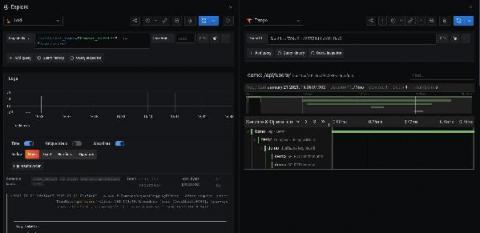
Auto-instrumenting a Java Spring Boot application for traces and logs using OpenTelemetry and Grafana Tempo

Auto-instrumentation is a subject I have not had much experience with. Here at Grafana Labs, we primarily develop in Go, which doesn’t afford such luxuries. However, there is an enormous amount of interest from the community in Java auto-instrumentation, so I set out to determine what was possible using the shiny new OpenTelemetry auto-instrumentation libraries.

Free Java Performance Monitoring and Troubleshooting Tools - Pros and Cons

Software developers are often only concerned about the functionality of their applications. When these applications are deployed in production, scalability and performance issues surface and application developers then have to worry about performance. Many a times, such situations warrant a complete restructuring of the application code, causing significant impact to new rollouts and current users.

6 Tips to Enhance Java Application Performance by Tuning JDBC Database Access Mechanisms

While tuning the performance of your application at the code level or sizing the JVM appropriately are important for enhancing performance, it is equally important to look at how to tune accesses to the backend database. After all, response time for a web request is dependent on the processing time in the Java application tier as well as the query processing time in the database tier.

Monitoring Java applications with Elastic: Multiservice traces and correlated logs

In this two-part blog post, we’ll use Elastic Observability to monitor a sample Java application. In the first blog post, we started by looking at how Elastic Observability monitors Java applications. We built and instrumented a sample Java Spring application composed of a data-access microservice supported by a MySQL backend. In this part, we’ll use Java ECS logging and APM log correlation to link transactions with their logs.

Java Logging: Best Practices for Success with your Java Application

Java is used by at least 7.6 Million developers worldwide. Java logging has been a staple of the Java platform since day one, boasting extensive, resourceful documentation and rich API’s. The cornerstone of monitoring your application is efficient and widespread logging. At Coralogix, we know that logs have become one of the most important components of a modern monitoring function.

Monitoring Java applications with Elastic: Getting started with the Elastic APM Java Agent

The goal of Java application monitoring is to minimize the time it takes to discover a problem with a Java application (mean time to detect, or MTTD) and the time it takes to recover from it (mean time to resolve, or MTTR). Understanding what's going on in our code is the biggest step in finding and eliminating the root cause of a problem, and let's face it — that code that seemed clear and concise when we wrote it a year ago might not be as "self documenting" as we thought.

Logging Java Apps with ELK and Logz.io

Java is a well-established object-oriented programming language that epitomizes cross-platform software development and helped to popularize the “write once, run anywhere” (WORA) concept. Java runs on billions of devices worldwide and powers a huge range of important software, such as the popular Android operating system and Elasticsearch. In this tutorial, we will go over how to manage Java logs with the ELK Stack and Logz.io.

Java Development Mistakes: Avoid These 7 Mistakes When Java Developing

Over time, Java has become a popular programming language in software development. Although Java is more popular with developers than C or C++, this programming language still has its problems. Here are seven Java development mistakes that developers can make and how you can avoid them.