As part of the Grafana Everywhere series, Chris Hodges from Dropbox shares why they chose Loki for their logging stack after their data center went dark.
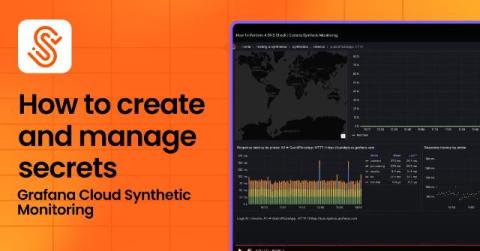
Observability isn’t just about collecting metrics and logs; it’s about proactively validating that your systems work as expected. Synthetic monitoring helps teams continuously test APIs, applications, and critical user journeys. But when those checks require the use of sensitive data, securely managing credentials becomes essential to maintain both reliability and security.
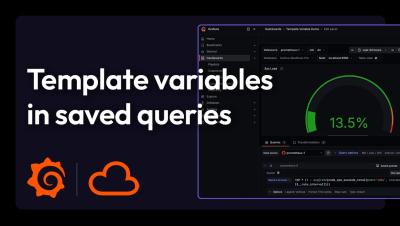
In this video, Collin Fingar, Software Engineer at Grafana Labs, demonstrates how template variables can be used in saved queries, a feature that enables users to reuse queries they or others in their org have saved. You'll see how a query that contains variables can be reused, and how the variables can be replaced at the point of reuse.
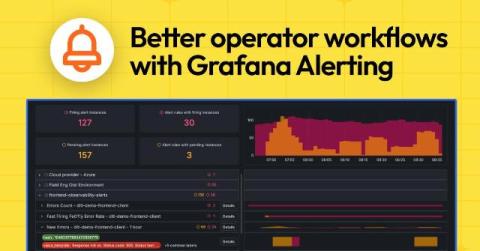
Alerts are only useful when you can quickly find and act on the right signal. That's why, over the past two years, we rebuilt Grafana Alerting’s UI to make it more reliable and efficient, especially at scale. The result: a faster, paginated alert rules page that handles tens of thousands of rules, with a powerful filter dropdown and saved searches so you can quickly get back to the views you care about most.
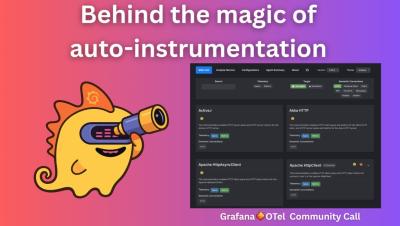
You add the OpenTelemetry Java agent, restart your app - and like magic, observability appears. But is it really magic? What’s actually enabled by default? What telemetry should you expect to see? What’s missing? And what might you want to tweak, tune, or even turn off?
At today’s community call, we will hear from David Grant, one of the engineers who has brought a new component, the Block Builder, into Mimir. Using the Ingest Storage architecture in Mimir 3.0, the Block Builder takes over the block-building responsibility from the Ingester. This feature is experimental in Mimir today, but is rolling out to production inside of Grafana Labs now. This is a great time to introduce the component, discuss the motivation, and show where it fits in the larger architecture.
Grafana Campfire Community Calls are back. We are starting with *Back to the Basics.* Even though you heard it so many times, but some of you are either new to or not very experienced with terms such as monitoring, observability, metrics, tracing, profiling etc. The good news is that you're not alone, and we've got this!! This will be a perfect learning opportunity to gain understanding during this live call and ask questions if anything is not clear.
Matt Toback is the VP of Culture at Grafana Labs. We published our original company values back in December 2020. We were a young company, growing fast, and fully remote. Our values at the time were aspirational, and painted a picture of the kind of company we wanted to be. Those values did real work and they mattered. You could hear them used in everyday conversations, and they helped get us to where we are today. But growth has a way of revealing gaps.
Sometimes the biggest shifts in technology aren’t about collecting more data — they’re about who (or what) gets to act on it. In this episode of “Grafana’s Big Tent” podcast, host Tom Wilkie, Grafana Labs CTO, is joined by Spiros Xanthos, Founder & CEO of Resolve AI, Manoj Acharya, VP of Engineering for Observability at Grafana Labs, and Cyril Tovena, Principal Engineer on the Grafana Assistant team, to discuss agentic AI in observability.
In the February edition of the Kubernetes Monitoring Helm chart office hours, we discuss the version 3.8 release, the upcoming 4.0 release and features, and we discuss the upcoming deprecation of the 1.x and 2.0 versions.