Operations | Monitoring | ITSM | DevOps | Cloud

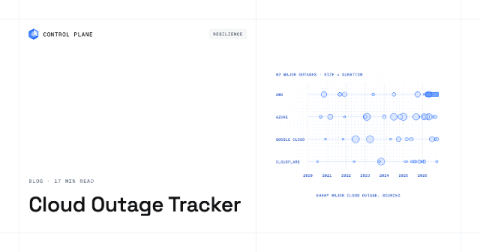
Cloud Outage Tracker: Major AWS, Azure, Google Cloud, and Cloudflare Outages Since 2020

Last updated: October 21, 2026. This tracker lists every major AWS, Microsoft Azure, Google Cloud, and Cloudflare outage since January 2020, with each provider’s own stated duration, root cause, and source. It covers 62 major incidents. The median outage lasted 6h 12m, and the most common cause was a configuration or deployment change (20 of 62, 32%), not hardware failure. We add new incidents as providers publish their post-incident reports. Control Plane publishes this tracker.

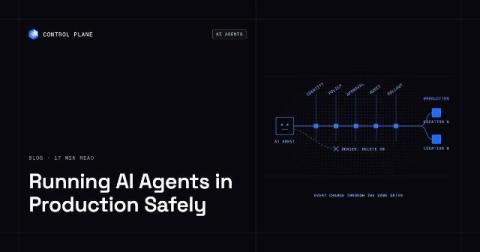
How to Let AI Agents Operate Production Infrastructure Safely

Yes, it can be safe to let an AI agent change production infrastructure, if the agent works through the same controls you would demand of a new engineer: scoped permissions, short-lived credentials, a tamper-proof audit trail, changes that roll out gradually behind health checks, and a fast rollback. The infrastructure also has to be built so that one bad change cannot take everything down.

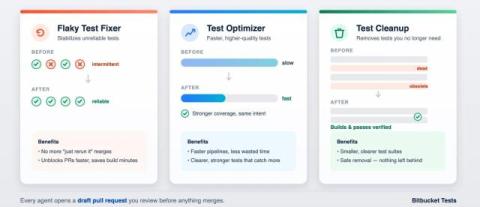
Optimize your test suite with two new agents

Flaky tests stall pull requests. Slow tests drag out builds. Outdated tests add maintenance work that’s easy to put off. To help optimize your test suite, we’re adding two new agents in Bitbucket, Test Optimizer and Test Cleanup and an improved Flaky Test Fixer. With these agents, your team will spend less time babysitting tests and more time shipping.

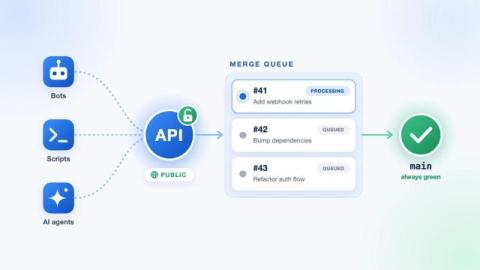
Merge queue APIs now available in Bitbucket Cloud

Merge Queues help keep your busy branches stable by testing how changes work together before they’re merged. Today, we’re introducing public APIs for Merge Queues, available to all Standard and Premium workspaces in Bitbucket Cloud. The new APIs let your tools use the existing merge endpoint to queue pull requests, track their progress and respond to the outcome.

What's new and coming in Redgate Monitor: AI, CIS compliance and cloud migration

This webinar covers what's new and coming in Redgate Monitor: AI with Redgate Assistant and the Redgate Monitor MCP server, CIS benchmark compliance checks and security alerting (Enterprise), AWS cloud migration advice for SQL Server workloads, and the roadmap into 2027. Redgate Monitor has shipped a lot this year, and there's more landing before the end of it. This session walks through what's new, what's coming over the next few months and into 2027, and what it all means for how you run your estate. Roadmap items are current direction, not commitments.

Scout Monitoring Is Now in Claude's Connector Directory

A customer messages support: checkout feels slow today. You open Scout, find the endpoint, open a trace, spot the query, copy it into Claude, and ask what’s wrong with it. Each step is quick, but together they add up to a lot of tab switching to answer one question. Scout Monitoring is now available in Claude’s connector directory. Connect it once and Claude can look at your production data directly.

Introducing AI Observability: Trace Every AI Agent Request from Prompt to Pod

TL;DR Logz.io AI Observability provides end-to-end tracing for AI agents and LLM applications. Built on OpenTelemetry, it lets you trace every request from prompt to backend service, visualize multi-step agent execution, isolate root causes across models and infrastructure, and track token usage per step, all alongside your existing logs, metrics, and traces.

What is Distributed Tracing? How a Request Becomes a Trace

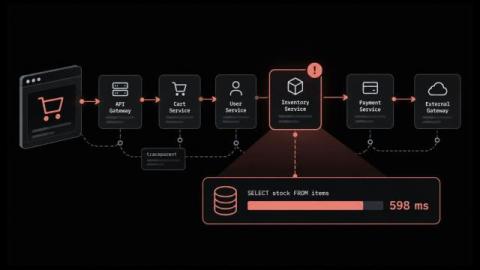
A checkout request leaves the browser and touches seven services before anything comes back. Seven dashboards light up. Every one of them reports a healthy number for its own service, and every one of them is telling the truth about a different slice of the work. Nobody measured the request. That gap is what pushed tracing in beside metrics and logs as a core signal of observability. In this blog, you will: By the end you will open a trace and say where the time went.

What is Jaeger Tracing and How does It Locate Slowdowns Across Microservices

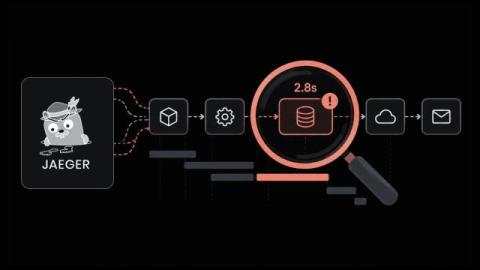
Why does a checkout or login take several seconds when CPU and memory look normal on every server? In microservices, one click can travel through a long chain of components before the user sees a response. Any one of them can hold the request up, and server graphs won't tell you which. Logs show what each service recorded. Metrics give you averages. What's missing is the path one request took and the place it lost time, and Jaeger tracing records exactly that.

Agentic AI Projects Die in the P&L Review. Here's How Revenue Leaders Can Keep Them Alive

‍‍Gartner expects more than 40% of agentic AI projects to be canceled by the end of 2027. Its reasons read like a budget memo: escalating costs, unclear business value, and inadequate risk controls. For revenue leaders, the stakes run in both directions. MGI Research estimates that at least 3% to 5% of revenue leaks between contract and cash, through missed renewals, unbilled usage, and pricing errors. Agents are well suited to close those gaps.

AI Changed How We Work. It Didn't Change What Your Platform Needs to Do.

If you've spent any time in an engineering Slack lately, you've probably noticed that AI comes up in just about every conversation. Someone's using an assistant to scaffold a new service. Someone else has an agent triaging alerts overnight. And at least one person is asking whether all of this means the team can finally skip the "platform stuff.".