
Operations | Monitoring | ITSM | DevOps | Cloud

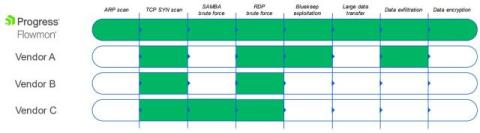
Catch Cyberattacks Through Reliable Network Detection

In today’s rapidly evolving cyberthreat landscape, organizations require network detection solutions that help identify and mitigate threats before significant damage happens. Among the options available on the Network Detection and Response (NDR) market, Progress Flowmon Anomaly Detection System (ADS) stands out for its unparalleled ability to detect threats throughout every stage of an attack.

Complete Guide: Understanding and Preventing DCSync Attacks

Gaining insights into DCSync attacks is key to fortifying your Active Directory (AD) against these sophisticated threats. By exploiting legitimate AD replication protocols, attackers can discreetly extract sensitive information, such as password hashes and Kerberos tickets. Recognizing these attack vectors enables you to implement more effective monitoring and auditing tools, enhancing your overall security posture.

DDoS monitoring: how to know you're under attack

A while back, we covered how to check your Windows IIS and Loggly logs to view the source of a DDoS attack, but how do you know when your network is under attack? It is not efficient to have humans monitor logs every day and every hour, so you must rely on automated resources. Automated DDoS monitoring gives your security team more bandwidth to focus on other important tasks and still get notifications should anomalies happen due to a DDoS event.

Enhancing WordPress Security in the Era of Evolving Cyber Threats

Today, website security is more important than ever because these are often targets for hackers who want to steal data, spread malware, or disrupt services. A secure website not only protects your information but also builds trust with your visitors. If people feel safe on your site, they're more likely to stay longer and come back again.

Data Poisoning: The Newest Threat in Artificial Intelligence and Machine Learning

As you integrate artificial intelligence (AI) and machine learning (ML) technologies into your business operations, you’ll notice the sophistication of cyber threats against these systems rising. Among these emerging threats, data poisoning stands out due to its potential to manipulate and undermine the integrity of your AI-driven systems. Understanding and mitigating data poisoning risks will help you maintain the security and reliability of your AI and ML applications.

MFA Fatigue Attack: What It Is & How to Prevent It

Credential theft has long been a leading cause of network security breaches, leading many organizations to implement multi-factor authentication (MFA) as a safeguard. It’s highly recommended that you enable MFA for all accounts as a best practice. However, the effectiveness of MFA depends significantly on how it’s set up because attackers are developing strategies to bypass it.

Social Engineering: The Human Factor in Cyber Threats

In the intricate web of cyber security threats, social engineering stands out not just for its technical cunning but for its reliance on a more fallible vector-human nature. Distinct from other cyber threats that predominantly target computer systems, social engineering zooms in on the individual, aiming to manipulate and exploit their natural tendencies for trust, helpfulness, and curiosity. As businesses and individuals fervently build their digital fortresses with the latest technological defenses, they must not overlook the cruciality of reinforcing the human element within their cyber security protocols.

MSP Lawsuit Underscores Importance of Multi-Factor Authentication (MFA)

Sacramento, CA law firm Mastagni Holstedt has alleged that its MSP LanTech LLC failed to protect it from a ransomware attack that took down its systems. According to ChannelE2E, Mastagni Holstedt is also suing LanTech’s backup vendor Acronis, which has denied any responsibility for the ransomware attack. We’ll be watching to see how it all shakes out. In the meantime, let’s look at what happened and what we can take away from it. Hint: multi-factor authentication matters. A lot.