Operations | Monitoring | ITSM | DevOps | Cloud

The latest News and Information on Databases and related technologies.

Basic SQL Server Query Tuning Secrets Every SQL Admin Should Know

The performance of your applications is a complex, multi-layered puzzle. Performance can be negatively impacted at the application layer or even by remote calls to networked services. However, the most common bottleneck for applications is the data storage layer. The most common data storage tier for applications is a relational database, whose performance can vary widely depending on query optimization.

How to Use Intelligent Query Processing to Boost Query Outcomes

Experienced SQL Server database administrators and developers spend years learning best practices within SQL Server and how to identify performance pitfalls in the query optimizer. Starting with SQL Server 2017, Microsoft introduced a family of features called “Intelligent Query Processing” to provide more consistent performance for your queries.

An Overview of Intelligent Query Processing in SQL Server

When you issue a query to SQL Server or Azure SQL, it internally tries to optimize a query plan through calculations such as whether to use an index. Much of SQL Server’s query plans are based on its best guess of what will happen at run time when your query executes. Even when SQL Server guesses right, as your data changes (especially as the volume of data increases), optimal plans can end up performing so poorly, they can drag your whole system’s performance down.

Monitor and visualize database performance with Datadog Database Monitoring

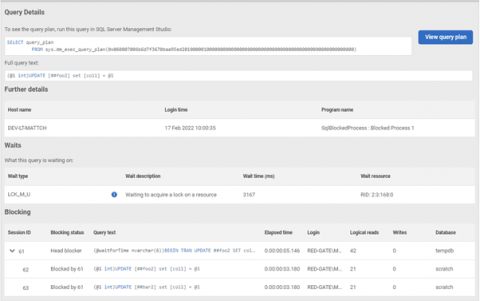
When you’re running databases at scale, finding performance bottlenecks can often feel like looking for a needle in a haystack. In any troubleshooting scenario, you need to know the exact state of your database at the onset of an issue, as well as its behavior leading up to it.

NiCE Oracle Management Pack 5.2 for Microsoft SCOM

TThe Management Pack provides clear and precise performance indicators and timely alerts enriched by pinpointing problem identification and troubleshooting information. It streamlines the workflow and helps for better planning based on detailed reports. The integration into System Center enables a single pane of glass view into your Oracle environment, secured by Microsoft technologies.

Choose the right time series database | Aiven Info Bytes

You have a load of time-stamped data coming in and you realize you need a time series database. But which one should you choose? Watch the video to find out! ABOUT AIVEN We help organizations fuel the continuous innovation needed to create awesome, data-intensive applications by using the leading open source technologies. After building expertise managing mission-critical data infrastructure for companies like F-Secure and Nokia, Aiven’s founders noticed that cloud adoption was increasing but infrastructure solutions were either proprietary or difficult to translate into business results.

Visibility Into Distributed Availability Groups With SQL Sentry

I began my career as an associate software development engineer in June of 2020, and during my short time in the industry, I’ve had the opportunity to build and troubleshoot continuous integration and continuous development (CI/CD) pipelines, work on many different technologies within several SolarWinds®, formerly SentryOne, products, and learn proper engineering practices.

Why Observability Requires a Distributed Column Store

Honeycomb is known for its incredibly fast performance: you can sift through billions of rows, comparing high-cardinality data across thousands of fields, and get fast answers to your queries. And none of that is possible without our purpose-built distributed column store. This post is an introduction to what a distributed column store is, how it functions, and why a distributed column store is a fundamental requirement for achieving observability.