The latest News and Information on DevOps, CI/CD, Automation and related technologies.
Redshift is a fast, managed, data warehouse solution that's part of AWS. Although it is traditional SQL and meant for BI (Business Intelligence), it is designed for scalability and can support many workloads typically reserved for Big Data tools. It is protocol-compatible with PostgreSQL and is available through JDBC/ODBC, opening it up to a huge range of existing SQL tools.
Imagine you’re driving a car, but there’s no windshield. You can’t see in front of you. On top of that, your car is full of friends looking out the side windows and yelling various things to you: “We should turn left!” “No, we should turn right!” “I’m pretty sure the next turn is in two miles.” In this scenario, how likely are you to reach your destination instead of ending up in a ditch or careening off a bridge?
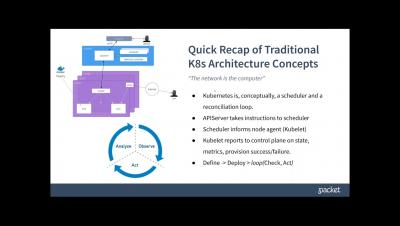
With Sumo Logic, we can put all of these pieces together to build end-to-end Observability in Kubernetes.
As compliance managers, we often find ourselves in a struggle. Our responsibility is to uphold compliance standards but in order to achieve this, we need to “sell” the concept to the relevant stakeholders, inter alia the business teams and R&D. We’re put in the position of justifying required changes and processes and are thus mistakenly perceived as business “stoppers” and not enablers.
As your infrastructure grows more complex, storing long-term metrics becomes difficult and costly to retain. Your team stars to limit the amount of historical data they archive, causing gaps in coverage. Anomalies start to slip through the cracks. Version 1.18 of Netdata aims to solve the monitoring metrics storage problem once and for all. Aside from 5 new collectors, 16 bug fixes, 27 improvements, and 20 documentation updates, here’s what you need to know.
Fluent Bit is a lightweight, multi-platform tool that can collect, parse, and forward log data from several different sources. Because Fluent Bit has a small memory footprint (~450 KB), it is an ideal solution for collecting logs in environments with limited resources, such as containerized services and embedded Linux systems (e.g., IoT devices).
In new and quickly-expanding fields like serverless, long-standing experts are few and far between. I am excited to welcome Tim Wagner, the original leader of the serverless movement, to the Stackery Board of Directors. Tim spent six years at Amazon Web Services as the General Manager of AWS Lambda, where he oversaw the team that built the success of serverless as a platform. In many ways, we have them to thank for creating the environment that supports Stackery and the serverless ecosystem.
There’s no longer any doubt, Go modules are an accepted part of Golang. The over 300,000 versioned Go modules in JFrog GoCenter shows how they have been embraced for package management by the Go community. With Go modules now enabled by default in Golang 1.13, the number of publicly available modules will grow even more rapidly — and some of them may be contributed by you. But once you share a Go module project with the community, what happens to it? Does it get used?