

Operations | Monitoring | ITSM | DevOps | Cloud

What Backup Monitoring Software Should Track to Protect RTO and RPO

How many backup jobs completed successfully in your environment last night, and how many of those systems could you bring back inside the window the business agreed to? Most backup consoles answer the first question well. They report job status, completion time and volume written, then roll it into a reassuring compliance summary. The second question needs different evidence, usually missing from that screen. The distance between those answers shows up during the recovery attempt.

The AI trust dial: from local agents to autonomous software factory

There are many conversations about the use of AI, particularly how engineering teams are using it in their coding workflows. Manual work is being replaced by agent-driven automation, and human value increasingly lies in the higher-order work: writing specs, thinking through architecture, steering the direction, exercising taste, and reviewing the output.

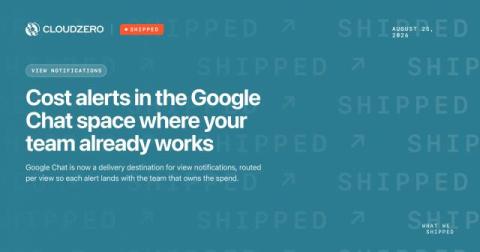
Shipped: Cost alerts in the Google Chat space where your team already works

If your company runs on Google Workspace, your team lives in Google Chat. That is where the standup happens and where threads turn into decisions. Cost alerts can now go there too. This is relevant because an alert only does something if it reaches people in a place where they can talk about it. Email is great for a record but not great for a reaction. An anomaly notification sitting in an inbox waits for that person to open it, decide it is real, and then go tell everybody else.

Zero-Code Instrumentation in Kubernetes Without the Instrumentation CRD

The OpenTelemetry Operator changed how teams approach telemetry collection in Kubernetes. The core appeal of zero-code instrumentation is that you can bring up telemetry inside application containers to collect traces, metrics, and logs without touching your source code or rebuilding your container images. However, if you follow the default OpenTelemetry Operator documentation, you quickly run into a heavy operational prerequisite: the Instrumentation CRD.

5 Best AI Photo Editors for Modern Image Editing in 2026 That Actually Save Hours

The demand for an efficient AI photo editor has increased as creators and businesses look for faster ways to produce high-quality visuals without relying on traditional manual editing workflows. From automated retouching to text-prompt-based image transformation, AI-driven tools are now widely used across e-commerce, advertising, and social media content creation.

How AI Answer Engines Like Perplexity Choose Which Brands to Cite in 2026

More product research now starts inside an AI assistant instead of a search engine. When someone asks ChatGPT, Perplexity or Google's AI Overviews for the best option in a category, they get a short written answer that names a few brands and links to a handful of sources. The brands that are named win the attention. The rest are not shown at all.

How ArcSonic Tech Limited Approaches System Architecture Reviews for Scalability Readiness

Most systems fail to scale, not because the team didn't work hard enough, but because the architecture was designed for the load it had rather than the load it would eventually face. The features worked. The performance was acceptable. The code was clean enough. But the structural decisions made early - about how data flows, how services communicate, where state lives - created ceilings that only became visible when the traffic arrived.

Best Voice AI Orchestration Platforms in 2026

Building an AI voice agent can be easy, but making it actually work on real phone calls is more challenging. Voice AI orchestration platforms help to connect speech-to-text, text-to-speech, and telephony networks into real-time conversational agents. Although these tools are AI-powered, they handle turn-taking and interruptions during web interactions. By using these platforms, you will get fluid voice conversations that are ready to use.

5 AI Tools Cutting SaaS Costs for IT and Marketing Teams in 2026

SaaS sprawl has become one of the quieter budget problems inside IT and marketing departments. Every team picks up a new tool to solve an immediate problem, nobody audits the stack regularly, and eighteen months later finance is asking why the software budget has ballooned while adoption of half those tools sits in single digits. AI tooling has followed the exact same pattern over the past two years, arguably faster than any other category before it.

Why Most "AirTag Alternatives" Still Make You Pick a Side

You lose your wallet. You check your phone. Nothing shows up, because the tracker inside that wallet only talks to iPhones, and you switched to a Galaxy last year. This happens more than people expect. Someone buys an AirTag alternative, assumes "alternative" means it works everywhere, and finds out the hard way that it doesn't. Most trackers marketed as universal are really just built for one ecosystem with a different logo on the box.