Operations | Monitoring | ITSM | DevOps | Cloud

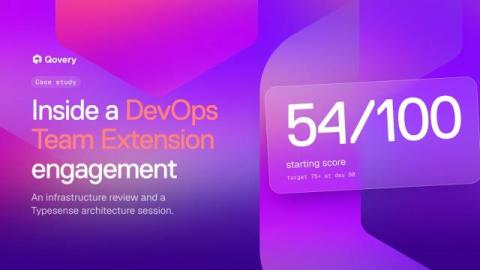
Inside a DevOps Team Extension engagement: an infrastructure review and a Typesense architecture session

How Qovery assessed a growing B2B SaaS company's infrastructure across about 150 controls, what the review with their team changed, and why a Typesense high-availability project turned into a sharding plan. Romaric founded Qovery to make Kubernetes accessible to every engineering team. He writes about platform strategy, developer experience, and the future of cloud infrastructure.
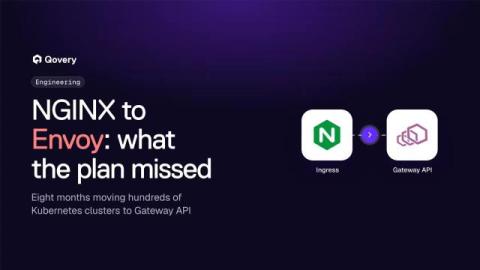
Replacing NGINX with Envoy Gateway on Hundreds of Clusters: What the Plan Missed

In February we planned to move every Qovery-managed cluster from ingress-nginx to Envoy Gateway by the end of March. It took until October. Here is the rollout model, every class of problem we hit, and what I would do differently. Benjamin is a staff engineer at Qovery focused on infrastructure automation, Kubernetes internals, and building the deployment engine that powers thousands of clusters.

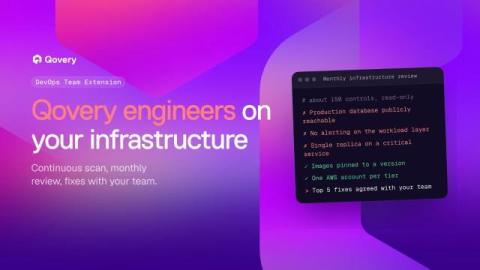
DevOps Team Extension: Qovery engineers watching your infrastructure every month

DevOps Team Extension gives growing engineering teams a named Qovery engineer, a continuous infrastructure scan, and a monthly remediation plan, so they can scale reliability, security and compliance without hiring a DevOps team first. Romaric founded Qovery to make Kubernetes accessible to every engineering team. He writes about platform strategy, developer experience, and the future of cloud infrastructure.
The Citrix Security Crisis Exposed a Bigger Problem

Citrix was facing a major security crisis before its official warning even went out. Companies were already pulling critical network devices offline as attackers exploited serious vulnerabilities in Citrix NetScaler ADC and Gateway systems. In this ShipTalk clip, Adam, Martin, and Starr break down the Citrix zero-day vulnerabilities, the race to respond, and the impossible decision facing security teams: keep potentially compromised infrastructure running or rush to deploy a patch.

SecureBridge 12.1, EntityDAC 4.1, and dbExpress drivers: Support for RAD Studio 13 Florence Release 2, SQL Server 2025, and MySQL 9.7

New versions of SecureBridge, EntityDAC, and dbExpress drivers are out. All three now work with RAD Studio 13 Florence Release 2 and offer improved support for the Arm64EC target platform. Devart dbExpress drivers also add support for Microsoft SQL Server 2025 and MySQL 9.7, while SecureBridge gains SFTP upload resume, multipart/form-data support, and a new SSL/TLS demo.

Elastic Introduces Elastic nightshift AI SRE to Investigate with the Full Context Others Can't Afford to Keep

The AI SRE uses complete context from across the entire stack to continuously detect issues and learn from every incident, delivering evidence-backed answers engineers can trust.

Sentry JavaScript SDK v11 adds tracing for all JS platforms

This post is about a recent change to the Sentry JavaScript SDKs. If you don’t use Sentry with JavaScript, it may still be useful as a look at how we made the change and why. In the Sentry JavaScript SDK v11, we rebuilt how our tracing integrations work. While we still support the OpenTelemetry standard (described in more detail below), we now instrument your dependencies with a code transformer instead of using the OpenTelemetry instrumentation classes as we did in previous versions.

Grafana Tempo: Redaction by query & TraceQL filtering in trace-by-ID v2 (Oct 2026 Community Call)

Trace redaction permanently removes sensitive data from your traces, for when something like an API key ends up in a span attribute. Tempo 3.0 could do it, but only from a list of trace IDs, so you had to go find every affected trace first. In Tempo 3.1 you can hand it a TraceQL query instead. Separately, trace-by-ID got a filter. You normally ask for a trace and get all of it. Now you can pass a TraceQL query and get back only the spans that match.

Landing on the Moon with Grafana and Thermal Engineering | Grafana Everywhere

In honor of World Space Week, we're spotlighting Jackson Sweeney's story and his role in Blue Ghost Mission 1. As a Thermal Engineer at Firefly Aerospace, he used Grafana to ensure that the spacecraft maintained the right temperature throughout the mission... and receive a Golden Grot Award for his use case. Behind every successful moonshot are people solving one hard problem after another. For engineers like Jackson, that means turning an extraordinary ambition into thousands of practical decisions.