Operations | Monitoring | ITSM | DevOps | Cloud

Getting started with Incident Management

When it comes to incident management, the end result is a smoothly running engine with incidents resolving on time, systems always operational, and your team in sync at all times. In this post, we will guide you through getting started with your first integration, a simple alert escalation and actually getting your first alerts with Spike.sh.


Incident management is a team responsibility

Effective teamwork plays a crucial role in maintaining system stability and preventing incidents. By collaborating and leveraging the diverse skills and perspectives of team members, potential issues can be identified and addressed proactively, ensuring a smooth and incident-free operation of the system.

What is the Benefit of Including Security with Your Observability Strategy?

Observability strategies are needed to ensure stable and performant applications, especially when complex distributed environments back them. Large volumes of observability data are collected to support automatic insights into these areas of applications. Logs, metrics, and traces are the three pillars of observability that feed these insights. Security data is often isolated instead of combined with data collected by existing observability tools.

Kubernetes 2024: Challenges and solutions

Kubernetes has become the world's leading container orchestration platform, aiding small-scale to large-scale businesses in automating, autoscaling, and managing application deployments. Before delving deeper, let's understand why cloud-native solutions like Kubernetes have become the world's—especially organizations'—favorite technology. Creating highly scalable, resilient applications requires flexible infrastructure management.

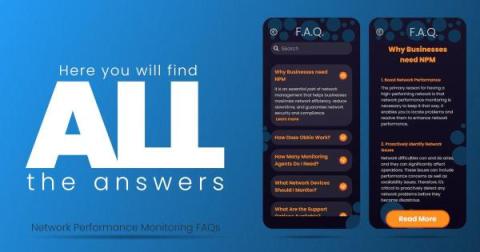
Network Performance Monitoring FAQs

There is an abundance of resources, tips, and tools available to network administrators and business owners to help improve their network performance. However, the wealth of information can be overwhelming, often leaving you more confused than enlightened. Whether you're a seasoned network administrator or a business owner navigating the intricacies of digital infrastructure, we've meticulously compiled essential information.

Why enterprises need MSPs equipped with advanced asset management expertise

In modern IT ecosystems, Managed Service Providers (MSPs) ensure the smooth operation of organizations’ technology infrastructure. Among their responsibilities, asset management is a key component. MSPs leverage advanced technology to automate tasks such as inventory tracking, software updates, and license management. This automation reduces manual workload and enables MSPs to allocate resources while dealing with asset management.

Crossplane loves Kubernetes as much as we do... But, differently!

Kubernetes has emerged as the de facto orchestrator for deploying and managing containerized applications. Its versatility and robust ecosystem have paved the way for innovative tools that leverage its capabilities, extending its utility beyond mere container orchestration. Among these tools, Crossplane and Qovery stand out for their unique approaches to simplifying cloud resource management.

Build and test LLM applications with AIConfig and CircleCI

The power of LLMs to solve real-world problems is undeniable, but unfortunately, in some cases, only theoretical. What’s stopping us from getting the most out of OpenAI’s text completion capabilities in production apps? One common problem is the inability to confidently guard against bad outputs in production the way we’re used to doing with non-AI test suites. Let’s go one step deeper. There is no equivalent of code coverage for an LLM.